Event submissions
Published
This submission belongs to the session S1. Environmental and Green Processes of the event The 4th International Electronic Conference on Processes
Published date
17 Oct, 2025
Academic Editor
'%3e%3cpath%20d='M12.6657%2010.9104C12.4185%2010.325%2012.0599%209.79327%2011.6097%209.34482C11.1609%208.89508%2010.6293%208.5365%2010.0442%208.28888C10.0389%208.28626%2010.0337%208.28495%2010.0285%208.28233C10.8446%207.69279%2011.3752%206.73249%2011.3752%205.64904C11.3752%203.8542%209.92103%202.39999%208.1262%202.39999C6.33136%202.39999%204.87715%203.8542%204.87715%205.64904C4.87715%206.73249%205.40774%207.69279%206.22393%208.28364C6.21869%208.28626%206.21345%208.28757%206.20821%208.29019C5.62129%208.5378%205.09463%208.89284%204.64265%209.34613C4.1929%209.79493%203.83432%2010.3266%203.58671%2010.9117C3.34345%2011.4845%203.21226%2012.0987%203.20023%2012.7209C3.19988%2012.7349%203.20233%2012.7488%203.20744%2012.7619C3.21255%2012.7749%203.22022%2012.7867%203.22998%2012.7968C3.23975%2012.8068%203.25142%2012.8147%203.26431%2012.8202C3.2772%2012.8256%203.29105%2012.8284%203.30504%2012.8284H4.09109C4.14874%2012.8284%204.19459%2012.7825%204.1959%2012.7262C4.2221%2011.7148%204.62823%2010.7676%205.34617%2010.0497C6.08899%209.30683%207.0755%208.89808%208.1262%208.89808C9.17689%208.89808%2010.1634%209.30683%2010.9062%2010.0497C11.6242%2010.7676%2012.0303%2011.7148%2012.0565%2012.7262C12.0578%2012.7838%2012.1037%2012.8284%2012.1613%2012.8284H12.9474C12.9613%2012.8284%2012.9752%2012.8256%2012.9881%2012.8202C13.001%2012.8147%2013.0126%2012.8068%2013.0224%2012.7968C13.0322%2012.7867%2013.0398%2012.7749%2013.0449%2012.7619C13.0501%2012.7488%2013.0525%2012.7349%2013.0522%2012.7209C13.0391%2012.0947%2012.9094%2011.4855%2012.6657%2010.9104ZM8.1262%207.9024C7.52486%207.9024%206.9589%207.6679%206.53312%207.24211C6.10733%206.81633%205.87283%206.25037%205.87283%205.64904C5.87283%205.0477%206.10733%204.48174%206.53312%204.05596C6.9589%203.63018%207.52486%203.39567%208.1262%203.39567C8.72753%203.39567%209.29349%203.63018%209.71927%204.05596C10.1451%204.48174%2010.3796%205.0477%2010.3796%205.64904C10.3796%206.25037%2010.1451%206.81633%209.71927%207.24211C9.29349%207.6679%208.72753%207.9024%208.1262%207.9024Z'%20fill='%235D1EE1'/%3e%3c/g%3e%3c/svg%3e) Young-Cheol Chang
Young-Cheol ChangCitation
Vasiliki Patrinou, George Aggelis, Athanasia G. Tekerlekopoulou, Biotreatment of Second Cheese Whey in Pilot-Scale Photobioreactors Using Cyanobacteria-based Consortia for Lipid Production, in Proceedings of The 4th International Electronic Conference on Processes, 20 October–22 October 2025, MDPI: Basel, Switzerland
Share
Email
Facebook
Twitter
LinkedIn
Biotreatment of Second Cheese Whey in Pilot-Scale Photobioreactors Using Cyanobacteria-based Consortia for Lipid Production

Vasiliki Patrinou 1

George Aggelis 2

Athanasia G. Tekerlekopoulou 3
1. Department of Sustainable Agriculture, University of Patras, 30100, Agrinio, Greece
2. Department of Biology, University of Patras, 26500, Rio-Patras, Greece
3. Department of Sustainable Agriculture, University of Patras, 30100, Agrinio, Greece
Abstract
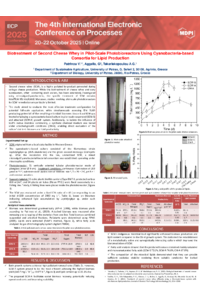
Second cheese whey (SCW), a by-product generated after the production of cottage cheese, remains a highly polluted effluent due to its high organic and nutrient load. Despite its environmental impact, the biotreatment of SCW using microalgae/cyanobacteria has been limited, with even fewer studies involving pilot-scale photobioreactors. In this study, unsterilized SCW was treated employing a Leptolyngbya-based culture in two pilot-scale systems: a suspended growth system (SCW-S) and an attached growth system (SCW-A), both operated in 9 L tubular photobioreactors. For the attached system, fishing lines equipped with plastic biofilm carriers served as support material for microbial attachment. Leptolyngbya sp. is known to increase lipid content at C:N ratios of ≈ 45; thus, SCW was studied under these conditions, with an initial d-COD of about 2000 mg L−1. The highest total biomass productivity was observed in SCW-A system, reaching 346.7 mg L−1d−1. Both systems achieved high effectiveness in pollutant removal (d-COD: 94.5-99.9%, TN: 89.0-96.5%, ΝΟ3−-Ν: 87.0-93.3%, PO43−: 98.8-93.4%), while lipid contents were 16.1 and 15.1% d.w. for SCW-S and SCW-A, respectively. SCW-A proved highly effective, achieving almost complete d-COD (99.9%) and TN (96.5%) removal. Lipid analysis revealed increased saturation of fatty acids in the SCW-A, representing 74.6% of total fatty acids. The attached system was also applied to synthetic chemical medium (CM-A) to evaluate lipid production potential. The CM-A recorded lower biomass productivity (142.8 mg L−1d−1) and lipid content (12.0 % d.w.), suggesting SCW’s indigenous microbiota enhanced growth and lipid production. In conclusion, SCW is an effective feedstock for lipid-rich biomass production with Leptolyngbya, yielding saturated lipids suitable for biofuels.
Keywords
Leptolyngbya-based consortia
pilot scale photobioreactors
suspended and attached growth systems
lipid production
Poster
EnvironmentalandGreenProcesses_24541_Biotreatment_of_Second_Cheese_sciforum-131757.pdf
Natural zeolites supported green-synthesized CeО2@Polybenzimidazole hybrid materials for dye degradation
Synthesis and catalytic ability of manganese carbonate ore/copper and cobalt oxide catalysts