Event submissions
Published
This submission belongs to the session S6. Pharmaceutical Processing and Particle Processes of the event The 4th International Electronic Conference on Processes
Published date
17 Oct, 2025
Academic Editor
'%3e%3cpath%20d='M12.6657%2010.9104C12.4185%2010.325%2012.0599%209.79327%2011.6097%209.34482C11.1609%208.89508%2010.6293%208.5365%2010.0442%208.28888C10.0389%208.28626%2010.0337%208.28495%2010.0285%208.28233C10.8446%207.69279%2011.3752%206.73249%2011.3752%205.64904C11.3752%203.8542%209.92103%202.39999%208.1262%202.39999C6.33136%202.39999%204.87715%203.8542%204.87715%205.64904C4.87715%206.73249%205.40774%207.69279%206.22393%208.28364C6.21869%208.28626%206.21345%208.28757%206.20821%208.29019C5.62129%208.5378%205.09463%208.89284%204.64265%209.34613C4.1929%209.79493%203.83432%2010.3266%203.58671%2010.9117C3.34345%2011.4845%203.21226%2012.0987%203.20023%2012.7209C3.19988%2012.7349%203.20233%2012.7488%203.20744%2012.7619C3.21255%2012.7749%203.22022%2012.7867%203.22998%2012.7968C3.23975%2012.8068%203.25142%2012.8147%203.26431%2012.8202C3.2772%2012.8256%203.29105%2012.8284%203.30504%2012.8284H4.09109C4.14874%2012.8284%204.19459%2012.7825%204.1959%2012.7262C4.2221%2011.7148%204.62823%2010.7676%205.34617%2010.0497C6.08899%209.30683%207.0755%208.89808%208.1262%208.89808C9.17689%208.89808%2010.1634%209.30683%2010.9062%2010.0497C11.6242%2010.7676%2012.0303%2011.7148%2012.0565%2012.7262C12.0578%2012.7838%2012.1037%2012.8284%2012.1613%2012.8284H12.9474C12.9613%2012.8284%2012.9752%2012.8256%2012.9881%2012.8202C13.001%2012.8147%2013.0126%2012.8068%2013.0224%2012.7968C13.0322%2012.7867%2013.0398%2012.7749%2013.0449%2012.7619C13.0501%2012.7488%2013.0525%2012.7349%2013.0522%2012.7209C13.0391%2012.0947%2012.9094%2011.4855%2012.6657%2010.9104ZM8.1262%207.9024C7.52486%207.9024%206.9589%207.6679%206.53312%207.24211C6.10733%206.81633%205.87283%206.25037%205.87283%205.64904C5.87283%205.0477%206.10733%204.48174%206.53312%204.05596C6.9589%203.63018%207.52486%203.39567%208.1262%203.39567C8.72753%203.39567%209.29349%203.63018%209.71927%204.05596C10.1451%204.48174%2010.3796%205.0477%2010.3796%205.64904C10.3796%206.25037%2010.1451%206.81633%209.71927%207.24211C9.29349%207.6679%208.72753%207.9024%208.1262%207.9024Z'%20fill='%235D1EE1'/%3e%3c/g%3e%3c/svg%3e) Paolo Trucillo
Paolo TrucilloCitation
Grigorios Loukas, Sustainable Design and Engineering of Bio-Based Gold Nanoparticles for Targeted Periodontal Therapy: From Green Synthesis to Scalable Production, in Proceedings of The 4th International Electronic Conference on Processes, 20 October–22 October 2025, MDPI: Basel, Switzerland
Share
Email
Facebook
Twitter
LinkedIn
Sustainable Design and Engineering of Bio-Based Gold Nanoparticles for Targeted Periodontal Therapy: From Green Synthesis to Scalable Production
'%3e%3cpath%20d='M12.6647%2010.9104C12.4176%2010.325%2012.0589%209.7933%2011.6088%209.34485C11.16%208.89511%2010.6283%208.53653%2010.0432%208.28891C10.038%208.28629%2010.0327%208.28498%2010.0275%208.28236C10.8437%207.69282%2011.3743%206.73252%2011.3743%205.64907C11.3743%203.85423%209.92005%202.40002%208.12522%202.40002C6.33038%202.40002%204.87618%203.85423%204.87618%205.64907C4.87618%206.73252%205.40677%207.69282%206.22296%208.28367C6.21772%208.28629%206.21248%208.2876%206.20724%208.29022C5.62031%208.53783%205.09365%208.89287%204.64167%209.34616C4.19192%209.79496%203.83334%2010.3266%203.58573%2010.9117C3.34247%2011.4846%203.21128%2012.0987%203.19925%2012.721C3.1989%2012.735%203.20135%2012.7489%203.20646%2012.7619C3.21157%2012.7749%203.21924%2012.7868%203.22901%2012.7968C3.23877%2012.8068%203.25045%2012.8148%203.26334%2012.8202C3.27623%2012.8256%203.29007%2012.8284%203.30406%2012.8284H4.09012C4.14776%2012.8284%204.19362%2012.7825%204.19493%2012.7262C4.22113%2011.7148%204.62726%2010.7676%205.34519%2010.0497C6.08802%209.30686%207.07452%208.89811%208.12522%208.89811C9.17592%208.89811%2010.1624%209.30686%2010.9052%2010.0497C11.6232%2010.7676%2012.0293%2011.7148%2012.0555%2012.7262C12.0568%2012.7839%2012.1027%2012.8284%2012.1603%2012.8284H12.9464C12.9604%2012.8284%2012.9742%2012.8256%2012.9871%2012.8202C13%2012.8148%2013.0117%2012.8068%2013.0214%2012.7968C13.0312%2012.7868%2013.0389%2012.7749%2013.044%2012.7619C13.0491%2012.7489%2013.0515%2012.735%2013.0512%2012.721C13.0381%2012.0947%2012.9084%2011.4856%2012.6647%2010.9104ZM8.12522%207.90243C7.52388%207.90243%206.95792%207.66793%206.53214%207.24215C6.10636%206.81636%205.87185%206.2504%205.87185%205.64907C5.87185%205.04773%206.10636%204.48177%206.53214%204.05599C6.95792%203.63021%207.52388%203.3957%208.12522%203.3957C8.72655%203.3957%209.29252%203.63021%209.7183%204.05599C10.1441%204.48177%2010.3786%205.04773%2010.3786%205.64907C10.3786%206.2504%2010.1441%206.81636%209.7183%207.24215C9.29252%207.66793%208.72655%207.90243%208.12522%207.90243Z'%20fill='%235D1EE1'/%3e%3c/g%3e%3c/svg%3e)
Grigorios Loukas 1
1. Private Dental Practitioner - owner of Dental Clinic in Athens Greece
Abstract
Introduction
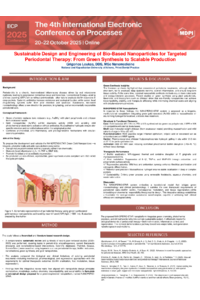
Periodontitis is a chronic inflammatory disease triggered by dysbiotic dental biofilms and is a leading cause of adult tooth loss. Conventional treatments (scaling and antibiotics) often leave residual pathogens and biofilms behind. Nanomedicine strategies are thus sought. Gold nanoparticles (AuNPs, ~50–150 nm) are promising carriers: they have excellent bioavailability, can mediate photothermal therapy, and exhibit intrinsic antibacterial/antifungal properties. Functionally, AuNPs can be engineered to target periodontal pathogens while also modulating inflammation and tissue regeneration.
Methods
Through a literature review, we propose to synthesize AuNPs via the green reduction of chloroauric acid using plant extracts (e.g. ginger rhizome or tea polyphenols). These bio-capped AuNPs will then be loaded with periodontal antibiotics (e.g. metronidazole, doxycycline or chlorhexidine) via surface conjugation or embedding. We may also formulate AuNP–antibiotic complexes in biodegradable hydrogels or coatings for sustained, localized release. Downstream, the process will be scaled using bioreactor-based production and continuous flow systems.
Expected Results
The proposed AuNP–antibiotic therapy is expected to yield potent antibacterial activity and enhanced tissue repair. In vitro, we anticipate the strong inhibition of major periodontal pathogens, while in vivo, similar AuNP systems have demonstrated dramatic effects: for instance, 45 nm AuNPs significantly reduced periodontal inflammation and greatly enhanced new attachment, bone and cementum formation. Likewise, an epigallocatechin-gallate–AuNP hydrogel (E-Au@H) in rats eradicated ~87% of dental biofilm and reduced alveolar bone loss by ~38% under NIR irradiation. We expect our antibiotic–AuNP composites to likewise suppress biofilms, modulate macrophage phenotypes, and promote periodontal regeneration.
Conclusion
This poster will present a combination of green nanotechnology with scalable engineering to tackle periodontitis through green nano-synthesis that is suitable for the large-scale production of nanoparticles. The proposed bio-based AuNP platform could provide a sustainable, targeted therapy that combines strong antimicrobial action with immunomodulation and tissue regeneration, addressing unmet needs in periodontal treatment.
Keywords
Green synthesis
gold nanoparticles
periodontitis
antibiotic delivery
scalable production
Poster
Grigorios Loukas Poster ECP 2025.pdf
Dye Sorption by Biosorbents and Biochars from Olive Pomance
Characterization and Preliminary Evaluation of CuO, FeS₂, and Zeolite Y for Tetracycline Adsorption from Simulated Hospital Wastewater