Event submissions
Published
This submission belongs to the session S1. Environmental and Green Processes of the event The 4th International Electronic Conference on Processes
Published date
17 Oct, 2025
Academic Editor
'%3e%3cpath%20d='M12.6657%2010.9104C12.4185%2010.325%2012.0599%209.79327%2011.6097%209.34482C11.1609%208.89508%2010.6293%208.5365%2010.0442%208.28888C10.0389%208.28626%2010.0337%208.28495%2010.0285%208.28233C10.8446%207.69279%2011.3752%206.73249%2011.3752%205.64904C11.3752%203.8542%209.92103%202.39999%208.1262%202.39999C6.33136%202.39999%204.87715%203.8542%204.87715%205.64904C4.87715%206.73249%205.40774%207.69279%206.22393%208.28364C6.21869%208.28626%206.21345%208.28757%206.20821%208.29019C5.62129%208.5378%205.09463%208.89284%204.64265%209.34613C4.1929%209.79493%203.83432%2010.3266%203.58671%2010.9117C3.34345%2011.4845%203.21226%2012.0987%203.20023%2012.7209C3.19988%2012.7349%203.20233%2012.7488%203.20744%2012.7619C3.21255%2012.7749%203.22022%2012.7867%203.22998%2012.7968C3.23975%2012.8068%203.25142%2012.8147%203.26431%2012.8202C3.2772%2012.8256%203.29105%2012.8284%203.30504%2012.8284H4.09109C4.14874%2012.8284%204.19459%2012.7825%204.1959%2012.7262C4.2221%2011.7148%204.62823%2010.7676%205.34617%2010.0497C6.08899%209.30683%207.0755%208.89808%208.1262%208.89808C9.17689%208.89808%2010.1634%209.30683%2010.9062%2010.0497C11.6242%2010.7676%2012.0303%2011.7148%2012.0565%2012.7262C12.0578%2012.7838%2012.1037%2012.8284%2012.1613%2012.8284H12.9474C12.9613%2012.8284%2012.9752%2012.8256%2012.9881%2012.8202C13.001%2012.8147%2013.0126%2012.8068%2013.0224%2012.7968C13.0322%2012.7867%2013.0398%2012.7749%2013.0449%2012.7619C13.0501%2012.7488%2013.0525%2012.7349%2013.0522%2012.7209C13.0391%2012.0947%2012.9094%2011.4855%2012.6657%2010.9104ZM8.1262%207.9024C7.52486%207.9024%206.9589%207.6679%206.53312%207.24211C6.10733%206.81633%205.87283%206.25037%205.87283%205.64904C5.87283%205.0477%206.10733%204.48174%206.53312%204.05596C6.9589%203.63018%207.52486%203.39567%208.1262%203.39567C8.72753%203.39567%209.29349%203.63018%209.71927%204.05596C10.1451%204.48174%2010.3796%205.0477%2010.3796%205.64904C10.3796%206.25037%2010.1451%206.81633%209.71927%207.24211C9.29349%207.6679%208.72753%207.9024%208.1262%207.9024Z'%20fill='%235D1EE1'/%3e%3c/g%3e%3c/svg%3e) Young-Cheol Chang
Young-Cheol ChangCitation
Ateeq Ur Rehman, Sandra Corasaniti, Paolo Coppa, Yasir Abbas Khan, Real-Time Adaptive Energy Management in Renewable Energy Communities: Reducing the Challenge of Forecasting and Prior Knowledge Dependencies, in Proceedings of The 4th International Electronic Conference on Processes, 20 October–22 October 2025, MDPI: Basel, Switzerland
Share
Email
Facebook
Twitter
LinkedIn
Real-Time Adaptive Energy Management in Renewable Energy Communities: Reducing the Challenge of Forecasting and Prior Knowledge Dependencies
'%3e%3cpath%20d='M12.6647%2010.9104C12.4176%2010.325%2012.0589%209.7933%2011.6088%209.34485C11.16%208.89511%2010.6283%208.53653%2010.0432%208.28891C10.038%208.28629%2010.0327%208.28498%2010.0275%208.28236C10.8437%207.69282%2011.3743%206.73252%2011.3743%205.64907C11.3743%203.85423%209.92005%202.40002%208.12522%202.40002C6.33038%202.40002%204.87618%203.85423%204.87618%205.64907C4.87618%206.73252%205.40677%207.69282%206.22296%208.28367C6.21772%208.28629%206.21248%208.2876%206.20724%208.29022C5.62031%208.53783%205.09365%208.89287%204.64167%209.34616C4.19192%209.79496%203.83334%2010.3266%203.58573%2010.9117C3.34247%2011.4846%203.21128%2012.0987%203.19925%2012.721C3.1989%2012.735%203.20135%2012.7489%203.20646%2012.7619C3.21157%2012.7749%203.21924%2012.7868%203.22901%2012.7968C3.23877%2012.8068%203.25045%2012.8148%203.26334%2012.8202C3.27623%2012.8256%203.29007%2012.8284%203.30406%2012.8284H4.09012C4.14776%2012.8284%204.19362%2012.7825%204.19493%2012.7262C4.22113%2011.7148%204.62726%2010.7676%205.34519%2010.0497C6.08802%209.30686%207.07452%208.89811%208.12522%208.89811C9.17592%208.89811%2010.1624%209.30686%2010.9052%2010.0497C11.6232%2010.7676%2012.0293%2011.7148%2012.0555%2012.7262C12.0568%2012.7839%2012.1027%2012.8284%2012.1603%2012.8284H12.9464C12.9604%2012.8284%2012.9742%2012.8256%2012.9871%2012.8202C13%2012.8148%2013.0117%2012.8068%2013.0214%2012.7968C13.0312%2012.7868%2013.0389%2012.7749%2013.044%2012.7619C13.0491%2012.7489%2013.0515%2012.735%2013.0512%2012.721C13.0381%2012.0947%2012.9084%2011.4856%2012.6647%2010.9104ZM8.12522%207.90243C7.52388%207.90243%206.95792%207.66793%206.53214%207.24215C6.10636%206.81636%205.87185%206.2504%205.87185%205.64907C5.87185%205.04773%206.10636%204.48177%206.53214%204.05599C6.95792%203.63021%207.52388%203.3957%208.12522%203.3957C8.72655%203.3957%209.29252%203.63021%209.7183%204.05599C10.1441%204.48177%2010.3786%205.04773%2010.3786%205.64907C10.3786%206.2504%2010.1441%206.81636%209.7183%207.24215C9.29252%207.66793%208.72655%207.90243%208.12522%207.90243Z'%20fill='%235D1EE1'/%3e%3c/g%3e%3c/svg%3e)
Ateeq Ur Rehman 1

Sandra Corasaniti 1

Paolo Coppa 1
Yasir Abbas Khan 2
1. Department of Industrial Engineering, University of Rome ‘‘Tor Vergata”, Via del Politecnico 1, 00133 Rome, Italy
2. United States-Pakistan Center for Advanced Studies, University of Engineering & Technology, Pesha-war 25000, Pakistan
Abstract
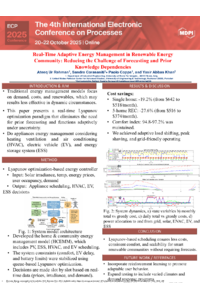
The integration of renewable energy (RE) sources and the increasing complexity of energy management (EM) systems have resulted in considerable advances in energy usage optimization in smart renewable energy communities (RECs). Existing methods rely on forecasting techniques that necessitate accurate projections of future energy prices, RE generation, user comfort, and behavior. While these strategies are effective in controlled contexts, they have limitations in dynamic, real-time scenarios where system inputs fluctuate unexpectedly. Using prior knowledge or forecasts might result in computational cost in real-time energy optimization. This study proposes a novel approach to real-time adaptive EM in RECs that overcomes the need for prior knowledge and the overhead of forecasting future buildings' EM systems. To tackle the uncertainties in system input dynamics (i.e., RE generation process, battery storage, load arrival processes, demand, and dynamic pricing), this study presents a one-slot-look-ahead queue-based Lyapunov optimization framework. This approach allows for real-time EM systems and reduces user discomfort in smart buildings that are linked and connected to the smart grid. The main goal is to reduce the average running costs (of procurement and operations) by optimizing the real-time scheduling of both electrical/thermal loads and electrical/thermal storage systems, managing their degradation and life cycle, and ensuring indoor user comfort. The optimization challenge is reduced to smaller sub-problems that can be solved one after the other in real time and are asymptotically optimal. They are particularly effective for real-time use in REC settings, especially when the input statistics are either unknown or highly variable. Simulation results under different scenarios and weather conditions, on both a daily and a monthly basis, indicate that the proposed method leads to average reductions in daily and monthly running costs of up to 13.53% and 19.37%, respectively, when benchmarked against other recent research, which reports similar decreases in the same scenarios.
Keywords
Lyapunov optimization
renewable energy communities
electrical storage
real-time energy
operation cost savings
energy efficiency
user comfort
Poster
Poster MDPI Processes_Ateeq.pdf
Optimization of Green Ultrasound-Assisted Extraction of Phenolic Compounds from a Species of the Scrophulariaceae Family
Silicon anodes for lithium ion batteries