Event submissions
Published
This submission belongs to the session S1. Environmental and Green Processes of the event The 4th International Electronic Conference on Processes
Published date
17 Oct, 2025
Academic Editor
'%3e%3cpath%20d='M12.6657%2010.9104C12.4185%2010.325%2012.0599%209.79327%2011.6097%209.34482C11.1609%208.89508%2010.6293%208.5365%2010.0442%208.28888C10.0389%208.28626%2010.0337%208.28495%2010.0285%208.28233C10.8446%207.69279%2011.3752%206.73249%2011.3752%205.64904C11.3752%203.8542%209.92103%202.39999%208.1262%202.39999C6.33136%202.39999%204.87715%203.8542%204.87715%205.64904C4.87715%206.73249%205.40774%207.69279%206.22393%208.28364C6.21869%208.28626%206.21345%208.28757%206.20821%208.29019C5.62129%208.5378%205.09463%208.89284%204.64265%209.34613C4.1929%209.79493%203.83432%2010.3266%203.58671%2010.9117C3.34345%2011.4845%203.21226%2012.0987%203.20023%2012.7209C3.19988%2012.7349%203.20233%2012.7488%203.20744%2012.7619C3.21255%2012.7749%203.22022%2012.7867%203.22998%2012.7968C3.23975%2012.8068%203.25142%2012.8147%203.26431%2012.8202C3.2772%2012.8256%203.29105%2012.8284%203.30504%2012.8284H4.09109C4.14874%2012.8284%204.19459%2012.7825%204.1959%2012.7262C4.2221%2011.7148%204.62823%2010.7676%205.34617%2010.0497C6.08899%209.30683%207.0755%208.89808%208.1262%208.89808C9.17689%208.89808%2010.1634%209.30683%2010.9062%2010.0497C11.6242%2010.7676%2012.0303%2011.7148%2012.0565%2012.7262C12.0578%2012.7838%2012.1037%2012.8284%2012.1613%2012.8284H12.9474C12.9613%2012.8284%2012.9752%2012.8256%2012.9881%2012.8202C13.001%2012.8147%2013.0126%2012.8068%2013.0224%2012.7968C13.0322%2012.7867%2013.0398%2012.7749%2013.0449%2012.7619C13.0501%2012.7488%2013.0525%2012.7349%2013.0522%2012.7209C13.0391%2012.0947%2012.9094%2011.4855%2012.6657%2010.9104ZM8.1262%207.9024C7.52486%207.9024%206.9589%207.6679%206.53312%207.24211C6.10733%206.81633%205.87283%206.25037%205.87283%205.64904C5.87283%205.0477%206.10733%204.48174%206.53312%204.05596C6.9589%203.63018%207.52486%203.39567%208.1262%203.39567C8.72753%203.39567%209.29349%203.63018%209.71927%204.05596C10.1451%204.48174%2010.3796%205.0477%2010.3796%205.64904C10.3796%206.25037%2010.1451%206.81633%209.71927%207.24211C9.29349%207.6679%208.72753%207.9024%208.1262%207.9024Z'%20fill='%235D1EE1'/%3e%3c/g%3e%3c/svg%3e) Omprakash Sarkar
Omprakash SarkarCitation
Georgia Moysiadou, Maria Daletou, Fotis Paloukis, Silicon anodes for lithium ion batteries, in Proceedings of The 4th International Electronic Conference on Processes, 20 October–22 October 2025, MDPI: Basel, Switzerland
Share
Email
Facebook
Twitter
LinkedIn
Silicon anodes for lithium ion batteries
'%3e%3cpath%20d='M12.6647%2010.9104C12.4176%2010.325%2012.0589%209.7933%2011.6088%209.34485C11.16%208.89511%2010.6283%208.53653%2010.0432%208.28891C10.038%208.28629%2010.0327%208.28498%2010.0275%208.28236C10.8437%207.69282%2011.3743%206.73252%2011.3743%205.64907C11.3743%203.85423%209.92005%202.40002%208.12522%202.40002C6.33038%202.40002%204.87618%203.85423%204.87618%205.64907C4.87618%206.73252%205.40677%207.69282%206.22296%208.28367C6.21772%208.28629%206.21248%208.2876%206.20724%208.29022C5.62031%208.53783%205.09365%208.89287%204.64167%209.34616C4.19192%209.79496%203.83334%2010.3266%203.58573%2010.9117C3.34247%2011.4846%203.21128%2012.0987%203.19925%2012.721C3.1989%2012.735%203.20135%2012.7489%203.20646%2012.7619C3.21157%2012.7749%203.21924%2012.7868%203.22901%2012.7968C3.23877%2012.8068%203.25045%2012.8148%203.26334%2012.8202C3.27623%2012.8256%203.29007%2012.8284%203.30406%2012.8284H4.09012C4.14776%2012.8284%204.19362%2012.7825%204.19493%2012.7262C4.22113%2011.7148%204.62726%2010.7676%205.34519%2010.0497C6.08802%209.30686%207.07452%208.89811%208.12522%208.89811C9.17592%208.89811%2010.1624%209.30686%2010.9052%2010.0497C11.6232%2010.7676%2012.0293%2011.7148%2012.0555%2012.7262C12.0568%2012.7839%2012.1027%2012.8284%2012.1603%2012.8284H12.9464C12.9604%2012.8284%2012.9742%2012.8256%2012.9871%2012.8202C13%2012.8148%2013.0117%2012.8068%2013.0214%2012.7968C13.0312%2012.7868%2013.0389%2012.7749%2013.044%2012.7619C13.0491%2012.7489%2013.0515%2012.735%2013.0512%2012.721C13.0381%2012.0947%2012.9084%2011.4856%2012.6647%2010.9104ZM8.12522%207.90243C7.52388%207.90243%206.95792%207.66793%206.53214%207.24215C6.10636%206.81636%205.87185%206.2504%205.87185%205.64907C5.87185%205.04773%206.10636%204.48177%206.53214%204.05599C6.95792%203.63021%207.52388%203.3957%208.12522%203.3957C8.72655%203.3957%209.29252%203.63021%209.7183%204.05599C10.1441%204.48177%2010.3786%205.04773%2010.3786%205.64907C10.3786%206.2504%2010.1441%206.81636%209.7183%207.24215C9.29252%207.66793%208.72655%207.90243%208.12522%207.90243Z'%20fill='%235D1EE1'/%3e%3c/g%3e%3c/svg%3e)
Georgia Moysiadou 1,2
Maria Daletou 1
Fotis Paloukis 1
1. Foundation of Research and Technology, Hellas - Institute of Chemical Engineering Sciences, FORTH/ICEHT, Stadiou Str, Platani Rion, P.O. Box 1414, Patras GR-26504, Greece
2. Department of Chemistry, University of Patras, Caratheodory 1, University Campus, GR-26504 Patras, Greece
Abstract
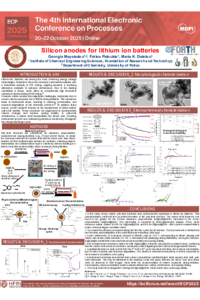
Lithium-ion batteries are recognized as one of the most promising energy storage options for applications such as electrical vehicles and portable electronics. While graphite is the most commonly used anode material, with a theoretical capacity of 372 mAh/g, alternatives are being sought to improve performance. Silicon has emerged as a leading candidate due to its exceptionally high theoretical capacity of 4200 mAh/g [1].
However, silicon anodes face significant challenges, particularly severe volume expansion (up to 300%) during lithiation, which causes cracking, pulverization, and eventual degradation of the electrode [2]. To address this, the present work focuses on developing silicon–carbon yolk–shell anodes deigned to buffer the volume change and improve cycling stability. In this structure, a carbon shell encases the silicon core, providing both mechanical support and electronic conductivity. The yolk–shells are synthesized through dopamine polymerization at varying durations. To create the void between the carbon and silicon, the bare silicon is oxidized by different methods and selectively etched after the carbonization of the polymer.
Transmission electron microscopy (TEM) confirms successful synthesis of the yolk–shell morphology. X-ray diffraction (XRD) reveals characteristic silicon peaks. The percentage of silicon was evaluated by thermogravimetric analysis (TGA) and it is between 93 and 75%. Electrochemical testing of half-cell coin cells demonstrates that bare silicon shows a less stable profile than the yolk–shell samples, confirming the protective effect of the carbon shell.
References
[1] Yaodong Ma, Pengqian Guo, Mengting Liu, Pu Cheng, Tianyao Zhang, Jiande Liu, Dequan Liu, Deyan He, To achieve controlled specific capacities of silicon-based anodes for high- performance lithium-ion batteries, Journal of Alloys and Compounds, Volume 905, 2022, 164189,ISSN0925 8388
[2] Fan Zhang, Zirui Jia, Chao Wang, Ailing Feng, Kuikui Wang, Tianqi Hou, Jiajia Liu, Yi Zhang, Guanglei Wu, Sandwich-like silicon/Ti3C2Tx MXene composite by electrostatic self-assembly for high performance lithium ion battery, Energy, Volume 195, 2020, 117047, ISSN 0360-5442
Keywords
batteries/ silicon batteries/ lithium ion/ yolk-shell
Poster
poster ECP.pdf
Real-Time Adaptive Energy Management in Renewable Energy Communities: Reducing the Challenge of Forecasting and Prior Knowledge Dependencies
Experimental and in silico studies to evaluate the corrosion inhibition potential of prawn shell-derived chitosan on mild steel in saline solution: effect of temperature and concentration