Event submissions
Published
This submission belongs to the session S1. Environmental and Green Processes of the event The 4th International Electronic Conference on Processes
Published date
17 Oct, 2025
Academic Editor
'%3e%3cpath%20d='M12.6657%2010.9104C12.4185%2010.325%2012.0599%209.79327%2011.6097%209.34482C11.1609%208.89508%2010.6293%208.5365%2010.0442%208.28888C10.0389%208.28626%2010.0337%208.28495%2010.0285%208.28233C10.8446%207.69279%2011.3752%206.73249%2011.3752%205.64904C11.3752%203.8542%209.92103%202.39999%208.1262%202.39999C6.33136%202.39999%204.87715%203.8542%204.87715%205.64904C4.87715%206.73249%205.40774%207.69279%206.22393%208.28364C6.21869%208.28626%206.21345%208.28757%206.20821%208.29019C5.62129%208.5378%205.09463%208.89284%204.64265%209.34613C4.1929%209.79493%203.83432%2010.3266%203.58671%2010.9117C3.34345%2011.4845%203.21226%2012.0987%203.20023%2012.7209C3.19988%2012.7349%203.20233%2012.7488%203.20744%2012.7619C3.21255%2012.7749%203.22022%2012.7867%203.22998%2012.7968C3.23975%2012.8068%203.25142%2012.8147%203.26431%2012.8202C3.2772%2012.8256%203.29105%2012.8284%203.30504%2012.8284H4.09109C4.14874%2012.8284%204.19459%2012.7825%204.1959%2012.7262C4.2221%2011.7148%204.62823%2010.7676%205.34617%2010.0497C6.08899%209.30683%207.0755%208.89808%208.1262%208.89808C9.17689%208.89808%2010.1634%209.30683%2010.9062%2010.0497C11.6242%2010.7676%2012.0303%2011.7148%2012.0565%2012.7262C12.0578%2012.7838%2012.1037%2012.8284%2012.1613%2012.8284H12.9474C12.9613%2012.8284%2012.9752%2012.8256%2012.9881%2012.8202C13.001%2012.8147%2013.0126%2012.8068%2013.0224%2012.7968C13.0322%2012.7867%2013.0398%2012.7749%2013.0449%2012.7619C13.0501%2012.7488%2013.0525%2012.7349%2013.0522%2012.7209C13.0391%2012.0947%2012.9094%2011.4855%2012.6657%2010.9104ZM8.1262%207.9024C7.52486%207.9024%206.9589%207.6679%206.53312%207.24211C6.10733%206.81633%205.87283%206.25037%205.87283%205.64904C5.87283%205.0477%206.10733%204.48174%206.53312%204.05596C6.9589%203.63018%207.52486%203.39567%208.1262%203.39567C8.72753%203.39567%209.29349%203.63018%209.71927%204.05596C10.1451%204.48174%2010.3796%205.0477%2010.3796%205.64904C10.3796%206.25037%2010.1451%206.81633%209.71927%207.24211C9.29349%207.6679%208.72753%207.9024%208.1262%207.9024Z'%20fill='%235D1EE1'/%3e%3c/g%3e%3c/svg%3e) Young-Cheol Chang
Young-Cheol ChangCitation
Zafeiria Lemoni, Rosa Leka, Theopisti Lymperopoulou, Diomi Mamma, Enzyme-assisted extraction of bioactive compounds from Origanum dictamnus L., in Proceedings of The 4th International Electronic Conference on Processes, 20 October–22 October 2025, MDPI: Basel, Switzerland
Share
Email
Facebook
Twitter
LinkedIn
Enzyme-assisted extraction of bioactive compounds from Origanum dictamnus L.
'%3e%3cpath%20d='M12.6647%2010.9104C12.4176%2010.325%2012.0589%209.7933%2011.6088%209.34485C11.16%208.89511%2010.6283%208.53653%2010.0432%208.28891C10.038%208.28629%2010.0327%208.28498%2010.0275%208.28236C10.8437%207.69282%2011.3743%206.73252%2011.3743%205.64907C11.3743%203.85423%209.92005%202.40002%208.12522%202.40002C6.33038%202.40002%204.87618%203.85423%204.87618%205.64907C4.87618%206.73252%205.40677%207.69282%206.22296%208.28367C6.21772%208.28629%206.21248%208.2876%206.20724%208.29022C5.62031%208.53783%205.09365%208.89287%204.64167%209.34616C4.19192%209.79496%203.83334%2010.3266%203.58573%2010.9117C3.34247%2011.4846%203.21128%2012.0987%203.19925%2012.721C3.1989%2012.735%203.20135%2012.7489%203.20646%2012.7619C3.21157%2012.7749%203.21924%2012.7868%203.22901%2012.7968C3.23877%2012.8068%203.25045%2012.8148%203.26334%2012.8202C3.27623%2012.8256%203.29007%2012.8284%203.30406%2012.8284H4.09012C4.14776%2012.8284%204.19362%2012.7825%204.19493%2012.7262C4.22113%2011.7148%204.62726%2010.7676%205.34519%2010.0497C6.08802%209.30686%207.07452%208.89811%208.12522%208.89811C9.17592%208.89811%2010.1624%209.30686%2010.9052%2010.0497C11.6232%2010.7676%2012.0293%2011.7148%2012.0555%2012.7262C12.0568%2012.7839%2012.1027%2012.8284%2012.1603%2012.8284H12.9464C12.9604%2012.8284%2012.9742%2012.8256%2012.9871%2012.8202C13%2012.8148%2013.0117%2012.8068%2013.0214%2012.7968C13.0312%2012.7868%2013.0389%2012.7749%2013.044%2012.7619C13.0491%2012.7489%2013.0515%2012.735%2013.0512%2012.721C13.0381%2012.0947%2012.9084%2011.4856%2012.6647%2010.9104ZM8.12522%207.90243C7.52388%207.90243%206.95792%207.66793%206.53214%207.24215C6.10636%206.81636%205.87185%206.2504%205.87185%205.64907C5.87185%205.04773%206.10636%204.48177%206.53214%204.05599C6.95792%203.63021%207.52388%203.3957%208.12522%203.3957C8.72655%203.3957%209.29252%203.63021%209.7183%204.05599C10.1441%204.48177%2010.3786%205.04773%2010.3786%205.64907C10.3786%206.2504%2010.1441%206.81636%209.7183%207.24215C9.29252%207.66793%208.72655%207.90243%208.12522%207.90243Z'%20fill='%235D1EE1'/%3e%3c/g%3e%3c/svg%3e)
Zafeiria Lemoni 1
Rosa Leka 1
Theopisti Lymperopoulou 2

Diomi Mamma 1
1. Biotechnology Laboratory, School of Chemical Engineering, National Technical University of Athens, Zografou Campus, 9 Iroon Polytechniou Str, 15780, Athens, Greece
2. Processes and Products Quality Control Horizontal Laboratory, School of Chemical Engineering, National Technical University of Athens, Zografou Campus, 9 Iroon Polytechniou Str, 15780, Athens, Greece
Abstract
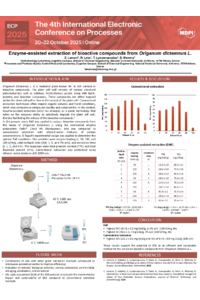
Origanum dictamnus L. is a medicinal plant known for its rich content in bioactive compounds. The plant cell wall consists of various structural polysaccharides such as cellulose, hemicellulose, and pectin, along with lignin, proteins, and bioactive compounds. These compounds are either trapped within the plant cell wall or free in the cytocol of the plant cell. Enzyme-assisted extraction (EAE) is a green technology that relies on the enzymes ability to selectively degrade the plant cell wall, thereby facilitating the release of bioactive compounds.
In the present study, EAE was applied to extract bioactive compounds from the leaves of Origanum dictamnus L. using the commercial enzyme preparation Cellic® CTec3 HS (Novozymes) and was compared to conventional extraction with ethanol–water mixtures of various concentrations. A Taguchi experimental design was applied to determine the optimal EAE conditions. The variables were enzyme loading (50, 100, and 200 U/mg), solid-to-liquid ratio (1, 4, and 7% w/v), and extraction time (1, 3, and 6 h). The responses were total phenolic content (TPC) and total flavonoid content (TFC). Conventional extraction was performed using ethanol–water mixtures of 0-100% v/v. TPC was determined using the Folin–Ciocalteu method and TFC with the aluminum chloride method. EAE achieved the highest TPC yield of 164.8 ± 5.2 mg GAE/g DW, at 1% w/v, 100 U/mg, and 6h. The maximum TFC yield reached 92.5 ± 5.7 mg CAE/g DW with 7% w/v, 100 U/mg, and 1h. In comparison, conventional extraction with 40% ethanol (v/v) gave the maximum TPC of 133.2 ± 0.5 mg GAE/g DW and TFC of 67.9 ± 0.9 mg CAE/g DW. These results support the potential of EAE as an efficient and sustainable method for the extraction of bioactive compounds from Origanum Dictamnus L.
Keywords
Origanum dictamnus L.
Enzyme Assisted Extraction (EAE)
Conventional extraction
Taguchi experimental design
Total flavonoid content (TFC)
Total phenolic content (TPC)
Poster
ECP 2025.pdf
Advanced Reduction Processes (ARPs) for the degradation of man-made compounds: A UV-C/Sulfite Approach
Passives Cooling and Heating Strategies for Energy-Efficient Buildings: A Study for Sustainable Environmentally Friendly Green Design Processes