Event submissions
Published
This submission belongs to the session S1. Environmental and Green Processes of the event The 4th International Electronic Conference on Processes
Published date
17 Oct, 2025
Academic Editor
'%3e%3cpath%20d='M12.6657%2010.9104C12.4185%2010.325%2012.0599%209.79327%2011.6097%209.34482C11.1609%208.89508%2010.6293%208.5365%2010.0442%208.28888C10.0389%208.28626%2010.0337%208.28495%2010.0285%208.28233C10.8446%207.69279%2011.3752%206.73249%2011.3752%205.64904C11.3752%203.8542%209.92103%202.39999%208.1262%202.39999C6.33136%202.39999%204.87715%203.8542%204.87715%205.64904C4.87715%206.73249%205.40774%207.69279%206.22393%208.28364C6.21869%208.28626%206.21345%208.28757%206.20821%208.29019C5.62129%208.5378%205.09463%208.89284%204.64265%209.34613C4.1929%209.79493%203.83432%2010.3266%203.58671%2010.9117C3.34345%2011.4845%203.21226%2012.0987%203.20023%2012.7209C3.19988%2012.7349%203.20233%2012.7488%203.20744%2012.7619C3.21255%2012.7749%203.22022%2012.7867%203.22998%2012.7968C3.23975%2012.8068%203.25142%2012.8147%203.26431%2012.8202C3.2772%2012.8256%203.29105%2012.8284%203.30504%2012.8284H4.09109C4.14874%2012.8284%204.19459%2012.7825%204.1959%2012.7262C4.2221%2011.7148%204.62823%2010.7676%205.34617%2010.0497C6.08899%209.30683%207.0755%208.89808%208.1262%208.89808C9.17689%208.89808%2010.1634%209.30683%2010.9062%2010.0497C11.6242%2010.7676%2012.0303%2011.7148%2012.0565%2012.7262C12.0578%2012.7838%2012.1037%2012.8284%2012.1613%2012.8284H12.9474C12.9613%2012.8284%2012.9752%2012.8256%2012.9881%2012.8202C13.001%2012.8147%2013.0126%2012.8068%2013.0224%2012.7968C13.0322%2012.7867%2013.0398%2012.7749%2013.0449%2012.7619C13.0501%2012.7488%2013.0525%2012.7349%2013.0522%2012.7209C13.0391%2012.0947%2012.9094%2011.4855%2012.6657%2010.9104ZM8.1262%207.9024C7.52486%207.9024%206.9589%207.6679%206.53312%207.24211C6.10733%206.81633%205.87283%206.25037%205.87283%205.64904C5.87283%205.0477%206.10733%204.48174%206.53312%204.05596C6.9589%203.63018%207.52486%203.39567%208.1262%203.39567C8.72753%203.39567%209.29349%203.63018%209.71927%204.05596C10.1451%204.48174%2010.3796%205.0477%2010.3796%205.64904C10.3796%206.25037%2010.1451%206.81633%209.71927%207.24211C9.29349%207.6679%208.72753%207.9024%208.1262%207.9024Z'%20fill='%235D1EE1'/%3e%3c/g%3e%3c/svg%3e) Young-Cheol Chang
Young-Cheol ChangCitation
Ruzimurod Jurayev, Bekzod Eshkulov, GROUNDWATER QUALITY PHYSICO-CHEMICAL ANALYSIS FOR SUSTAINABLE WATER MANAGEMENT, in Proceedings of The 4th International Electronic Conference on Processes, 20 October–22 October 2025, MDPI: Basel, Switzerland
Share
Email
Facebook
Twitter
LinkedIn
GROUNDWATER QUALITY PHYSICO-CHEMICAL ANALYSIS FOR SUSTAINABLE WATER MANAGEMENT

Ruzimurod Jurayev 1

Bekzod Eshkulov 2
1. Department of “Chemical Engineering ”, Karshi State Technical University Shahrisabz Faculty of Food Engineering, 20, Shakhrisabz str., Shakhrisabz 181306, Uzbekistan
2. Student of “Chemical technology”, Karshi State Technical University Shahrisabz Faculty of Food Engineering, 20, Shakhrisabz str., Shakhrisabz 181306, Uzbekistan
Abstract
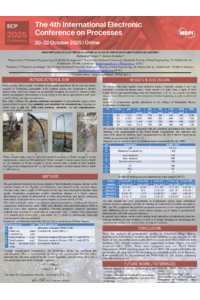
Groundwater plays a crucial role in regions like southern Uzbekistan, where surface water is limited. This study investigates the physico-chemical properties of groundwater in the Koson district (Kashkadarya region) to assess its suitability for drinking and sustainable use. Four samples (S1–S4) collected from different depths (100–1650 m) were analyzed for pH, electrical conductivity (EC), total alkalinity, total hardness (TH), calcium hardness (CaH), magnesium hardness (MgH), and total dissolved solids (TDS). Ionometric and elemental analyses were also conducted using standard methods, including ICP-MS. While all samples had a pH within WHO-recommended limits (6.5–8.5), EC, TDS, and hardness values exceeded permissible levels in most cases. Sample S2 recorded the highest EC (6295 µS/cm) and TDS (7600 mg/L), indicating excessive salinity. Total hardness in some samples reached up to 930 mg/L, suggesting unsuitable conditions for direct consumption. Elemental analysis revealed relatively high sodium, calcium, and magnesium levels, though within safe limits. Ionometric data indicated possible contamination from agricultural and anthropogenic sources, including elevated nitrate (NO₃⁻) and ammonium (NH₄⁺) levels. The findings suggest that while groundwater can be a critical water source, proper treatment is required before use. Regular monitoring and management are essential to prevent health risks and ensure long-term water sustainability in the region.
Keywords
groundwater
hydrochemistry
total dissolved solids (TDS)
geological formations
anthropogenic activities
control factors
Poster
Poster for water management.pdf
Evaluating the Extraction Efficiency of Choline Chloride–Malic Acid DES Against Conventional Solvents for Quercetin and Caffeic Acid: A Green Approach
A Systematic Review of LCA and OpenLCA Applications for Carbon Emission Mapping in Processes