Event submissions
Published
This submission belongs to the session S1. Environmental and Green Processes of the event The 4th International Electronic Conference on Processes
Published date
17 Oct, 2025
Academic Editor
'%3e%3cpath%20d='M12.6657%2010.9104C12.4185%2010.325%2012.0599%209.79327%2011.6097%209.34482C11.1609%208.89508%2010.6293%208.5365%2010.0442%208.28888C10.0389%208.28626%2010.0337%208.28495%2010.0285%208.28233C10.8446%207.69279%2011.3752%206.73249%2011.3752%205.64904C11.3752%203.8542%209.92103%202.39999%208.1262%202.39999C6.33136%202.39999%204.87715%203.8542%204.87715%205.64904C4.87715%206.73249%205.40774%207.69279%206.22393%208.28364C6.21869%208.28626%206.21345%208.28757%206.20821%208.29019C5.62129%208.5378%205.09463%208.89284%204.64265%209.34613C4.1929%209.79493%203.83432%2010.3266%203.58671%2010.9117C3.34345%2011.4845%203.21226%2012.0987%203.20023%2012.7209C3.19988%2012.7349%203.20233%2012.7488%203.20744%2012.7619C3.21255%2012.7749%203.22022%2012.7867%203.22998%2012.7968C3.23975%2012.8068%203.25142%2012.8147%203.26431%2012.8202C3.2772%2012.8256%203.29105%2012.8284%203.30504%2012.8284H4.09109C4.14874%2012.8284%204.19459%2012.7825%204.1959%2012.7262C4.2221%2011.7148%204.62823%2010.7676%205.34617%2010.0497C6.08899%209.30683%207.0755%208.89808%208.1262%208.89808C9.17689%208.89808%2010.1634%209.30683%2010.9062%2010.0497C11.6242%2010.7676%2012.0303%2011.7148%2012.0565%2012.7262C12.0578%2012.7838%2012.1037%2012.8284%2012.1613%2012.8284H12.9474C12.9613%2012.8284%2012.9752%2012.8256%2012.9881%2012.8202C13.001%2012.8147%2013.0126%2012.8068%2013.0224%2012.7968C13.0322%2012.7867%2013.0398%2012.7749%2013.0449%2012.7619C13.0501%2012.7488%2013.0525%2012.7349%2013.0522%2012.7209C13.0391%2012.0947%2012.9094%2011.4855%2012.6657%2010.9104ZM8.1262%207.9024C7.52486%207.9024%206.9589%207.6679%206.53312%207.24211C6.10733%206.81633%205.87283%206.25037%205.87283%205.64904C5.87283%205.0477%206.10733%204.48174%206.53312%204.05596C6.9589%203.63018%207.52486%203.39567%208.1262%203.39567C8.72753%203.39567%209.29349%203.63018%209.71927%204.05596C10.1451%204.48174%2010.3796%205.0477%2010.3796%205.64904C10.3796%206.25037%2010.1451%206.81633%209.71927%207.24211C9.29349%207.6679%208.72753%207.9024%208.1262%207.9024Z'%20fill='%235D1EE1'/%3e%3c/g%3e%3c/svg%3e) Young-Cheol Chang
Young-Cheol ChangCitation
Mariana Chelu, Razvan State, Irina Atkinson, Cornel Munteanu, Anca Vasile, Florica Papa, Exploring the efficacy of Pd-Au-decorated ZnO nanoparticles obtained through green synthesis as a sustainable approach for water treatment, in Proceedings of The 4th International Electronic Conference on Processes, 20 October–22 October 2025, MDPI: Basel, Switzerland
Share
Email
Facebook
Twitter
LinkedIn
Exploring the efficacy of Pd-Au-decorated ZnO nanoparticles obtained through green synthesis as a sustainable approach for water treatment

Mariana Chelu 1

Razvan State 1
'%3e%3cpath%20d='M12.6647%2010.9104C12.4176%2010.325%2012.0589%209.7933%2011.6088%209.34485C11.16%208.89511%2010.6283%208.53653%2010.0432%208.28891C10.038%208.28629%2010.0327%208.28498%2010.0275%208.28236C10.8437%207.69282%2011.3743%206.73252%2011.3743%205.64907C11.3743%203.85423%209.92005%202.40002%208.12522%202.40002C6.33038%202.40002%204.87618%203.85423%204.87618%205.64907C4.87618%206.73252%205.40677%207.69282%206.22296%208.28367C6.21772%208.28629%206.21248%208.2876%206.20724%208.29022C5.62031%208.53783%205.09365%208.89287%204.64167%209.34616C4.19192%209.79496%203.83334%2010.3266%203.58573%2010.9117C3.34247%2011.4846%203.21128%2012.0987%203.19925%2012.721C3.1989%2012.735%203.20135%2012.7489%203.20646%2012.7619C3.21157%2012.7749%203.21924%2012.7868%203.22901%2012.7968C3.23877%2012.8068%203.25045%2012.8148%203.26334%2012.8202C3.27623%2012.8256%203.29007%2012.8284%203.30406%2012.8284H4.09012C4.14776%2012.8284%204.19362%2012.7825%204.19493%2012.7262C4.22113%2011.7148%204.62726%2010.7676%205.34519%2010.0497C6.08802%209.30686%207.07452%208.89811%208.12522%208.89811C9.17592%208.89811%2010.1624%209.30686%2010.9052%2010.0497C11.6232%2010.7676%2012.0293%2011.7148%2012.0555%2012.7262C12.0568%2012.7839%2012.1027%2012.8284%2012.1603%2012.8284H12.9464C12.9604%2012.8284%2012.9742%2012.8256%2012.9871%2012.8202C13%2012.8148%2013.0117%2012.8068%2013.0214%2012.7968C13.0312%2012.7868%2013.0389%2012.7749%2013.044%2012.7619C13.0491%2012.7489%2013.0515%2012.735%2013.0512%2012.721C13.0381%2012.0947%2012.9084%2011.4856%2012.6647%2010.9104ZM8.12522%207.90243C7.52388%207.90243%206.95792%207.66793%206.53214%207.24215C6.10636%206.81636%205.87185%206.2504%205.87185%205.64907C5.87185%205.04773%206.10636%204.48177%206.53214%204.05599C6.95792%203.63021%207.52388%203.3957%208.12522%203.3957C8.72655%203.3957%209.29252%203.63021%209.7183%204.05599C10.1441%204.48177%2010.3786%205.04773%2010.3786%205.64907C10.3786%206.2504%2010.1441%206.81636%209.7183%207.24215C9.29252%207.66793%208.72655%207.90243%208.12522%207.90243Z'%20fill='%235D1EE1'/%3e%3c/g%3e%3c/svg%3e)
Irina Atkinson 1
Cornel Munteanu 1

Anca Vasile 1

Florica Papa 1
1. “Ilie Murgulescu” Institute of Physical Chemistry, 202 Spl. Independentei, 060021 Bucharest, Romania
Abstract
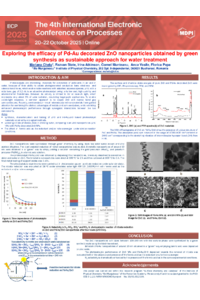
Addressing water contamination with hazardous pollutants, particularly nitrites with strong carcinogenic potential, is an essential priority in environmental remediation efforts. This research explored the photoreduction of nitrate in drinking water, comparing plain ZnO nanoparticles (ZnO NPs) with Pd-Au-decorated ZnO NPs. In the first step, ZnO NPs were synthesized using a simple and environmentally friendly precipitation method using black tea solid waste extract. In the second step, bimetallic nanoparticles were obtained using a green chemistry method from Au and Pd precursors (at a 1:1 molar ratio) in a tannic acid solution. The Pd-Au/ZnO photocatalytic material was obtained by dispersing bimetallic nanoparticles, previously dissolved through sonication in deionized water, onto ZnO. Both the ZnO and Pd-Au/ZnO NPs were characterized in terms of their structural crystallinity and morphology using XRD, SEM-EDX, and TEM. The photocatalytic efficiency of the synthesized ZnO and Pd-Au/ZnO NPs was evaluated according to their ability to degrade nitrates from water, in the absence and presence of formic acid as a reducing agent and/or a hole scavenger, under UV irradiation with a 125 W Hg lamp. Compared to the ZnO NPs, the catalysts loaded with bimetallic Pd-Au nanoparticles demonstrated excellent N2 selectivity in the photocatalytic reduction of nitrate in the presence of formic acid. The maximum photocatalytic activity and N2 selectivity were achieved using the Pd–Au/ZnO NPs, with a total metal loading of 1 wt%. A possible photocatalytic mechanism was proposed. Upon UV irradiation, zinc oxide (ZnO) generates electrons that are transferred to the bimetallic nanoparticles. Subsequently, protons (H+) adsorbed onto the surface of the metal particles facilitate the reduction of nitrate ions (NO3−). These materials are expected to exhibit a high photocatalytic performance by enhancing the rate of photoexcited electron capture and reducing recombination effects, thanks to the electron storage capacity of the palladium–gold (Pd-Au) nanoparticles.
Keywords
ZnO
bimetallic nanoparticles
green synthesis
nitrites degradation
photocatalysis
Poster
Poster ECP 2025_Mariana Chelu.pdf
Recovery of spent battery materials for reuse in energy storage applications.
High-Performance Nanosized Co/rGO Composite as an Efficient Oxygen Electrode Material