Event submissions
Published
This submission belongs to the session S1. Environmental and Green Processes of the event The 4th International Electronic Conference on Processes
Published date
17 Oct, 2025
Academic Editor
'%3e%3cpath%20d='M12.6657%2010.9104C12.4185%2010.325%2012.0599%209.79327%2011.6097%209.34482C11.1609%208.89508%2010.6293%208.5365%2010.0442%208.28888C10.0389%208.28626%2010.0337%208.28495%2010.0285%208.28233C10.8446%207.69279%2011.3752%206.73249%2011.3752%205.64904C11.3752%203.8542%209.92103%202.39999%208.1262%202.39999C6.33136%202.39999%204.87715%203.8542%204.87715%205.64904C4.87715%206.73249%205.40774%207.69279%206.22393%208.28364C6.21869%208.28626%206.21345%208.28757%206.20821%208.29019C5.62129%208.5378%205.09463%208.89284%204.64265%209.34613C4.1929%209.79493%203.83432%2010.3266%203.58671%2010.9117C3.34345%2011.4845%203.21226%2012.0987%203.20023%2012.7209C3.19988%2012.7349%203.20233%2012.7488%203.20744%2012.7619C3.21255%2012.7749%203.22022%2012.7867%203.22998%2012.7968C3.23975%2012.8068%203.25142%2012.8147%203.26431%2012.8202C3.2772%2012.8256%203.29105%2012.8284%203.30504%2012.8284H4.09109C4.14874%2012.8284%204.19459%2012.7825%204.1959%2012.7262C4.2221%2011.7148%204.62823%2010.7676%205.34617%2010.0497C6.08899%209.30683%207.0755%208.89808%208.1262%208.89808C9.17689%208.89808%2010.1634%209.30683%2010.9062%2010.0497C11.6242%2010.7676%2012.0303%2011.7148%2012.0565%2012.7262C12.0578%2012.7838%2012.1037%2012.8284%2012.1613%2012.8284H12.9474C12.9613%2012.8284%2012.9752%2012.8256%2012.9881%2012.8202C13.001%2012.8147%2013.0126%2012.8068%2013.0224%2012.7968C13.0322%2012.7867%2013.0398%2012.7749%2013.0449%2012.7619C13.0501%2012.7488%2013.0525%2012.7349%2013.0522%2012.7209C13.0391%2012.0947%2012.9094%2011.4855%2012.6657%2010.9104ZM8.1262%207.9024C7.52486%207.9024%206.9589%207.6679%206.53312%207.24211C6.10733%206.81633%205.87283%206.25037%205.87283%205.64904C5.87283%205.0477%206.10733%204.48174%206.53312%204.05596C6.9589%203.63018%207.52486%203.39567%208.1262%203.39567C8.72753%203.39567%209.29349%203.63018%209.71927%204.05596C10.1451%204.48174%2010.3796%205.0477%2010.3796%205.64904C10.3796%206.25037%2010.1451%206.81633%209.71927%207.24211C9.29349%207.6679%208.72753%207.9024%208.1262%207.9024Z'%20fill='%235D1EE1'/%3e%3c/g%3e%3c/svg%3e) Young-Cheol Chang
Young-Cheol ChangCitation
Mary Gojeh, Bemgba B Nyakuma, Sambo G Ishaku, Bognet Obed, Tella Abdulkareem, Benjamin Tagang, Umar Dalhatu, ADSORPTION OF METHYLENE BLUE DYE USING MANGO LEAF POWDER, in Proceedings of The 4th International Electronic Conference on Processes, 20 October–22 October 2025, MDPI: Basel, Switzerland
Share
Email
Facebook
Twitter
LinkedIn
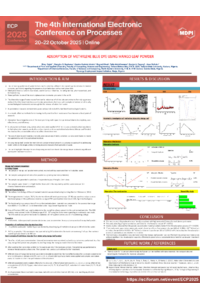
ADSORPTION OF METHYLENE BLUE DYE USING MANGO LEAF POWDER
'%3e%3cpath%20d='M12.6647%2010.9104C12.4176%2010.325%2012.0589%209.7933%2011.6088%209.34485C11.16%208.89511%2010.6283%208.53653%2010.0432%208.28891C10.038%208.28629%2010.0327%208.28498%2010.0275%208.28236C10.8437%207.69282%2011.3743%206.73252%2011.3743%205.64907C11.3743%203.85423%209.92005%202.40002%208.12522%202.40002C6.33038%202.40002%204.87618%203.85423%204.87618%205.64907C4.87618%206.73252%205.40677%207.69282%206.22296%208.28367C6.21772%208.28629%206.21248%208.2876%206.20724%208.29022C5.62031%208.53783%205.09365%208.89287%204.64167%209.34616C4.19192%209.79496%203.83334%2010.3266%203.58573%2010.9117C3.34247%2011.4846%203.21128%2012.0987%203.19925%2012.721C3.1989%2012.735%203.20135%2012.7489%203.20646%2012.7619C3.21157%2012.7749%203.21924%2012.7868%203.22901%2012.7968C3.23877%2012.8068%203.25045%2012.8148%203.26334%2012.8202C3.27623%2012.8256%203.29007%2012.8284%203.30406%2012.8284H4.09012C4.14776%2012.8284%204.19362%2012.7825%204.19493%2012.7262C4.22113%2011.7148%204.62726%2010.7676%205.34519%2010.0497C6.08802%209.30686%207.07452%208.89811%208.12522%208.89811C9.17592%208.89811%2010.1624%209.30686%2010.9052%2010.0497C11.6232%2010.7676%2012.0293%2011.7148%2012.0555%2012.7262C12.0568%2012.7839%2012.1027%2012.8284%2012.1603%2012.8284H12.9464C12.9604%2012.8284%2012.9742%2012.8256%2012.9871%2012.8202C13%2012.8148%2013.0117%2012.8068%2013.0214%2012.7968C13.0312%2012.7868%2013.0389%2012.7749%2013.044%2012.7619C13.0491%2012.7489%2013.0515%2012.735%2013.0512%2012.721C13.0381%2012.0947%2012.9084%2011.4856%2012.6647%2010.9104ZM8.12522%207.90243C7.52388%207.90243%206.95792%207.66793%206.53214%207.24215C6.10636%206.81636%205.87185%206.2504%205.87185%205.64907C5.87185%205.04773%206.10636%204.48177%206.53214%204.05599C6.95792%203.63021%207.52388%203.3957%208.12522%203.3957C8.72655%203.3957%209.29252%203.63021%209.7183%204.05599C10.1441%204.48177%2010.3786%205.04773%2010.3786%205.64907C10.3786%206.2504%2010.1441%206.81636%209.7183%207.24215C9.29252%207.66793%208.72655%207.90243%208.12522%207.90243Z'%20fill='%235D1EE1'/%3e%3c/g%3e%3c/svg%3e)
Mary Gojeh 1
Bemgba B Nyakuma 2
Sambo G Ishaku 3
Bognet Obed 4
Tella Abdulkareem 4
Benjamin Tagang 4
Umar Dalhatu 2
1. Department of Pure & Applied Chemistry, College of Computing, Science and Engineering, Faculty of Physical Sciences, Kaduna State University, P. M. B. 2339, Kaduna, Kaduna State, 234, Nigeria
2. Department of Chemical Sciences, North-Eastern University, P. M. B. 0198 Gombe, Gombe State, Nigeria
3. Synergy Empowerment Impact Initiative, Abuja, Nigeria
4. Department of Pure & Applied Chemistry, Kaduna State University, P. M. B. 2339 Kaduna, Kaduna State, Nigeria
Abstract
This research investigates the adsorption of methylene blue dye. Methylene blue is a common cationic dye used in various industries, and its presence in wastewater poses significant environmental and health concerns. Traditional methods for dye removal can be expensive and generate secondary pollutants. Mango leaf powder proves to be a cost-effective and environmentally friendly adsorbent for the removal of methylene blue (MB) dye from aqueous solutions. Characterization was performed through Scanning Electron Microscopy (SEM) for the morphology of the mango leaf powder; Fourier Transform Infrared Spectroscopy (FTIR) and X-ray Diffraction (XRD) for the crystallinity of the mango leaf powder; and Thermogravimetric Analysis (TGA) for the thermal stability of the mango leaf powder. Batch adsorption experiments were conducted to evaluate the efficiency of mango leaf powder in removing methylene blue from aqueous solutions. The study employed both Langmuir and Freundlich isotherms to analyze the adsorption data, revealing a higher correlation coefficient for the Freundlich model (R² = 0.932) compared to the Langmuir model (R² = 0.8864). Kinetic studies indicated that the pseudo-second-order model provided a better fit for the adsorption process (R² = 0.8288). Thermodynamic parameters were calculated, showing a Gibbs free energy change (ΔG) of -0.364 × 10⁻³ kJ/mol, an enthalpy change (ΔH) of -0.521 × 10⁻³ kJ/mol, and an entropy change (ΔS) of 2.233 J/mol·K, indicating that the adsorption process is spontaneous and exothermic in nature. Furthermore, a reusability study demonstrated that mango leaf powder can be effectively reused across three cycles without significant loss in adsorption capacity, affirming its potential as a sustainable biosorbent for wastewater treatment applications.
Keywords
Methylene blue
Adsorption
Isotherm
Kinetics
Thermodynamics
Poster
MDPI Poster .pdf
TOWARD COPPER–SILVER ELECTROCHEMICAL NANOSENSOR FOR 1,3 – DINITROBENZENE
Carbonisation and Characterisation of Charcoal Produced from Combretum malabaricum, Mimosa pigra, and Ipomoea carnea