Event submissions
Published
This submission belongs to the session S1. Environmental and Green Processes of the event The 4th International Electronic Conference on Processes
Published date
17 Oct, 2025
Academic Editor
'%3e%3cpath%20d='M12.6657%2010.9104C12.4185%2010.325%2012.0599%209.79327%2011.6097%209.34482C11.1609%208.89508%2010.6293%208.5365%2010.0442%208.28888C10.0389%208.28626%2010.0337%208.28495%2010.0285%208.28233C10.8446%207.69279%2011.3752%206.73249%2011.3752%205.64904C11.3752%203.8542%209.92103%202.39999%208.1262%202.39999C6.33136%202.39999%204.87715%203.8542%204.87715%205.64904C4.87715%206.73249%205.40774%207.69279%206.22393%208.28364C6.21869%208.28626%206.21345%208.28757%206.20821%208.29019C5.62129%208.5378%205.09463%208.89284%204.64265%209.34613C4.1929%209.79493%203.83432%2010.3266%203.58671%2010.9117C3.34345%2011.4845%203.21226%2012.0987%203.20023%2012.7209C3.19988%2012.7349%203.20233%2012.7488%203.20744%2012.7619C3.21255%2012.7749%203.22022%2012.7867%203.22998%2012.7968C3.23975%2012.8068%203.25142%2012.8147%203.26431%2012.8202C3.2772%2012.8256%203.29105%2012.8284%203.30504%2012.8284H4.09109C4.14874%2012.8284%204.19459%2012.7825%204.1959%2012.7262C4.2221%2011.7148%204.62823%2010.7676%205.34617%2010.0497C6.08899%209.30683%207.0755%208.89808%208.1262%208.89808C9.17689%208.89808%2010.1634%209.30683%2010.9062%2010.0497C11.6242%2010.7676%2012.0303%2011.7148%2012.0565%2012.7262C12.0578%2012.7838%2012.1037%2012.8284%2012.1613%2012.8284H12.9474C12.9613%2012.8284%2012.9752%2012.8256%2012.9881%2012.8202C13.001%2012.8147%2013.0126%2012.8068%2013.0224%2012.7968C13.0322%2012.7867%2013.0398%2012.7749%2013.0449%2012.7619C13.0501%2012.7488%2013.0525%2012.7349%2013.0522%2012.7209C13.0391%2012.0947%2012.9094%2011.4855%2012.6657%2010.9104ZM8.1262%207.9024C7.52486%207.9024%206.9589%207.6679%206.53312%207.24211C6.10733%206.81633%205.87283%206.25037%205.87283%205.64904C5.87283%205.0477%206.10733%204.48174%206.53312%204.05596C6.9589%203.63018%207.52486%203.39567%208.1262%203.39567C8.72753%203.39567%209.29349%203.63018%209.71927%204.05596C10.1451%204.48174%2010.3796%205.0477%2010.3796%205.64904C10.3796%206.25037%2010.1451%206.81633%209.71927%207.24211C9.29349%207.6679%208.72753%207.9024%208.1262%207.9024Z'%20fill='%235D1EE1'/%3e%3c/g%3e%3c/svg%3e) Young-Cheol Chang
Young-Cheol ChangCitation
Lucas Marinho de Souza, Kátia Rodrigues de Souza, Leonardo Zanon Costa, Ronei de Almeida, Assessing electrocoagulation (Al and Fe electrodes) and the electro-Fenton process for landfill leachate membrane concentrate treatment, in Proceedings of The 4th International Electronic Conference on Processes, 20 October–22 October 2025, MDPI: Basel, Switzerland
Share
Email
Facebook
Twitter
LinkedIn
Assessing electrocoagulation (Al and Fe electrodes) and the electro-Fenton process for landfill leachate membrane concentrate treatment
'%3e%3cpath%20d='M12.6647%2010.9104C12.4176%2010.325%2012.0589%209.7933%2011.6088%209.34485C11.16%208.89511%2010.6283%208.53653%2010.0432%208.28891C10.038%208.28629%2010.0327%208.28498%2010.0275%208.28236C10.8437%207.69282%2011.3743%206.73252%2011.3743%205.64907C11.3743%203.85423%209.92005%202.40002%208.12522%202.40002C6.33038%202.40002%204.87618%203.85423%204.87618%205.64907C4.87618%206.73252%205.40677%207.69282%206.22296%208.28367C6.21772%208.28629%206.21248%208.2876%206.20724%208.29022C5.62031%208.53783%205.09365%208.89287%204.64167%209.34616C4.19192%209.79496%203.83334%2010.3266%203.58573%2010.9117C3.34247%2011.4846%203.21128%2012.0987%203.19925%2012.721C3.1989%2012.735%203.20135%2012.7489%203.20646%2012.7619C3.21157%2012.7749%203.21924%2012.7868%203.22901%2012.7968C3.23877%2012.8068%203.25045%2012.8148%203.26334%2012.8202C3.27623%2012.8256%203.29007%2012.8284%203.30406%2012.8284H4.09012C4.14776%2012.8284%204.19362%2012.7825%204.19493%2012.7262C4.22113%2011.7148%204.62726%2010.7676%205.34519%2010.0497C6.08802%209.30686%207.07452%208.89811%208.12522%208.89811C9.17592%208.89811%2010.1624%209.30686%2010.9052%2010.0497C11.6232%2010.7676%2012.0293%2011.7148%2012.0555%2012.7262C12.0568%2012.7839%2012.1027%2012.8284%2012.1603%2012.8284H12.9464C12.9604%2012.8284%2012.9742%2012.8256%2012.9871%2012.8202C13%2012.8148%2013.0117%2012.8068%2013.0214%2012.7968C13.0312%2012.7868%2013.0389%2012.7749%2013.044%2012.7619C13.0491%2012.7489%2013.0515%2012.735%2013.0512%2012.721C13.0381%2012.0947%2012.9084%2011.4856%2012.6647%2010.9104ZM8.12522%207.90243C7.52388%207.90243%206.95792%207.66793%206.53214%207.24215C6.10636%206.81636%205.87185%206.2504%205.87185%205.64907C5.87185%205.04773%206.10636%204.48177%206.53214%204.05599C6.95792%203.63021%207.52388%203.3957%208.12522%203.3957C8.72655%203.3957%209.29252%203.63021%209.7183%204.05599C10.1441%204.48177%2010.3786%205.04773%2010.3786%205.64907C10.3786%206.2504%2010.1441%206.81636%209.7183%207.24215C9.29252%207.66793%208.72655%207.90243%208.12522%207.90243Z'%20fill='%235D1EE1'/%3e%3c/g%3e%3c/svg%3e)
Lucas Marinho de Souza 1
Kátia Rodrigues de Souza 2
Leonardo Zanon Costa 2
Ronei de Almeida 2
1. Universidade do Estado do Rio de Janeiro, R. São Francisco Xavier, 524 - Maracanã, Rio de Janeiro - RJ, 20550-013, Brazil
2. Department of Sanitary and Environmental Engineering, Faculty of Engineering, Universidade do Estado do Rio de Janeiro/UERJ, Rio de Janeiro/ RJ 20550-013, Brazil
Abstract
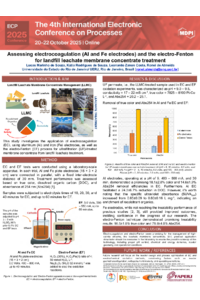
In compliance with stringent standards for wastewater disposal, advanced processes have been implemented in several landfill leachate treatment plants (LTPs). Among these, membrane-based technologies have been adopted to remove contaminants beyond the capabilities of conventional methods. However, managing landfill leachate membrane concentrate (LLMC), the residual stream from membrane filtration, is a challenge for landfill operators. LLMC can comprise up to 50% of the incoming leachate, making its management a critical aspect of LTP operations. This study investigates the application of electrocoagulation (EC), using aluminum (Al) and iron (Fe) electrodes, as well as the electro-Fenton (EF) process, for LLMC treatment. EC tests were conducted using a laboratory-scale apparatus. In each trial, Al and Fe plate electrodes (15 × 3 × 2 cm) were connected in parallel, with a fixed inter-electrode distance of 30 mm. Treatment performance was assessed based on the true color, absorbance at 254 nm (Abs254), and dissolved organic carbon (DOC) removal. Abs254 was measured using a Shimadzu UV-1800 spectrophotometer (Method 5910-B). True color (Method 2120-C) and the chemical oxygen demand (COD; Method 5310-C) were determined according to the APHA (2017) standard methods, using a Hach DR2800 portable spectrophotometer for true color and a Shimadzu TOC-V analyzer for the COD, respectively. Before analysis, samples were filtered through 0.45 µm cellulose membrane filters. With the Al electrodes (pH = 9, 300–600 mA, 30 min), removal efficiencies of 18.1 ± 2.8% for color, 14.6 ± 1.9% for Abs254, and 24.3 ± 6.7% for DOC were achieved. Although the Fe electrodes yielded slightly better results, the overall performance remained below the levels reported in previous studies. Consequently, the treatability assessment was extended to include the electro-Fenton technique. Electrochemical advanced oxidation processes were evaluated by varying the LLMC's pH (3.0–5.0) and hydrogen peroxide (H₂O₂) concentrations (0–1000 ppm). These results are detailed in the extended abstract. Future research will focus on the economic feasibility of EC and electrochemical oxidation methods, considering factors such as the energy and electrode consumption and reagent requirements.
Keywords
Absorbance at 254 nm
Advanced oxidation
Electrochemical treatment
Fenton oxidation
Waste management
Poster
0c1919e527ac2d251e47296d51489d9e.pdf
BIODIESEL PRODUCTION FROM MICROALGAE USING IONIC LIQUID AS SOLVENT
Post-synthetic modification of bimetallic Zn/Mg-metal–organic framework-74 for enhanced carbon capture efficacy