Event submissions
Published
This submission belongs to the session S8. Crop Production of the event The 3rd International Online Conference on Agriculture
Published date
20 Oct, 2025
Academic Editor
'%3e%3cpath%20d='M12.6657%2010.9104C12.4185%2010.325%2012.0599%209.79327%2011.6097%209.34482C11.1609%208.89508%2010.6293%208.5365%2010.0442%208.28888C10.0389%208.28626%2010.0337%208.28495%2010.0285%208.28233C10.8446%207.69279%2011.3752%206.73249%2011.3752%205.64904C11.3752%203.8542%209.92103%202.39999%208.1262%202.39999C6.33136%202.39999%204.87715%203.8542%204.87715%205.64904C4.87715%206.73249%205.40774%207.69279%206.22393%208.28364C6.21869%208.28626%206.21345%208.28757%206.20821%208.29019C5.62129%208.5378%205.09463%208.89284%204.64265%209.34613C4.1929%209.79493%203.83432%2010.3266%203.58671%2010.9117C3.34345%2011.4845%203.21226%2012.0987%203.20023%2012.7209C3.19988%2012.7349%203.20233%2012.7488%203.20744%2012.7619C3.21255%2012.7749%203.22022%2012.7867%203.22998%2012.7968C3.23975%2012.8068%203.25142%2012.8147%203.26431%2012.8202C3.2772%2012.8256%203.29105%2012.8284%203.30504%2012.8284H4.09109C4.14874%2012.8284%204.19459%2012.7825%204.1959%2012.7262C4.2221%2011.7148%204.62823%2010.7676%205.34617%2010.0497C6.08899%209.30683%207.0755%208.89808%208.1262%208.89808C9.17689%208.89808%2010.1634%209.30683%2010.9062%2010.0497C11.6242%2010.7676%2012.0303%2011.7148%2012.0565%2012.7262C12.0578%2012.7838%2012.1037%2012.8284%2012.1613%2012.8284H12.9474C12.9613%2012.8284%2012.9752%2012.8256%2012.9881%2012.8202C13.001%2012.8147%2013.0126%2012.8068%2013.0224%2012.7968C13.0322%2012.7867%2013.0398%2012.7749%2013.0449%2012.7619C13.0501%2012.7488%2013.0525%2012.7349%2013.0522%2012.7209C13.0391%2012.0947%2012.9094%2011.4855%2012.6657%2010.9104ZM8.1262%207.9024C7.52486%207.9024%206.9589%207.6679%206.53312%207.24211C6.10733%206.81633%205.87283%206.25037%205.87283%205.64904C5.87283%205.0477%206.10733%204.48174%206.53312%204.05596C6.9589%203.63018%207.52486%203.39567%208.1262%203.39567C8.72753%203.39567%209.29349%203.63018%209.71927%204.05596C10.1451%204.48174%2010.3796%205.0477%2010.3796%205.64904C10.3796%206.25037%2010.1451%206.81633%209.71927%207.24211C9.29349%207.6679%208.72753%207.9024%208.1262%207.9024Z'%20fill='%235D1EE1'/%3e%3c/g%3e%3c/svg%3e) Lorenzo Negri
Lorenzo NegriCitation
Catarina Macedo, Cláudia Marinho, Ana Faustino, Ana Usié, Liliana Marum, Somatic Embryogenesis as a Tool for the Clonal Propagation of Elite Cork Oak Genotypes in Montado Restoration, in Proceedings of The 3rd International Online Conference on Agriculture, 22 October–24 October 2025, MDPI: Basel, Switzerland
Share
Email
Facebook
Twitter
LinkedIn
Somatic Embryogenesis as a Tool for the Clonal Propagation of Elite Cork Oak Genotypes in Montado Restoration
'%3e%3cpath%20d='M12.6647%2010.9104C12.4176%2010.325%2012.0589%209.7933%2011.6088%209.34485C11.16%208.89511%2010.6283%208.53653%2010.0432%208.28891C10.038%208.28629%2010.0327%208.28498%2010.0275%208.28236C10.8437%207.69282%2011.3743%206.73252%2011.3743%205.64907C11.3743%203.85423%209.92005%202.40002%208.12522%202.40002C6.33038%202.40002%204.87618%203.85423%204.87618%205.64907C4.87618%206.73252%205.40677%207.69282%206.22296%208.28367C6.21772%208.28629%206.21248%208.2876%206.20724%208.29022C5.62031%208.53783%205.09365%208.89287%204.64167%209.34616C4.19192%209.79496%203.83334%2010.3266%203.58573%2010.9117C3.34247%2011.4846%203.21128%2012.0987%203.19925%2012.721C3.1989%2012.735%203.20135%2012.7489%203.20646%2012.7619C3.21157%2012.7749%203.21924%2012.7868%203.22901%2012.7968C3.23877%2012.8068%203.25045%2012.8148%203.26334%2012.8202C3.27623%2012.8256%203.29007%2012.8284%203.30406%2012.8284H4.09012C4.14776%2012.8284%204.19362%2012.7825%204.19493%2012.7262C4.22113%2011.7148%204.62726%2010.7676%205.34519%2010.0497C6.08802%209.30686%207.07452%208.89811%208.12522%208.89811C9.17592%208.89811%2010.1624%209.30686%2010.9052%2010.0497C11.6232%2010.7676%2012.0293%2011.7148%2012.0555%2012.7262C12.0568%2012.7839%2012.1027%2012.8284%2012.1603%2012.8284H12.9464C12.9604%2012.8284%2012.9742%2012.8256%2012.9871%2012.8202C13%2012.8148%2013.0117%2012.8068%2013.0214%2012.7968C13.0312%2012.7868%2013.0389%2012.7749%2013.044%2012.7619C13.0491%2012.7489%2013.0515%2012.735%2013.0512%2012.721C13.0381%2012.0947%2012.9084%2011.4856%2012.6647%2010.9104ZM8.12522%207.90243C7.52388%207.90243%206.95792%207.66793%206.53214%207.24215C6.10636%206.81636%205.87185%206.2504%205.87185%205.64907C5.87185%205.04773%206.10636%204.48177%206.53214%204.05599C6.95792%203.63021%207.52388%203.3957%208.12522%203.3957C8.72655%203.3957%209.29252%203.63021%209.7183%204.05599C10.1441%204.48177%2010.3786%205.04773%2010.3786%205.64907C10.3786%206.2504%2010.1441%206.81636%209.7183%207.24215C9.29252%207.66793%208.72655%207.90243%208.12522%207.90243Z'%20fill='%235D1EE1'/%3e%3c/g%3e%3c/svg%3e)
Catarina Macedo 1,2
Cláudia Marinho 1,2
Ana Faustino 1,3
Ana Usié 1,2
Liliana Marum 1,2
1. Alentejo Biotechnology Center for Agriculture and Agro-Food (CEBAL)/ Polytechnic University of Beja (IPBeja), 7801-908 Beja, Portugal
2. MED – Mediterranean Institute for Agriculture, Environment, and Development and CHANGE – Global Change and Sustainability Institute, CEBAL, 7801-908, Beja, Portugal
3. MED – Mediterranean Institute for Agriculture, Environment and Development, Instituto de Investigação e Formação Avançada, Universidade de Évora, Pólo da Mitra, Ap. 94, 7006-554 Évora, Portugal
Abstract
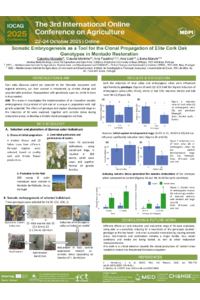
The cork oak (Quercus suber) supports Montado ecosystems in the Mediterranean region, a rich biodiversity hotspot. Its high‑value bark enables diverse production, fuelling the regional economy and global exports. Q. suber survival is threatened by climate change, desertification, and unsustainable practices. It is crucial to repopulate Montado ecosystems with genetically superior, longer-living cork oaks. Thus, clonal propagation of disease-free, more resistant cork oaks proves fundamental. Currently, new methods are being implemented by our research group based on a unique germplasm resource with high genetic potential from the F1 population of known pedigree. After traditional propagation methods failed, the main goal of this study was to implement an innovative method of somatic embryogenesis (SE) on the F1 population. Leaf explants with two different vegetative stages (0.5-1cm and 1-1.5cm) were selected on G31, G36 and J2 genotypes, using the protocol described by Hernandez et al. 2003. The results revealed that SE induction varied significantly by genotype (G31-70%, J2-40%, and G36-0%, with N>11), but not by leaf size. Somatic embryos matured spontaneously in free-hormone media, doubling their weight after 11 weeks, resulting in seven medium-sized (5-10mm) and 1.7 large-sized (>10mm) mature embryos per initial gram. Germination was attempted via a two-month cold-dark treatment, which promoted radicle and hypocotyl emergence in most embryos, but resulted in poor shoot formation. Subsequent photoperiod exposure did not improve shoot development, and posterior ex vitro acclimation failed. This result is consistent with those of other studies, which present germination as a bottleneck in SE. This emphasises the importance of optimising the final stages of SE. Additionally, maturation conditions are being optimised to increase embryo energetic reserves, thereby improving plantlet subsequent survival during the germination and acclimatisation phases. Overall, this work represents an important step towards developing efficient SE protocols for regenerating Montado with genetically uniform, resilient cork oaks.
Keywords
Quercus suber
vegetative propagation
cork
embryo maturation
F1 offspring
Poster
Poster_Iocag25_132659.pdf
SELECTION OF HIGH-YIELDING STABLE GENOTYPES OF CHERRY TOMATO (Solanum lycopersicum var. cerasiforme) THROUGH MULTILOCATION TRIALS
Performance of SL-8H in Modified System of Rice Intensification (SRI) under a Lowland Irrigated Ecosystem