Event submissions
Published
This submission belongs to the session S8. Crop Production of the event The 3rd International Online Conference on Agriculture
Published date
20 Oct, 2025
Academic Editor
'%3e%3cpath%20d='M12.6657%2010.9104C12.4185%2010.325%2012.0599%209.79327%2011.6097%209.34482C11.1609%208.89508%2010.6293%208.5365%2010.0442%208.28888C10.0389%208.28626%2010.0337%208.28495%2010.0285%208.28233C10.8446%207.69279%2011.3752%206.73249%2011.3752%205.64904C11.3752%203.8542%209.92103%202.39999%208.1262%202.39999C6.33136%202.39999%204.87715%203.8542%204.87715%205.64904C4.87715%206.73249%205.40774%207.69279%206.22393%208.28364C6.21869%208.28626%206.21345%208.28757%206.20821%208.29019C5.62129%208.5378%205.09463%208.89284%204.64265%209.34613C4.1929%209.79493%203.83432%2010.3266%203.58671%2010.9117C3.34345%2011.4845%203.21226%2012.0987%203.20023%2012.7209C3.19988%2012.7349%203.20233%2012.7488%203.20744%2012.7619C3.21255%2012.7749%203.22022%2012.7867%203.22998%2012.7968C3.23975%2012.8068%203.25142%2012.8147%203.26431%2012.8202C3.2772%2012.8256%203.29105%2012.8284%203.30504%2012.8284H4.09109C4.14874%2012.8284%204.19459%2012.7825%204.1959%2012.7262C4.2221%2011.7148%204.62823%2010.7676%205.34617%2010.0497C6.08899%209.30683%207.0755%208.89808%208.1262%208.89808C9.17689%208.89808%2010.1634%209.30683%2010.9062%2010.0497C11.6242%2010.7676%2012.0303%2011.7148%2012.0565%2012.7262C12.0578%2012.7838%2012.1037%2012.8284%2012.1613%2012.8284H12.9474C12.9613%2012.8284%2012.9752%2012.8256%2012.9881%2012.8202C13.001%2012.8147%2013.0126%2012.8068%2013.0224%2012.7968C13.0322%2012.7867%2013.0398%2012.7749%2013.0449%2012.7619C13.0501%2012.7488%2013.0525%2012.7349%2013.0522%2012.7209C13.0391%2012.0947%2012.9094%2011.4855%2012.6657%2010.9104ZM8.1262%207.9024C7.52486%207.9024%206.9589%207.6679%206.53312%207.24211C6.10733%206.81633%205.87283%206.25037%205.87283%205.64904C5.87283%205.0477%206.10733%204.48174%206.53312%204.05596C6.9589%203.63018%207.52486%203.39567%208.1262%203.39567C8.72753%203.39567%209.29349%203.63018%209.71927%204.05596C10.1451%204.48174%2010.3796%205.0477%2010.3796%205.64904C10.3796%206.25037%2010.1451%206.81633%209.71927%207.24211C9.29349%207.6679%208.72753%207.9024%208.1262%207.9024Z'%20fill='%235D1EE1'/%3e%3c/g%3e%3c/svg%3e) Rodomiro Ortiz
Rodomiro OrtizCitation
John Mark R. Francisco, Anna Lea M. Layola, Mary Grace R. Magluyan, Marilyn M. Belarmino, Effects of Foliar Application of Varying Levels of Paclobutrazol on the Morphological Response of NSIC SP 30 Sweet Potato Variety (Ipomoea batatas L.) under Waterlogged Conditions, in Proceedings of The 3rd International Online Conference on Agriculture, 22 October–24 October 2025, MDPI: Basel, Switzerland
Share
Email
Facebook
Twitter
LinkedIn
Effects of Foliar Application of Varying Levels of Paclobutrazol on the Morphological Response of NSIC SP 30 Sweet Potato Variety (Ipomoea batatas L.) under Waterlogged Conditions

John Mark R. Francisco 1

Anna Lea M. Layola 1

Mary Grace R. Magluyan 1
'%3e%3cpath%20d='M12.6647%2010.9104C12.4176%2010.325%2012.0589%209.7933%2011.6088%209.34485C11.16%208.89511%2010.6283%208.53653%2010.0432%208.28891C10.038%208.28629%2010.0327%208.28498%2010.0275%208.28236C10.8437%207.69282%2011.3743%206.73252%2011.3743%205.64907C11.3743%203.85423%209.92005%202.40002%208.12522%202.40002C6.33038%202.40002%204.87618%203.85423%204.87618%205.64907C4.87618%206.73252%205.40677%207.69282%206.22296%208.28367C6.21772%208.28629%206.21248%208.2876%206.20724%208.29022C5.62031%208.53783%205.09365%208.89287%204.64167%209.34616C4.19192%209.79496%203.83334%2010.3266%203.58573%2010.9117C3.34247%2011.4846%203.21128%2012.0987%203.19925%2012.721C3.1989%2012.735%203.20135%2012.7489%203.20646%2012.7619C3.21157%2012.7749%203.21924%2012.7868%203.22901%2012.7968C3.23877%2012.8068%203.25045%2012.8148%203.26334%2012.8202C3.27623%2012.8256%203.29007%2012.8284%203.30406%2012.8284H4.09012C4.14776%2012.8284%204.19362%2012.7825%204.19493%2012.7262C4.22113%2011.7148%204.62726%2010.7676%205.34519%2010.0497C6.08802%209.30686%207.07452%208.89811%208.12522%208.89811C9.17592%208.89811%2010.1624%209.30686%2010.9052%2010.0497C11.6232%2010.7676%2012.0293%2011.7148%2012.0555%2012.7262C12.0568%2012.7839%2012.1027%2012.8284%2012.1603%2012.8284H12.9464C12.9604%2012.8284%2012.9742%2012.8256%2012.9871%2012.8202C13%2012.8148%2013.0117%2012.8068%2013.0214%2012.7968C13.0312%2012.7868%2013.0389%2012.7749%2013.044%2012.7619C13.0491%2012.7489%2013.0515%2012.735%2013.0512%2012.721C13.0381%2012.0947%2012.9084%2011.4856%2012.6647%2010.9104ZM8.12522%207.90243C7.52388%207.90243%206.95792%207.66793%206.53214%207.24215C6.10636%206.81636%205.87185%206.2504%205.87185%205.64907C5.87185%205.04773%206.10636%204.48177%206.53214%204.05599C6.95792%203.63021%207.52388%203.3957%208.12522%203.3957C8.72655%203.3957%209.29252%203.63021%209.7183%204.05599C10.1441%204.48177%2010.3786%205.04773%2010.3786%205.64907C10.3786%206.2504%2010.1441%206.81636%209.7183%207.24215C9.29252%207.66793%208.72655%207.90243%208.12522%207.90243Z'%20fill='%235D1EE1'/%3e%3c/g%3e%3c/svg%3e)
Marilyn M. Belarmino 1,2
1. Department of Horticulture, Faculty of Agriculture and Food Science,
Visayas State University, Baybay City, Leyte 6521-A, Philippines
2. Office of the Graduate Education, Visayas State University, Baybay City, Leyte 6521-A, Philippines
Abstract
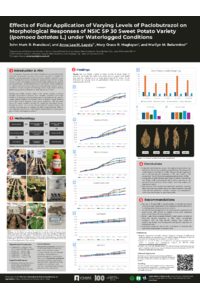
The Philippines, being highly prone to natural hazards, is frequently struck by typhoons. In Region VIII, Eastern Visayas, the major islands of Samar and Leyte lie within the infamous typhoon belt. These areas are repeatedly battered by strong winds, storm surges, and heavy rains, often resulting in floods that damage a significant portion of productive land. Flooding caused by intense rainfall poses a serious threat to the fresh market production of sweet potato in the region. In response, this study aimed to evaluate the morphological responses of Ipomoea batatas L. var. NSIC SP 30 (Sweet Potato) to foliar applications of paclobutrazol (PBZ) under waterlogged conditions. The experiment was conducted at the BL2 Greenhouse of the Philippine Root Crops Research and Training Center (PRRTC), Visayas State University, Baybay City, Leyte, from March 14, 2025, to May 17, 2025. A Randomized Complete Block Design (RCBD) was employed with five treatments: 0 ppm (control), 25 ppm, 50 ppm, 75 ppm, and 100 ppm PBZ, each replicated three times. Plants were subjected to continuous waterlogging, submerged in a basin with water, and observed for four weeks.
Vine diameter, petiole length, and lateral branches exhibited no significant differences. PBZ treatments significantly affected vine length, internode length, number of leaves, and leaf length and width. The control group produced the most vigorous vegetative growth; however, the 75 ppm PBZ treatment maintained comparable shoot and root biomass, with a fresh root weight of 18.71 g, fresh shoot weight of 92.86 g, oven-dried root weight of 1.81 g, and oven-dried shoot weight of 24.89 g, despite its reduced shoot elongation. Higher PBZ levels, especially at 100 ppm, caused excessive growth suppression, leading to reduced biomass and poor root development. Economically, cost and return analysis indicated that PBZ-treated plants achieved higher net income per hectare compared to the untreated control. Foliar application of 75 ppm PBZ was found to be the most effective and economical treatment, promoting stress resilience while maintaining productive growth, making it a viable option for agricultural areas prone to waterlogging.
Keywords
Foliar application
paclobutrazol
waterlogged
NSIC SP 30
Poster
SciForum 135060.pdf
Development of an Empirical Model for Estimating Quinoa Canopy Cover from NDVI under Different Irrigation and Fertilization Stress Conditions
Potential of Spent Mushroom Substrates (SMSs) from Oyster Mushroom (Pleurotus ostreatus) Production as Growth Media For Vegetative Growth of Garden Balsam (Impatiens balsamina)