Event submissions
Published
This submission belongs to the session S8. Crop Production of the event The 3rd International Online Conference on Agriculture
Published date
20 Oct, 2025
Academic Editor
'%3e%3cpath%20d='M12.6657%2010.9104C12.4185%2010.325%2012.0599%209.79327%2011.6097%209.34482C11.1609%208.89508%2010.6293%208.5365%2010.0442%208.28888C10.0389%208.28626%2010.0337%208.28495%2010.0285%208.28233C10.8446%207.69279%2011.3752%206.73249%2011.3752%205.64904C11.3752%203.8542%209.92103%202.39999%208.1262%202.39999C6.33136%202.39999%204.87715%203.8542%204.87715%205.64904C4.87715%206.73249%205.40774%207.69279%206.22393%208.28364C6.21869%208.28626%206.21345%208.28757%206.20821%208.29019C5.62129%208.5378%205.09463%208.89284%204.64265%209.34613C4.1929%209.79493%203.83432%2010.3266%203.58671%2010.9117C3.34345%2011.4845%203.21226%2012.0987%203.20023%2012.7209C3.19988%2012.7349%203.20233%2012.7488%203.20744%2012.7619C3.21255%2012.7749%203.22022%2012.7867%203.22998%2012.7968C3.23975%2012.8068%203.25142%2012.8147%203.26431%2012.8202C3.2772%2012.8256%203.29105%2012.8284%203.30504%2012.8284H4.09109C4.14874%2012.8284%204.19459%2012.7825%204.1959%2012.7262C4.2221%2011.7148%204.62823%2010.7676%205.34617%2010.0497C6.08899%209.30683%207.0755%208.89808%208.1262%208.89808C9.17689%208.89808%2010.1634%209.30683%2010.9062%2010.0497C11.6242%2010.7676%2012.0303%2011.7148%2012.0565%2012.7262C12.0578%2012.7838%2012.1037%2012.8284%2012.1613%2012.8284H12.9474C12.9613%2012.8284%2012.9752%2012.8256%2012.9881%2012.8202C13.001%2012.8147%2013.0126%2012.8068%2013.0224%2012.7968C13.0322%2012.7867%2013.0398%2012.7749%2013.0449%2012.7619C13.0501%2012.7488%2013.0525%2012.7349%2013.0522%2012.7209C13.0391%2012.0947%2012.9094%2011.4855%2012.6657%2010.9104ZM8.1262%207.9024C7.52486%207.9024%206.9589%207.6679%206.53312%207.24211C6.10733%206.81633%205.87283%206.25037%205.87283%205.64904C5.87283%205.0477%206.10733%204.48174%206.53312%204.05596C6.9589%203.63018%207.52486%203.39567%208.1262%203.39567C8.72753%203.39567%209.29349%203.63018%209.71927%204.05596C10.1451%204.48174%2010.3796%205.0477%2010.3796%205.64904C10.3796%206.25037%2010.1451%206.81633%209.71927%207.24211C9.29349%207.6679%208.72753%207.9024%208.1262%207.9024Z'%20fill='%235D1EE1'/%3e%3c/g%3e%3c/svg%3e) Lorenzo Negri
Lorenzo NegriCitation
Abdallah Aldahadha, Physiological and Agronomic Benefits of Seed Priming in Durum Wheat Exposed to Tillering and Anthesis Drought, in Proceedings of The 3rd International Online Conference on Agriculture, 22 October–24 October 2025, MDPI: Basel, Switzerland
Share
Email
Facebook
Twitter
LinkedIn
Physiological and Agronomic Benefits of Seed Priming in Durum Wheat Exposed to Tillering and Anthesis Drought

Abdallah Aldahadha 1
1. National Agricultural Research Centre (NARC); Baqa’a, Al Balqa; Jordan
Abstract
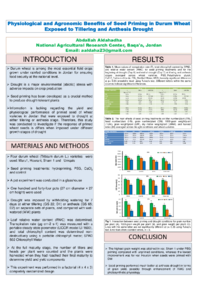
A controlled pot experiment was conducted to evaluate the effects of seed priming on physiological traits, growth, and yield components of four durum wheat (Triticum durum) varieties—Hourani, Umqais, Sham 1, and Maru 1—under drought stress imposed during the tillering and anthesis stages. Four seed treatments were applied prior to sowing: hydropriming with distilled water, osmopriming with polyethylene glycol (PEG), osmopriming with 1.5% calcium chloride (CaCl₂), and an untreated control. Seeds were primed for 12 hours at 24 °C. Drought stress was simulated by withholding irrigation for seven days during each respective stage, and plants exposed to drought stress were compared to well-watered controls. The experimental layout followed a 4 × 4 × 3 factorial design within a completely randomized design (CRD) with three replicates. Under anthesis-stage drought, seed priming significantly improved key physiological parameters, including the transpiration rate (+29%), total chlorophyll content (+1.7%), and relative water content (RWC, +3.5%), relative to the tillering stage. Conversely, drought stress reduced these parameters by 18.6%, 6.5%, and 12.1%, respectively. Osmopriming with PEG led to a 35% higher transpiration rate and 4.9% greater RWC compared to hydropriming during anthesis. In terms of agronomic performance, the PEG and CaCl₂ osmopriming treatments significantly enhanced both growth and yield metrics over hydropriming. Notably, Sham 1 exhibited the highest grain yield increase (82.7%) under PEG priming, while Hourani showed the most severe yield reduction (67.8%) under anthesis-stage drought. In conclusion, seed priming, particularly with PEG or CaCl₂, substantially enhanced durum wheat’s physiological resilience and productivity under drought, with the most pronounced effects observed during anthesis. This suggests that seed priming is a promising strategy for improving drought tolerance in durum wheat cultivated under water-limited conditions.
Keywords
osmopriming
polyethylene glycol
total chlorophyll content
anthesis stage
grain yield
Poster
Seed priming poster Abdallah Aldahadha.pdf
Screening of High Capsaicin Rich and High-Yielding Hot Chilli Genotypes for Future Varietal Improvement
Screening of lactic acid bacteria inhibiting xanthine oxidase and safety evaluation