Event submissions
Published
This submission belongs to the session S9. Farm Animal Production of the event The 3rd International Online Conference on Agriculture
Published date
20 Oct, 2025
Academic Editor
'%3e%3cpath%20d='M12.6657%2010.9104C12.4185%2010.325%2012.0599%209.79327%2011.6097%209.34482C11.1609%208.89508%2010.6293%208.5365%2010.0442%208.28888C10.0389%208.28626%2010.0337%208.28495%2010.0285%208.28233C10.8446%207.69279%2011.3752%206.73249%2011.3752%205.64904C11.3752%203.8542%209.92103%202.39999%208.1262%202.39999C6.33136%202.39999%204.87715%203.8542%204.87715%205.64904C4.87715%206.73249%205.40774%207.69279%206.22393%208.28364C6.21869%208.28626%206.21345%208.28757%206.20821%208.29019C5.62129%208.5378%205.09463%208.89284%204.64265%209.34613C4.1929%209.79493%203.83432%2010.3266%203.58671%2010.9117C3.34345%2011.4845%203.21226%2012.0987%203.20023%2012.7209C3.19988%2012.7349%203.20233%2012.7488%203.20744%2012.7619C3.21255%2012.7749%203.22022%2012.7867%203.22998%2012.7968C3.23975%2012.8068%203.25142%2012.8147%203.26431%2012.8202C3.2772%2012.8256%203.29105%2012.8284%203.30504%2012.8284H4.09109C4.14874%2012.8284%204.19459%2012.7825%204.1959%2012.7262C4.2221%2011.7148%204.62823%2010.7676%205.34617%2010.0497C6.08899%209.30683%207.0755%208.89808%208.1262%208.89808C9.17689%208.89808%2010.1634%209.30683%2010.9062%2010.0497C11.6242%2010.7676%2012.0303%2011.7148%2012.0565%2012.7262C12.0578%2012.7838%2012.1037%2012.8284%2012.1613%2012.8284H12.9474C12.9613%2012.8284%2012.9752%2012.8256%2012.9881%2012.8202C13.001%2012.8147%2013.0126%2012.8068%2013.0224%2012.7968C13.0322%2012.7867%2013.0398%2012.7749%2013.0449%2012.7619C13.0501%2012.7488%2013.0525%2012.7349%2013.0522%2012.7209C13.0391%2012.0947%2012.9094%2011.4855%2012.6657%2010.9104ZM8.1262%207.9024C7.52486%207.9024%206.9589%207.6679%206.53312%207.24211C6.10733%206.81633%205.87283%206.25037%205.87283%205.64904C5.87283%205.0477%206.10733%204.48174%206.53312%204.05596C6.9589%203.63018%207.52486%203.39567%208.1262%203.39567C8.72753%203.39567%209.29349%203.63018%209.71927%204.05596C10.1451%204.48174%2010.3796%205.0477%2010.3796%205.64904C10.3796%206.25037%2010.1451%206.81633%209.71927%207.24211C9.29349%207.6679%208.72753%207.9024%208.1262%207.9024Z'%20fill='%235D1EE1'/%3e%3c/g%3e%3c/svg%3e) Jalil Ghassemi Nejad
Jalil Ghassemi NejadCitation
Qiujin Liu, Changsheng Bai, Junyi Yin, Qiufeng Tian, Huan Wang, Zhanmei Xue, Yan Zhang, Hao Tan, Zhongbo Wang, Screening of lactic acid bacteria inhibiting xanthine oxidase and safety evaluation, in Proceedings of The 3rd International Online Conference on Agriculture, 22 October–24 October 2025, MDPI: Basel, Switzerland
Share
Email
Facebook
Twitter
LinkedIn
Screening of lactic acid bacteria inhibiting xanthine oxidase and safety evaluation
'%3e%3cpath%20d='M12.6647%2010.9104C12.4176%2010.325%2012.0589%209.7933%2011.6088%209.34485C11.16%208.89511%2010.6283%208.53653%2010.0432%208.28891C10.038%208.28629%2010.0327%208.28498%2010.0275%208.28236C10.8437%207.69282%2011.3743%206.73252%2011.3743%205.64907C11.3743%203.85423%209.92005%202.40002%208.12522%202.40002C6.33038%202.40002%204.87618%203.85423%204.87618%205.64907C4.87618%206.73252%205.40677%207.69282%206.22296%208.28367C6.21772%208.28629%206.21248%208.2876%206.20724%208.29022C5.62031%208.53783%205.09365%208.89287%204.64167%209.34616C4.19192%209.79496%203.83334%2010.3266%203.58573%2010.9117C3.34247%2011.4846%203.21128%2012.0987%203.19925%2012.721C3.1989%2012.735%203.20135%2012.7489%203.20646%2012.7619C3.21157%2012.7749%203.21924%2012.7868%203.22901%2012.7968C3.23877%2012.8068%203.25045%2012.8148%203.26334%2012.8202C3.27623%2012.8256%203.29007%2012.8284%203.30406%2012.8284H4.09012C4.14776%2012.8284%204.19362%2012.7825%204.19493%2012.7262C4.22113%2011.7148%204.62726%2010.7676%205.34519%2010.0497C6.08802%209.30686%207.07452%208.89811%208.12522%208.89811C9.17592%208.89811%2010.1624%209.30686%2010.9052%2010.0497C11.6232%2010.7676%2012.0293%2011.7148%2012.0555%2012.7262C12.0568%2012.7839%2012.1027%2012.8284%2012.1603%2012.8284H12.9464C12.9604%2012.8284%2012.9742%2012.8256%2012.9871%2012.8202C13%2012.8148%2013.0117%2012.8068%2013.0214%2012.7968C13.0312%2012.7868%2013.0389%2012.7749%2013.044%2012.7619C13.0491%2012.7489%2013.0515%2012.735%2013.0512%2012.721C13.0381%2012.0947%2012.9084%2011.4856%2012.6647%2010.9104ZM8.12522%207.90243C7.52388%207.90243%206.95792%207.66793%206.53214%207.24215C6.10636%206.81636%205.87185%206.2504%205.87185%205.64907C5.87185%205.04773%206.10636%204.48177%206.53214%204.05599C6.95792%203.63021%207.52388%203.3957%208.12522%203.3957C8.72655%203.3957%209.29252%203.63021%209.7183%204.05599C10.1441%204.48177%2010.3786%205.04773%2010.3786%205.64907C10.3786%206.2504%2010.1441%206.81636%209.7183%207.24215C9.29252%207.66793%208.72655%207.90243%208.12522%207.90243Z'%20fill='%235D1EE1'/%3e%3c/g%3e%3c/svg%3e)
Qiujin Liu 1
Changsheng Bai 1
Junyi Yin 1
Qiufeng Tian 1
Huan Wang 1
Zhanmei Xue 1
Yan Zhang 1
Hao Tan 2
Zhongbo Wang 2
1. Branch of Animal Husbandry and Veterinary of Heilongjiang Academy of Agricultural Sciences, Qiqihar 161005, China
2. Yi'an County Animal Husbandry and Veterinary General Station of Heilongjiang Province,Qiqihar 161500, China
Abstract
This study aimed to screen lactic acid bacteria (LAB) strains with potent xanthine oxidase (XOD)-inhibitory activity for potential application in reducing uric acid levels in poultry. A two-tiered approach was employed. First, we performed in vitro screening: The XOD inhibition rates of cell-free extracts (CFEs) from 26 LAB strains were determined. Four high-performing strains (A2, A6, SC, SN) were subsequently evaluated for the inhibition rates of their cell-free supernatants (CFSs). Further in vitro characterization included assessing their tolerance to artificial gastrointestinal fluids and antibiotic susceptibility profiling against 21 antimicrobials. The strains were identified via 16S rDNA sequencing. Subsequently, an in vivo safety study was conducted: mice received daily intraperitoneal injections of bacterial suspensions (1010 CFU/mL) for two weeks, with the incidence of mortality and organ lesions monitored. In vitro, the CFEs of strains A2, A6, SC, and SN exhibited XOD inhibition rates of 23.41%, 27.45%, 24.47%, and 27.23%, respectively, while their CFSs showed rates of 14.26%, 17.02%, 22.34%, and 19.57%. All four strains demonstrated high gastrointestinal tolerance, maintaining viable counts of above 108 CFU/mL post-digestion. They were sensitive to key antibiotics like cephalosporins, macrolides, and penicillins. Molecular identification classified them as Lactobacillus paracasei (A2), Lactobacillus plantarum (A6), Lactobacillus brevis (SC), and Lactobacillus rhamnosus (SN). Critically, the in vivo safety assay revealed no mortality or organ lesions in mice treated with any of the four strains. Four LAB strains with potent in vitro XOD-inhibitory activity and proven in vivo safety were obtained, offering promising candidates for probiotic control of avian hyperuricemia.
Keywords
hyperuricemia
lactic acid bacteria
xanthine oxidase
probiotic properties
safety
Poster
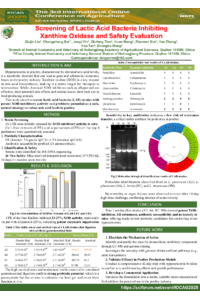
Screening of Lactic Acid Bacteria Inhibiting Xanthine Oxidase and Safety Evaluation.pdf
Physiological and Agronomic Benefits of Seed Priming in Durum Wheat Exposed to Tillering and Anthesis Drought
Related Effects of Climate Change on Root System Dynamics and Symbiotic Activity in Local Bean Varieties (Phaseolus vulgaris L.) in the Humid Tropics of Costa Rica