Event submissions
Published
This submission belongs to the session S8. Crop Production of the event The 3rd International Online Conference on Agriculture
Published date
20 Oct, 2025
Academic Editor
'%3e%3cpath%20d='M12.6657%2010.9104C12.4185%2010.325%2012.0599%209.79327%2011.6097%209.34482C11.1609%208.89508%2010.6293%208.5365%2010.0442%208.28888C10.0389%208.28626%2010.0337%208.28495%2010.0285%208.28233C10.8446%207.69279%2011.3752%206.73249%2011.3752%205.64904C11.3752%203.8542%209.92103%202.39999%208.1262%202.39999C6.33136%202.39999%204.87715%203.8542%204.87715%205.64904C4.87715%206.73249%205.40774%207.69279%206.22393%208.28364C6.21869%208.28626%206.21345%208.28757%206.20821%208.29019C5.62129%208.5378%205.09463%208.89284%204.64265%209.34613C4.1929%209.79493%203.83432%2010.3266%203.58671%2010.9117C3.34345%2011.4845%203.21226%2012.0987%203.20023%2012.7209C3.19988%2012.7349%203.20233%2012.7488%203.20744%2012.7619C3.21255%2012.7749%203.22022%2012.7867%203.22998%2012.7968C3.23975%2012.8068%203.25142%2012.8147%203.26431%2012.8202C3.2772%2012.8256%203.29105%2012.8284%203.30504%2012.8284H4.09109C4.14874%2012.8284%204.19459%2012.7825%204.1959%2012.7262C4.2221%2011.7148%204.62823%2010.7676%205.34617%2010.0497C6.08899%209.30683%207.0755%208.89808%208.1262%208.89808C9.17689%208.89808%2010.1634%209.30683%2010.9062%2010.0497C11.6242%2010.7676%2012.0303%2011.7148%2012.0565%2012.7262C12.0578%2012.7838%2012.1037%2012.8284%2012.1613%2012.8284H12.9474C12.9613%2012.8284%2012.9752%2012.8256%2012.9881%2012.8202C13.001%2012.8147%2013.0126%2012.8068%2013.0224%2012.7968C13.0322%2012.7867%2013.0398%2012.7749%2013.0449%2012.7619C13.0501%2012.7488%2013.0525%2012.7349%2013.0522%2012.7209C13.0391%2012.0947%2012.9094%2011.4855%2012.6657%2010.9104ZM8.1262%207.9024C7.52486%207.9024%206.9589%207.6679%206.53312%207.24211C6.10733%206.81633%205.87283%206.25037%205.87283%205.64904C5.87283%205.0477%206.10733%204.48174%206.53312%204.05596C6.9589%203.63018%207.52486%203.39567%208.1262%203.39567C8.72753%203.39567%209.29349%203.63018%209.71927%204.05596C10.1451%204.48174%2010.3796%205.0477%2010.3796%205.64904C10.3796%206.25037%2010.1451%206.81633%209.71927%207.24211C9.29349%207.6679%208.72753%207.9024%208.1262%207.9024Z'%20fill='%235D1EE1'/%3e%3c/g%3e%3c/svg%3e) MARGA ROS
MARGA ROSCitation
Massakib Bekkaye, Nassima Baha, Sabrina Behairi, Karima Karaali, Roumaissa Moulkaf, Samia Issad, Rosa Maria Pérez-Clemente, Yahia Kaci, Promoting Sustainable Agriculture: PGPR-Driven Enhancement of Plant Growth and Salinity Stress Tolerance, in Proceedings of The 3rd International Online Conference on Agriculture, 22 October–24 October 2025, MDPI: Basel, Switzerland
Share
Email
Facebook
Twitter
LinkedIn
Promoting Sustainable Agriculture: PGPR-Driven Enhancement of Plant Growth and Salinity Stress Tolerance
'%3e%3cpath%20d='M12.6647%2010.9104C12.4176%2010.325%2012.0589%209.7933%2011.6088%209.34485C11.16%208.89511%2010.6283%208.53653%2010.0432%208.28891C10.038%208.28629%2010.0327%208.28498%2010.0275%208.28236C10.8437%207.69282%2011.3743%206.73252%2011.3743%205.64907C11.3743%203.85423%209.92005%202.40002%208.12522%202.40002C6.33038%202.40002%204.87618%203.85423%204.87618%205.64907C4.87618%206.73252%205.40677%207.69282%206.22296%208.28367C6.21772%208.28629%206.21248%208.2876%206.20724%208.29022C5.62031%208.53783%205.09365%208.89287%204.64167%209.34616C4.19192%209.79496%203.83334%2010.3266%203.58573%2010.9117C3.34247%2011.4846%203.21128%2012.0987%203.19925%2012.721C3.1989%2012.735%203.20135%2012.7489%203.20646%2012.7619C3.21157%2012.7749%203.21924%2012.7868%203.22901%2012.7968C3.23877%2012.8068%203.25045%2012.8148%203.26334%2012.8202C3.27623%2012.8256%203.29007%2012.8284%203.30406%2012.8284H4.09012C4.14776%2012.8284%204.19362%2012.7825%204.19493%2012.7262C4.22113%2011.7148%204.62726%2010.7676%205.34519%2010.0497C6.08802%209.30686%207.07452%208.89811%208.12522%208.89811C9.17592%208.89811%2010.1624%209.30686%2010.9052%2010.0497C11.6232%2010.7676%2012.0293%2011.7148%2012.0555%2012.7262C12.0568%2012.7839%2012.1027%2012.8284%2012.1603%2012.8284H12.9464C12.9604%2012.8284%2012.9742%2012.8256%2012.9871%2012.8202C13%2012.8148%2013.0117%2012.8068%2013.0214%2012.7968C13.0312%2012.7868%2013.0389%2012.7749%2013.044%2012.7619C13.0491%2012.7489%2013.0515%2012.735%2013.0512%2012.721C13.0381%2012.0947%2012.9084%2011.4856%2012.6647%2010.9104ZM8.12522%207.90243C7.52388%207.90243%206.95792%207.66793%206.53214%207.24215C6.10636%206.81636%205.87185%206.2504%205.87185%205.64907C5.87185%205.04773%206.10636%204.48177%206.53214%204.05599C6.95792%203.63021%207.52388%203.3957%208.12522%203.3957C8.72655%203.3957%209.29252%203.63021%209.7183%204.05599C10.1441%204.48177%2010.3786%205.04773%2010.3786%205.64907C10.3786%206.2504%2010.1441%206.81636%209.7183%207.24215C9.29252%207.66793%208.72655%207.90243%208.12522%207.90243Z'%20fill='%235D1EE1'/%3e%3c/g%3e%3c/svg%3e)
Massakib Bekkaye 1
Nassima Baha 1
Sabrina Behairi 1
Karima Karaali 1
Roumaissa Moulkaf 1
Samia Issad 1
Rosa Maria Pérez-Clemente 2
Yahia Kaci 1
1. University of Science and Technology Houari Boumediene (USTHB), Bab Ezzouar, Algiers 16111, Algeria
2. Department of Biology, Biochemistry and Natural Sciences, Universitat Jaume I, Castelló de la Plana, Spain
Abstract
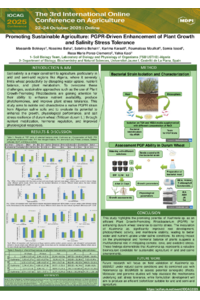
Salinity poses a major challenge to agriculture, especially in arid environments such as those found in Algeria, by significantly reducing crop yield. This study investigates the use of native Plant Growth-Promoting Rhizobacteria to improve the growth and stress tolerance of durum wheat (Triticum durum L.) under saline conditions. A bacterial isolate, designated BSSM27, was recovered from saline soils and assessed for key biofertilizer traits, including indole-3-acetic acid (IAA) production, siderophore secretion, ammonium generation, and phosphate solubilization. Its biocontrol potential was also evaluated through antagonism against Fusarium spp.
Wheat seeds were inoculated with this strain and grown in pots filled with sandy soil from the Oued Souf region in Southern Algeria. Plants were irrigated with bacterial suspensions under different salinity levels (0, 0.1 M, and 0.2 M NaCl). Inoculated plants showed enhanced germination, increased shoot and root biomass, and a higher number of lateral roots compared to non-inoculated controls. Physiological assessments revealed improved chlorophyll content, relative water content, and membrane stability. Moreover, lower levels of proline and malondialdehyde (MDA) indicated reduced oxidative stress. Hormonal profiling demonstrated a favorable balance, with reduced abscisic acid (ABA) and elevated IAA levels, supporting improved growth under stress.
These results highlight the multifunctional role of native PGPR in promoting plant growth and mitigating salinity stress through nutrient mobilization, hormonal regulation, and physiological enhancement. The use of such bio-inoculants represents a sustainable and environmentally friendly strategy for improving crop performance in saline soils.
Keywords
Plant Growth-Promoting Rhizobacteria
Wheat
Salinity Stress
Biofertilization
Biocontrol
Phytohormones
Poster
sciforum-139168-Bekkaye Massakib MDPI 2025.pdf
Light spectrum-mediated improved drought-resilient rootstock performance under drought stress in Okra genotypes
Efficient In Vitro Propagation Approach for Mass Multiplication of Curcuma longa L (Turmeric)