Event submissions
Published
This submission belongs to the session S8. Crop Production of the event The 3rd International Online Conference on Agriculture
Published date
20 Oct, 2025
Academic Editor
'%3e%3cpath%20d='M12.6657%2010.9104C12.4185%2010.325%2012.0599%209.79327%2011.6097%209.34482C11.1609%208.89508%2010.6293%208.5365%2010.0442%208.28888C10.0389%208.28626%2010.0337%208.28495%2010.0285%208.28233C10.8446%207.69279%2011.3752%206.73249%2011.3752%205.64904C11.3752%203.8542%209.92103%202.39999%208.1262%202.39999C6.33136%202.39999%204.87715%203.8542%204.87715%205.64904C4.87715%206.73249%205.40774%207.69279%206.22393%208.28364C6.21869%208.28626%206.21345%208.28757%206.20821%208.29019C5.62129%208.5378%205.09463%208.89284%204.64265%209.34613C4.1929%209.79493%203.83432%2010.3266%203.58671%2010.9117C3.34345%2011.4845%203.21226%2012.0987%203.20023%2012.7209C3.19988%2012.7349%203.20233%2012.7488%203.20744%2012.7619C3.21255%2012.7749%203.22022%2012.7867%203.22998%2012.7968C3.23975%2012.8068%203.25142%2012.8147%203.26431%2012.8202C3.2772%2012.8256%203.29105%2012.8284%203.30504%2012.8284H4.09109C4.14874%2012.8284%204.19459%2012.7825%204.1959%2012.7262C4.2221%2011.7148%204.62823%2010.7676%205.34617%2010.0497C6.08899%209.30683%207.0755%208.89808%208.1262%208.89808C9.17689%208.89808%2010.1634%209.30683%2010.9062%2010.0497C11.6242%2010.7676%2012.0303%2011.7148%2012.0565%2012.7262C12.0578%2012.7838%2012.1037%2012.8284%2012.1613%2012.8284H12.9474C12.9613%2012.8284%2012.9752%2012.8256%2012.9881%2012.8202C13.001%2012.8147%2013.0126%2012.8068%2013.0224%2012.7968C13.0322%2012.7867%2013.0398%2012.7749%2013.0449%2012.7619C13.0501%2012.7488%2013.0525%2012.7349%2013.0522%2012.7209C13.0391%2012.0947%2012.9094%2011.4855%2012.6657%2010.9104ZM8.1262%207.9024C7.52486%207.9024%206.9589%207.6679%206.53312%207.24211C6.10733%206.81633%205.87283%206.25037%205.87283%205.64904C5.87283%205.0477%206.10733%204.48174%206.53312%204.05596C6.9589%203.63018%207.52486%203.39567%208.1262%203.39567C8.72753%203.39567%209.29349%203.63018%209.71927%204.05596C10.1451%204.48174%2010.3796%205.0477%2010.3796%205.64904C10.3796%206.25037%2010.1451%206.81633%209.71927%207.24211C9.29349%207.6679%208.72753%207.9024%208.1262%207.9024Z'%20fill='%235D1EE1'/%3e%3c/g%3e%3c/svg%3e) Bin Gao
Bin GaoCitation
Achinthi Premasiri, Kumari Fonseka, Efficient In Vitro Propagation Approach for Mass Multiplication of Curcuma longa L (Turmeric), in Proceedings of The 3rd International Online Conference on Agriculture, 22 October–24 October 2025, MDPI: Basel, Switzerland
Share
Email
Facebook
Twitter
LinkedIn
Efficient In Vitro Propagation Approach for Mass Multiplication of Curcuma longa L (Turmeric)
'%3e%3cpath%20d='M12.6647%2010.9104C12.4176%2010.325%2012.0589%209.7933%2011.6088%209.34485C11.16%208.89511%2010.6283%208.53653%2010.0432%208.28891C10.038%208.28629%2010.0327%208.28498%2010.0275%208.28236C10.8437%207.69282%2011.3743%206.73252%2011.3743%205.64907C11.3743%203.85423%209.92005%202.40002%208.12522%202.40002C6.33038%202.40002%204.87618%203.85423%204.87618%205.64907C4.87618%206.73252%205.40677%207.69282%206.22296%208.28367C6.21772%208.28629%206.21248%208.2876%206.20724%208.29022C5.62031%208.53783%205.09365%208.89287%204.64167%209.34616C4.19192%209.79496%203.83334%2010.3266%203.58573%2010.9117C3.34247%2011.4846%203.21128%2012.0987%203.19925%2012.721C3.1989%2012.735%203.20135%2012.7489%203.20646%2012.7619C3.21157%2012.7749%203.21924%2012.7868%203.22901%2012.7968C3.23877%2012.8068%203.25045%2012.8148%203.26334%2012.8202C3.27623%2012.8256%203.29007%2012.8284%203.30406%2012.8284H4.09012C4.14776%2012.8284%204.19362%2012.7825%204.19493%2012.7262C4.22113%2011.7148%204.62726%2010.7676%205.34519%2010.0497C6.08802%209.30686%207.07452%208.89811%208.12522%208.89811C9.17592%208.89811%2010.1624%209.30686%2010.9052%2010.0497C11.6232%2010.7676%2012.0293%2011.7148%2012.0555%2012.7262C12.0568%2012.7839%2012.1027%2012.8284%2012.1603%2012.8284H12.9464C12.9604%2012.8284%2012.9742%2012.8256%2012.9871%2012.8202C13%2012.8148%2013.0117%2012.8068%2013.0214%2012.7968C13.0312%2012.7868%2013.0389%2012.7749%2013.044%2012.7619C13.0491%2012.7489%2013.0515%2012.735%2013.0512%2012.721C13.0381%2012.0947%2012.9084%2011.4856%2012.6647%2010.9104ZM8.12522%207.90243C7.52388%207.90243%206.95792%207.66793%206.53214%207.24215C6.10636%206.81636%205.87185%206.2504%205.87185%205.64907C5.87185%205.04773%206.10636%204.48177%206.53214%204.05599C6.95792%203.63021%207.52388%203.3957%208.12522%203.3957C8.72655%203.3957%209.29252%203.63021%209.7183%204.05599C10.1441%204.48177%2010.3786%205.04773%2010.3786%205.64907C10.3786%206.2504%2010.1441%206.81636%209.7183%207.24215C9.29252%207.66793%208.72655%207.90243%208.12522%207.90243Z'%20fill='%235D1EE1'/%3e%3c/g%3e%3c/svg%3e)
Achinthi Premasiri 1
Kumari Fonseka 1
1. Department of Crop Science, Faculty of Agriculture, University of Ruhuna, Matara 81000, Sri Lanka
Abstract
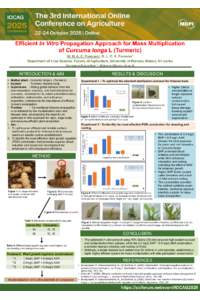
Curcuma longa (Turmeric) is a remarkable plant widely used in Ayurvedic medicine, pharmacology, culinary practices, and cosmetic production. Its primary bioactive compound, curcumin, a potent polyphenol, possesses anti-inflammatory, antioxidant, antimicrobial, anticancer, and neuroprotective properties. It acts as a remedy for various chronic diseases, including cancer, diabetes, and cardiovascular disorders. Turmeric is valued as a natural colorant and preservative in agriculture and the food industry. This study aims to investigate the in vitro propagation of turmeric, offering a scalable solution for high-quality plant production. Rhizome buds were surface-sterilized using 10% and 15% Clorox solutions with exposure times of 10 and 15 minutes. Initially, the buds were placed in sealed culture containers filled with sterilized coir dust. Each rhizome produced more than eight buds simultaneously, allowing for reuse. Out of 120 replicates, the most effective sterilization protocol was 10% Clorox for 10 minutes, yielding 81% contamination-free cultures. The results were statistically significant under a two-factor Completely Randomized Design (P < 0.05). Healthy buds were subcultured on Murashige and Skoog (MS) medium supplemented with BAP (1.5, 2.0, and 2.5 mg/L) and NAA (0.5 mg/L) to induce shooting and rooting. The optimal response was observed with 2.0 mg/L BAP with 0.5 mg/L NAA, resulting in an average of 9 shoots (6.5 cm in length) and 11 roots (7 cm in length) per explant within 8 weeks. The results were statistically significant under a completely randomized design (p < 0.05). Statistical analysis was performed using the SAS software, employing ANOVA, with mean separation conducted through Duncan’s Multiple Range Test (DMRT). The optimized protocol developed through this study offers a reliable, efficient, and reproducible method for the rapid multiplication and conservation of elite turmeric varieties, producing over 50 in vitro derived plantlets from each rhizome bud. This represents a significant advancement for commercial-scale propagation and germplasm preservation.
Keywords
Curcuma longa
In vitro
Sterilization
Turmeric
Multiplication
Poster
Final version; sciforum 139166_Efficient In Vitro Propagation Approach for Mass Multiplication of Curcuma longa L (Turmeric).pdf
Promoting Sustainable Agriculture: PGPR-Driven Enhancement of Plant Growth and Salinity Stress Tolerance
Eco-Design of Pressmud-Based Organic Blends for Revitalizing Nutrient-Depleted Agricultural Soils