Event submissions
Published
This submission belongs to the session S8. Crop Production of the event The 3rd International Online Conference on Agriculture
Published date
20 Oct, 2025
Academic Editor
'%3e%3cpath%20d='M12.6657%2010.9104C12.4185%2010.325%2012.0599%209.79327%2011.6097%209.34482C11.1609%208.89508%2010.6293%208.5365%2010.0442%208.28888C10.0389%208.28626%2010.0337%208.28495%2010.0285%208.28233C10.8446%207.69279%2011.3752%206.73249%2011.3752%205.64904C11.3752%203.8542%209.92103%202.39999%208.1262%202.39999C6.33136%202.39999%204.87715%203.8542%204.87715%205.64904C4.87715%206.73249%205.40774%207.69279%206.22393%208.28364C6.21869%208.28626%206.21345%208.28757%206.20821%208.29019C5.62129%208.5378%205.09463%208.89284%204.64265%209.34613C4.1929%209.79493%203.83432%2010.3266%203.58671%2010.9117C3.34345%2011.4845%203.21226%2012.0987%203.20023%2012.7209C3.19988%2012.7349%203.20233%2012.7488%203.20744%2012.7619C3.21255%2012.7749%203.22022%2012.7867%203.22998%2012.7968C3.23975%2012.8068%203.25142%2012.8147%203.26431%2012.8202C3.2772%2012.8256%203.29105%2012.8284%203.30504%2012.8284H4.09109C4.14874%2012.8284%204.19459%2012.7825%204.1959%2012.7262C4.2221%2011.7148%204.62823%2010.7676%205.34617%2010.0497C6.08899%209.30683%207.0755%208.89808%208.1262%208.89808C9.17689%208.89808%2010.1634%209.30683%2010.9062%2010.0497C11.6242%2010.7676%2012.0303%2011.7148%2012.0565%2012.7262C12.0578%2012.7838%2012.1037%2012.8284%2012.1613%2012.8284H12.9474C12.9613%2012.8284%2012.9752%2012.8256%2012.9881%2012.8202C13.001%2012.8147%2013.0126%2012.8068%2013.0224%2012.7968C13.0322%2012.7867%2013.0398%2012.7749%2013.0449%2012.7619C13.0501%2012.7488%2013.0525%2012.7349%2013.0522%2012.7209C13.0391%2012.0947%2012.9094%2011.4855%2012.6657%2010.9104ZM8.1262%207.9024C7.52486%207.9024%206.9589%207.6679%206.53312%207.24211C6.10733%206.81633%205.87283%206.25037%205.87283%205.64904C5.87283%205.0477%206.10733%204.48174%206.53312%204.05596C6.9589%203.63018%207.52486%203.39567%208.1262%203.39567C8.72753%203.39567%209.29349%203.63018%209.71927%204.05596C10.1451%204.48174%2010.3796%205.0477%2010.3796%205.64904C10.3796%206.25037%2010.1451%206.81633%209.71927%207.24211C9.29349%207.6679%208.72753%207.9024%208.1262%207.9024Z'%20fill='%235D1EE1'/%3e%3c/g%3e%3c/svg%3e) Bin Gao
Bin GaoCitation
Nosipho Minenhle Phungula, Sandile Thamsanqa Hadebe, Lucky Sithole, Nomali Ziphorah Ngobese, Yield Stability of Selected Potato Cultivars under Mulch and Fungicide Application for Different Environments, in Proceedings of The 3rd International Online Conference on Agriculture, 22 October–24 October 2025, MDPI: Basel, Switzerland
Share
Email
Facebook
Twitter
LinkedIn
Yield Stability of Selected Potato Cultivars under Mulch and Fungicide Application for Different Environments
'%3e%3cpath%20d='M12.6647%2010.9104C12.4176%2010.325%2012.0589%209.7933%2011.6088%209.34485C11.16%208.89511%2010.6283%208.53653%2010.0432%208.28891C10.038%208.28629%2010.0327%208.28498%2010.0275%208.28236C10.8437%207.69282%2011.3743%206.73252%2011.3743%205.64907C11.3743%203.85423%209.92005%202.40002%208.12522%202.40002C6.33038%202.40002%204.87618%203.85423%204.87618%205.64907C4.87618%206.73252%205.40677%207.69282%206.22296%208.28367C6.21772%208.28629%206.21248%208.2876%206.20724%208.29022C5.62031%208.53783%205.09365%208.89287%204.64167%209.34616C4.19192%209.79496%203.83334%2010.3266%203.58573%2010.9117C3.34247%2011.4846%203.21128%2012.0987%203.19925%2012.721C3.1989%2012.735%203.20135%2012.7489%203.20646%2012.7619C3.21157%2012.7749%203.21924%2012.7868%203.22901%2012.7968C3.23877%2012.8068%203.25045%2012.8148%203.26334%2012.8202C3.27623%2012.8256%203.29007%2012.8284%203.30406%2012.8284H4.09012C4.14776%2012.8284%204.19362%2012.7825%204.19493%2012.7262C4.22113%2011.7148%204.62726%2010.7676%205.34519%2010.0497C6.08802%209.30686%207.07452%208.89811%208.12522%208.89811C9.17592%208.89811%2010.1624%209.30686%2010.9052%2010.0497C11.6232%2010.7676%2012.0293%2011.7148%2012.0555%2012.7262C12.0568%2012.7839%2012.1027%2012.8284%2012.1603%2012.8284H12.9464C12.9604%2012.8284%2012.9742%2012.8256%2012.9871%2012.8202C13%2012.8148%2013.0117%2012.8068%2013.0214%2012.7968C13.0312%2012.7868%2013.0389%2012.7749%2013.044%2012.7619C13.0491%2012.7489%2013.0515%2012.735%2013.0512%2012.721C13.0381%2012.0947%2012.9084%2011.4856%2012.6647%2010.9104ZM8.12522%207.90243C7.52388%207.90243%206.95792%207.66793%206.53214%207.24215C6.10636%206.81636%205.87185%206.2504%205.87185%205.64907C5.87185%205.04773%206.10636%204.48177%206.53214%204.05599C6.95792%203.63021%207.52388%203.3957%208.12522%203.3957C8.72655%203.3957%209.29252%203.63021%209.7183%204.05599C10.1441%204.48177%2010.3786%205.04773%2010.3786%205.64907C10.3786%206.2504%2010.1441%206.81636%209.7183%207.24215C9.29252%207.66793%208.72655%207.90243%208.12522%207.90243Z'%20fill='%235D1EE1'/%3e%3c/g%3e%3c/svg%3e)
Nosipho Minenhle Phungula 1,2
Sandile Thamsanqa Hadebe 3
Lucky Sithole 4
Nomali Ziphorah Ngobese 2
1. Department of Science, Botany and Plant Biotechnology, University of Johannesburg, P.O. Box 524, Auckland Park 2006, South Africa
2. Unit for Environmental Sciences and Management, Faculty of Natural and Agricultural Sciences, North-West University, Private Bag X6001, Potchefstroom, South Africa
3. Department of Plant Production, Soil Science and Agricultural Engineering, University of Limpopo, Private Bag X1106, Sovenga 0727, South Africa
4. Department of Agriculture and Rural Development Pietermaritzburg, 3245, South Africa
Abstract
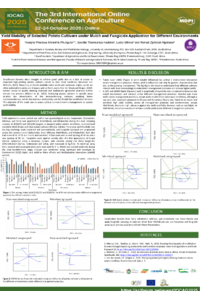
Smallholder farmers often experience low yields that fluctuate yearly due to the variability of climate, resources, and diseases. The objective of the study was to assess cultivar x environment x management on potato yield stability. The experiments were conducted in five different environments (Mbalenhle, Hlathikhulu, Mbhava, Stezi, and Gobizembe) in KwaZulu-Natal (South Africa) for two consecutive seasons (2022/23 and 2023/24) at smallholder farming settings under rainfed open field conditions. Four selected potato cultivars (Mondial, Electra, Sababa, and Panamera) were planted in different management practices, which were two levels of mulch (non-mulch and mulch), and fungicides (sprayed and unsprayed) in a randomized complete block design. Analysis was conducted using Genotype and Genotype by Environment (GGE) biplot and Additive Main effects and Multiplicative Interaction (AMMI) models. The analysis of variance from AMMI revealed that the cultivar and environment interactions showed significant differences (P<0.05) under different management practices. A GGE and AMMI biplot graphically showed the inter-relationship between the tested environment and cultivars under different management practices. Mondial was more stable across management practices, except under mulched and unsprayed conditions, although a low yield was observed compared to Electra and Panamera. Electra was found to be stable and had high yield stability across all management practices and environments except Hlathikhulu due to its high tolerance against dry spells and foliar diseases such as late blight. At Hlathikhulu, Panamera was found to have a stable yield across different management practices. Smallholder farmers from Stezi, Mbalenhle, Mbhava, and Gobizembe can select Electra and apply the spraying of fungicides; in contrast, those from Hlathikhulu can use Panamera and fungicide spraying to obtain a potato yield with fewer fluctuations.
Keywords
Adaptability
GGE biplot
management practices
smallholder farmers
Poster
Session _8_NP Phungula.pdf
Evaluating the Role of Plant Growth-Promoting Rhizobacteria on the Nutritional Quality of Trifolium alexandrium
Enhancing Nitrogen Efficiency and Reducing Carbon Footprint in Malting Barley through Ascophyllum nodosum Biostimulants and Optimized Fertilization Strategies