Event submissions
Published
This submission belongs to the session S5. Agricultural Water Management of the event The 3rd International Online Conference on Agriculture
Published date
20 Oct, 2025
Academic Editor
'%3e%3cpath%20d='M12.6657%2010.9104C12.4185%2010.325%2012.0599%209.79327%2011.6097%209.34482C11.1609%208.89508%2010.6293%208.5365%2010.0442%208.28888C10.0389%208.28626%2010.0337%208.28495%2010.0285%208.28233C10.8446%207.69279%2011.3752%206.73249%2011.3752%205.64904C11.3752%203.8542%209.92103%202.39999%208.1262%202.39999C6.33136%202.39999%204.87715%203.8542%204.87715%205.64904C4.87715%206.73249%205.40774%207.69279%206.22393%208.28364C6.21869%208.28626%206.21345%208.28757%206.20821%208.29019C5.62129%208.5378%205.09463%208.89284%204.64265%209.34613C4.1929%209.79493%203.83432%2010.3266%203.58671%2010.9117C3.34345%2011.4845%203.21226%2012.0987%203.20023%2012.7209C3.19988%2012.7349%203.20233%2012.7488%203.20744%2012.7619C3.21255%2012.7749%203.22022%2012.7867%203.22998%2012.7968C3.23975%2012.8068%203.25142%2012.8147%203.26431%2012.8202C3.2772%2012.8256%203.29105%2012.8284%203.30504%2012.8284H4.09109C4.14874%2012.8284%204.19459%2012.7825%204.1959%2012.7262C4.2221%2011.7148%204.62823%2010.7676%205.34617%2010.0497C6.08899%209.30683%207.0755%208.89808%208.1262%208.89808C9.17689%208.89808%2010.1634%209.30683%2010.9062%2010.0497C11.6242%2010.7676%2012.0303%2011.7148%2012.0565%2012.7262C12.0578%2012.7838%2012.1037%2012.8284%2012.1613%2012.8284H12.9474C12.9613%2012.8284%2012.9752%2012.8256%2012.9881%2012.8202C13.001%2012.8147%2013.0126%2012.8068%2013.0224%2012.7968C13.0322%2012.7867%2013.0398%2012.7749%2013.0449%2012.7619C13.0501%2012.7488%2013.0525%2012.7349%2013.0522%2012.7209C13.0391%2012.0947%2012.9094%2011.4855%2012.6657%2010.9104ZM8.1262%207.9024C7.52486%207.9024%206.9589%207.6679%206.53312%207.24211C6.10733%206.81633%205.87283%206.25037%205.87283%205.64904C5.87283%205.0477%206.10733%204.48174%206.53312%204.05596C6.9589%203.63018%207.52486%203.39567%208.1262%203.39567C8.72753%203.39567%209.29349%203.63018%209.71927%204.05596C10.1451%204.48174%2010.3796%205.0477%2010.3796%205.64904C10.3796%206.25037%2010.1451%206.81633%209.71927%207.24211C9.29349%207.6679%208.72753%207.9024%208.1262%207.9024Z'%20fill='%235D1EE1'/%3e%3c/g%3e%3c/svg%3e) Antonio Paz-Gonzalez
Antonio Paz-GonzalezCitation
Panchali Sengupta, Irrigating farms the smarter way—a study on the utilization of precision irrigation by vegetable farmers from South 24-Parganas district, West Bengal, India, in Proceedings of The 3rd International Online Conference on Agriculture, 22 October–24 October 2025, MDPI: Basel, Switzerland
Share
Email
Facebook
Twitter
LinkedIn
Irrigating farms the smarter way—a study on the utilization of precision irrigation by vegetable farmers from South 24-Parganas district, West Bengal, India
'%3e%3cpath%20d='M12.6647%2010.9104C12.4176%2010.325%2012.0589%209.7933%2011.6088%209.34485C11.16%208.89511%2010.6283%208.53653%2010.0432%208.28891C10.038%208.28629%2010.0327%208.28498%2010.0275%208.28236C10.8437%207.69282%2011.3743%206.73252%2011.3743%205.64907C11.3743%203.85423%209.92005%202.40002%208.12522%202.40002C6.33038%202.40002%204.87618%203.85423%204.87618%205.64907C4.87618%206.73252%205.40677%207.69282%206.22296%208.28367C6.21772%208.28629%206.21248%208.2876%206.20724%208.29022C5.62031%208.53783%205.09365%208.89287%204.64167%209.34616C4.19192%209.79496%203.83334%2010.3266%203.58573%2010.9117C3.34247%2011.4846%203.21128%2012.0987%203.19925%2012.721C3.1989%2012.735%203.20135%2012.7489%203.20646%2012.7619C3.21157%2012.7749%203.21924%2012.7868%203.22901%2012.7968C3.23877%2012.8068%203.25045%2012.8148%203.26334%2012.8202C3.27623%2012.8256%203.29007%2012.8284%203.30406%2012.8284H4.09012C4.14776%2012.8284%204.19362%2012.7825%204.19493%2012.7262C4.22113%2011.7148%204.62726%2010.7676%205.34519%2010.0497C6.08802%209.30686%207.07452%208.89811%208.12522%208.89811C9.17592%208.89811%2010.1624%209.30686%2010.9052%2010.0497C11.6232%2010.7676%2012.0293%2011.7148%2012.0555%2012.7262C12.0568%2012.7839%2012.1027%2012.8284%2012.1603%2012.8284H12.9464C12.9604%2012.8284%2012.9742%2012.8256%2012.9871%2012.8202C13%2012.8148%2013.0117%2012.8068%2013.0214%2012.7968C13.0312%2012.7868%2013.0389%2012.7749%2013.044%2012.7619C13.0491%2012.7489%2013.0515%2012.735%2013.0512%2012.721C13.0381%2012.0947%2012.9084%2011.4856%2012.6647%2010.9104ZM8.12522%207.90243C7.52388%207.90243%206.95792%207.66793%206.53214%207.24215C6.10636%206.81636%205.87185%206.2504%205.87185%205.64907C5.87185%205.04773%206.10636%204.48177%206.53214%204.05599C6.95792%203.63021%207.52388%203.3957%208.12522%203.3957C8.72655%203.3957%209.29252%203.63021%209.7183%204.05599C10.1441%204.48177%2010.3786%205.04773%2010.3786%205.64907C10.3786%206.2504%2010.1441%206.81636%209.7183%207.24215C9.29252%207.66793%208.72655%207.90243%208.12522%207.90243Z'%20fill='%235D1EE1'/%3e%3c/g%3e%3c/svg%3e)
Panchali Sengupta 1
1. Department of Zoology, West Bengal State University, Kolkata, 700126, India
Abstract
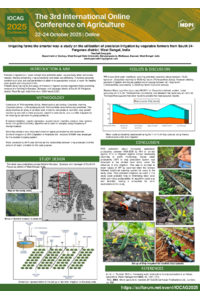
Precision irrigation is a novel concept that optimizes water use precisely when and where needed, thereby enhancing crop productivity and water use efficiency. It involves accurate monitoring of crop and soil parameters to determine the appropriate amount of water for healthy plant growth and crop production. The present study highlights the usage of precision irrigation across vegetable fields practicing monoculture farming in the Baruipur, Sonarpur, and Jaynagar blocks of South 24-Parganas district, West Bengal, India, from April 2024 to March 2025. Cultivation of Trichosanthes dioica, Abelmoschus esculentus, Cucurbita maxima, Cucumis sativus, Luffa acutangula, and Trichosanthes cucumerina was practiced. This study involves an array of sensors (soil, moisture, temperature, humidity, crop growth monitoring, and soil nutrient analyzer), algorithms, and drip tip and sprinkler irrigation for formulating an optimum irrigating schedule. K-nearest neighbors, logistic regression, support vector machine, decision tree, random forest, and the gradient boosting algorithm were used for analysis using the Raspberry Pi microprocessor. A watering schedule was designed based on the signal generated by a microcontroller. Sprinkler irrigation at 50% Depletion of Available Soil moisture (DASM) was employed for the studied cropping system. Thus, in a typical crop production system, water productivity (WP) was defined as the relationship between crops produced and the amount of water provided for the said purpose. WP in the crop field under the traditional watering schedule recorded values between 18.22 kg/ha/cm. (Cucurbita maxima) and 48.65 kg/ha/cm (Trichosanthes dioica). However, utilizing precision irrigation techniques yielded results varying between 22.15kg/ha/cm (Trichosanthes cucumerina) and 52.68 kg/ha/cm (Cucumis sativus). The Random Boost algorithm (accuracy=98.20% for Cucurbita maxima), random forest (accuracy=97.5 % for Trichosanthes cucumerina), and decision tree (accuracy=97.20% for Trichosanthes cucumerina) were found to provide the most accurate results. In spite of the prevalence of small, illiterate landholders, adoption of such digitized technologies appears quite rewarding for the farming community.
Keywords
Abelmoschus esculentus
algorithm
Cucumis sativus
Cucurbita maxima
precision irrigation
sensors
Luffa acutangula
Trichosanthes dioica
Trichosanthes cucumerina
Poster
Sengupta-sciforum135567.pdf
"From Hydrocarbons to Harvests: A Machine Learning-Based Zonation Model for Climate-Smart Agriculture."
ENVIRONMENTAL ASPECTS OF AUTONOMOUS ROBOTIC AGRICULTURAL MACHINES