Event submissions
Published
This submission belongs to the session S1. Climate-Smart Agriculture: Practices, Determinants, Productivity, and Efficiency of the event The 3rd International Online Conference on Agriculture
Published date
20 Oct, 2025
Academic Editor
'%3e%3cpath%20d='M12.6657%2010.9104C12.4185%2010.325%2012.0599%209.79327%2011.6097%209.34482C11.1609%208.89508%2010.6293%208.5365%2010.0442%208.28888C10.0389%208.28626%2010.0337%208.28495%2010.0285%208.28233C10.8446%207.69279%2011.3752%206.73249%2011.3752%205.64904C11.3752%203.8542%209.92103%202.39999%208.1262%202.39999C6.33136%202.39999%204.87715%203.8542%204.87715%205.64904C4.87715%206.73249%205.40774%207.69279%206.22393%208.28364C6.21869%208.28626%206.21345%208.28757%206.20821%208.29019C5.62129%208.5378%205.09463%208.89284%204.64265%209.34613C4.1929%209.79493%203.83432%2010.3266%203.58671%2010.9117C3.34345%2011.4845%203.21226%2012.0987%203.20023%2012.7209C3.19988%2012.7349%203.20233%2012.7488%203.20744%2012.7619C3.21255%2012.7749%203.22022%2012.7867%203.22998%2012.7968C3.23975%2012.8068%203.25142%2012.8147%203.26431%2012.8202C3.2772%2012.8256%203.29105%2012.8284%203.30504%2012.8284H4.09109C4.14874%2012.8284%204.19459%2012.7825%204.1959%2012.7262C4.2221%2011.7148%204.62823%2010.7676%205.34617%2010.0497C6.08899%209.30683%207.0755%208.89808%208.1262%208.89808C9.17689%208.89808%2010.1634%209.30683%2010.9062%2010.0497C11.6242%2010.7676%2012.0303%2011.7148%2012.0565%2012.7262C12.0578%2012.7838%2012.1037%2012.8284%2012.1613%2012.8284H12.9474C12.9613%2012.8284%2012.9752%2012.8256%2012.9881%2012.8202C13.001%2012.8147%2013.0126%2012.8068%2013.0224%2012.7968C13.0322%2012.7867%2013.0398%2012.7749%2013.0449%2012.7619C13.0501%2012.7488%2013.0525%2012.7349%2013.0522%2012.7209C13.0391%2012.0947%2012.9094%2011.4855%2012.6657%2010.9104ZM8.1262%207.9024C7.52486%207.9024%206.9589%207.6679%206.53312%207.24211C6.10733%206.81633%205.87283%206.25037%205.87283%205.64904C5.87283%205.0477%206.10733%204.48174%206.53312%204.05596C6.9589%203.63018%207.52486%203.39567%208.1262%203.39567C8.72753%203.39567%209.29349%203.63018%209.71927%204.05596C10.1451%204.48174%2010.3796%205.0477%2010.3796%205.64904C10.3796%206.25037%2010.1451%206.81633%209.71927%207.24211C9.29349%207.6679%208.72753%207.9024%208.1262%207.9024Z'%20fill='%235D1EE1'/%3e%3c/g%3e%3c/svg%3e) Sanzidur Rahman
Sanzidur RahmanCitation
anshika parihar, Socio-Economic Determinants of Drip Irrigation Adoption in Semi-Arid India: Evidence from Sangamner, Maharashtra, in Proceedings of The 3rd International Online Conference on Agriculture, 22 October–24 October 2025, MDPI: Basel, Switzerland
Share
Email
Facebook
Twitter
LinkedIn
Socio-Economic Determinants of Drip Irrigation Adoption in Semi-Arid India: Evidence from Sangamner, Maharashtra
'%3e%3cpath%20d='M12.6647%2010.9104C12.4176%2010.325%2012.0589%209.7933%2011.6088%209.34485C11.16%208.89511%2010.6283%208.53653%2010.0432%208.28891C10.038%208.28629%2010.0327%208.28498%2010.0275%208.28236C10.8437%207.69282%2011.3743%206.73252%2011.3743%205.64907C11.3743%203.85423%209.92005%202.40002%208.12522%202.40002C6.33038%202.40002%204.87618%203.85423%204.87618%205.64907C4.87618%206.73252%205.40677%207.69282%206.22296%208.28367C6.21772%208.28629%206.21248%208.2876%206.20724%208.29022C5.62031%208.53783%205.09365%208.89287%204.64167%209.34616C4.19192%209.79496%203.83334%2010.3266%203.58573%2010.9117C3.34247%2011.4846%203.21128%2012.0987%203.19925%2012.721C3.1989%2012.735%203.20135%2012.7489%203.20646%2012.7619C3.21157%2012.7749%203.21924%2012.7868%203.22901%2012.7968C3.23877%2012.8068%203.25045%2012.8148%203.26334%2012.8202C3.27623%2012.8256%203.29007%2012.8284%203.30406%2012.8284H4.09012C4.14776%2012.8284%204.19362%2012.7825%204.19493%2012.7262C4.22113%2011.7148%204.62726%2010.7676%205.34519%2010.0497C6.08802%209.30686%207.07452%208.89811%208.12522%208.89811C9.17592%208.89811%2010.1624%209.30686%2010.9052%2010.0497C11.6232%2010.7676%2012.0293%2011.7148%2012.0555%2012.7262C12.0568%2012.7839%2012.1027%2012.8284%2012.1603%2012.8284H12.9464C12.9604%2012.8284%2012.9742%2012.8256%2012.9871%2012.8202C13%2012.8148%2013.0117%2012.8068%2013.0214%2012.7968C13.0312%2012.7868%2013.0389%2012.7749%2013.044%2012.7619C13.0491%2012.7489%2013.0515%2012.735%2013.0512%2012.721C13.0381%2012.0947%2012.9084%2011.4856%2012.6647%2010.9104ZM8.12522%207.90243C7.52388%207.90243%206.95792%207.66793%206.53214%207.24215C6.10636%206.81636%205.87185%206.2504%205.87185%205.64907C5.87185%205.04773%206.10636%204.48177%206.53214%204.05599C6.95792%203.63021%207.52388%203.3957%208.12522%203.3957C8.72655%203.3957%209.29252%203.63021%209.7183%204.05599C10.1441%204.48177%2010.3786%205.04773%2010.3786%205.64907C10.3786%206.2504%2010.1441%206.81636%209.7183%207.24215C9.29252%207.66793%208.72655%207.90243%208.12522%207.90243Z'%20fill='%235D1EE1'/%3e%3c/g%3e%3c/svg%3e)
anshika parihar 1
1. Bachelor of Science in Analytics and Sustainability Studies School of Management and Labour Studies (SMLS) Tata Institute of Social Sciences (TISS), Mumbai, 400088, India
Abstract
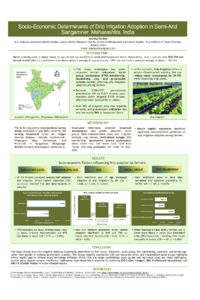
Sangamner block in Ahmednagar district, Maharashtra, India, is a semi-arid region receiving only 500 – 750 mm of annual rainfall. Heavy reliance on agriculture, coupled with steadily declining groundwater levels, heightens farmers’ climate vulnerability. Drip irrigation, a climate-resilient technology, is increasingly adopted in response.
This study employed a cross-sectional survey conducted in July 2024, covering 159 farming households from six villages (Kawthe Malkapur, Kolwade, Kumbharwadi, Pimpalgaon Depa, Shendewadi, and Warwandi). Structured interviews captured data for the 2023–2024 agricultural year, including household demographics, institutional support, government-scheme access, and crop production.
Binary logistic regression identified education, social group, FPO membership, land size, and age as significant predictors. Farmers with low and medium education levels are 84% (OR = 0.16, p = 0.017) and 74% (OR = 0.26, p = 0.035) less likely to adopt drip irrigation compared to highly educated farmers. Social group-wise, Other Backward Class (OBC) farmers are four times more likely to adopt drip irrigation than Scheduled Tribe farmers (OR = 4.037, p = 0.004). Each additional acre of land and each extra year in age raised adoption odds by 14.5% (p = 0.015) and 4% (p = 0.046), respectively. Lastly, Farmer Producer Organisation (FPO) membership was the strongest driver, with non-members being 87% less likely to adopt drip irrigation (OR = 0.126, p < 0.001). Conversely, gender and government schemes, including Kisan Credit Cards, Soil Health Cards, and Pradhan Mantri Fasal Bima Yojana, showed no significant relationship.
Descriptive analysis revealed that traditional climate-resilient cereals (bajra, jowar) achieved stable yields across all irrigation types, whereas high-value, water-sensitive crops like onion and tomato yielded 8 to 50 times higher yields under drip systems.
These findings highlight the need for targeted educational interventions and FPO-based extension programs to accelerate drip adoption, particularly focusing on marginalized communities and less-educated farmers to strengthen climate resilience in water-stressed regions.
Keywords
Drip irrigation adoption
Socio-economic factors
Climate resilience
Farmer Producer Organization (FPO)
Water-use efficiency
Semi-arid agriculture
Poster
Presentation Poster submission.pdf
THE EFFECTS OF CONSERVATION AGRICULTURE PRACTICES ON SOIL GREENHOUSE GAS EMISSIONS IN MAIZE PRODUCTION SYSTEMS IN BUEA, CAMEROON
Agronomic performance of Brachypodium cover crop varieties grown under mediterranean agroclimatic conditions