Event submissions
Published
This submission belongs to the session S5. Agricultural Water Management of the event The 3rd International Online Conference on Agriculture
Published date
20 Oct, 2025
Academic Editor
'%3e%3cpath%20d='M12.6657%2010.9104C12.4185%2010.325%2012.0599%209.79327%2011.6097%209.34482C11.1609%208.89508%2010.6293%208.5365%2010.0442%208.28888C10.0389%208.28626%2010.0337%208.28495%2010.0285%208.28233C10.8446%207.69279%2011.3752%206.73249%2011.3752%205.64904C11.3752%203.8542%209.92103%202.39999%208.1262%202.39999C6.33136%202.39999%204.87715%203.8542%204.87715%205.64904C4.87715%206.73249%205.40774%207.69279%206.22393%208.28364C6.21869%208.28626%206.21345%208.28757%206.20821%208.29019C5.62129%208.5378%205.09463%208.89284%204.64265%209.34613C4.1929%209.79493%203.83432%2010.3266%203.58671%2010.9117C3.34345%2011.4845%203.21226%2012.0987%203.20023%2012.7209C3.19988%2012.7349%203.20233%2012.7488%203.20744%2012.7619C3.21255%2012.7749%203.22022%2012.7867%203.22998%2012.7968C3.23975%2012.8068%203.25142%2012.8147%203.26431%2012.8202C3.2772%2012.8256%203.29105%2012.8284%203.30504%2012.8284H4.09109C4.14874%2012.8284%204.19459%2012.7825%204.1959%2012.7262C4.2221%2011.7148%204.62823%2010.7676%205.34617%2010.0497C6.08899%209.30683%207.0755%208.89808%208.1262%208.89808C9.17689%208.89808%2010.1634%209.30683%2010.9062%2010.0497C11.6242%2010.7676%2012.0303%2011.7148%2012.0565%2012.7262C12.0578%2012.7838%2012.1037%2012.8284%2012.1613%2012.8284H12.9474C12.9613%2012.8284%2012.9752%2012.8256%2012.9881%2012.8202C13.001%2012.8147%2013.0126%2012.8068%2013.0224%2012.7968C13.0322%2012.7867%2013.0398%2012.7749%2013.0449%2012.7619C13.0501%2012.7488%2013.0525%2012.7349%2013.0522%2012.7209C13.0391%2012.0947%2012.9094%2011.4855%2012.6657%2010.9104ZM8.1262%207.9024C7.52486%207.9024%206.9589%207.6679%206.53312%207.24211C6.10733%206.81633%205.87283%206.25037%205.87283%205.64904C5.87283%205.0477%206.10733%204.48174%206.53312%204.05596C6.9589%203.63018%207.52486%203.39567%208.1262%203.39567C8.72753%203.39567%209.29349%203.63018%209.71927%204.05596C10.1451%204.48174%2010.3796%205.0477%2010.3796%205.64904C10.3796%206.25037%2010.1451%206.81633%209.71927%207.24211C9.29349%207.6679%208.72753%207.9024%208.1262%207.9024Z'%20fill='%235D1EE1'/%3e%3c/g%3e%3c/svg%3e) Antonio Paz-Gonzalez
Antonio Paz-GonzalezCitation
Farid Errouh, Lahoucine Ech-chatir, Salah Er-Raki, Abdelilah Meddich, Performance of Steel Slag and Compost on Grain Yield, Irrigation Water Use Efficiency, and Soil Fertility of Durum Wheat (Triticum durum Desf.) Under Sustained Deficit Irrigation in Arid Conditions of Morocco, in Proceedings of The 3rd International Online Conference on Agriculture, 22 October–24 October 2025, MDPI: Basel, Switzerland
Share
Email
Facebook
Twitter
LinkedIn
Performance of Steel Slag and Compost on Grain Yield, Irrigation Water Use Efficiency, and Soil Fertility of Durum Wheat (Triticum durum Desf.) Under Sustained Deficit Irrigation in Arid Conditions of Morocco
'%3e%3cpath%20d='M12.6647%2010.9104C12.4176%2010.325%2012.0589%209.7933%2011.6088%209.34485C11.16%208.89511%2010.6283%208.53653%2010.0432%208.28891C10.038%208.28629%2010.0327%208.28498%2010.0275%208.28236C10.8437%207.69282%2011.3743%206.73252%2011.3743%205.64907C11.3743%203.85423%209.92005%202.40002%208.12522%202.40002C6.33038%202.40002%204.87618%203.85423%204.87618%205.64907C4.87618%206.73252%205.40677%207.69282%206.22296%208.28367C6.21772%208.28629%206.21248%208.2876%206.20724%208.29022C5.62031%208.53783%205.09365%208.89287%204.64167%209.34616C4.19192%209.79496%203.83334%2010.3266%203.58573%2010.9117C3.34247%2011.4846%203.21128%2012.0987%203.19925%2012.721C3.1989%2012.735%203.20135%2012.7489%203.20646%2012.7619C3.21157%2012.7749%203.21924%2012.7868%203.22901%2012.7968C3.23877%2012.8068%203.25045%2012.8148%203.26334%2012.8202C3.27623%2012.8256%203.29007%2012.8284%203.30406%2012.8284H4.09012C4.14776%2012.8284%204.19362%2012.7825%204.19493%2012.7262C4.22113%2011.7148%204.62726%2010.7676%205.34519%2010.0497C6.08802%209.30686%207.07452%208.89811%208.12522%208.89811C9.17592%208.89811%2010.1624%209.30686%2010.9052%2010.0497C11.6232%2010.7676%2012.0293%2011.7148%2012.0555%2012.7262C12.0568%2012.7839%2012.1027%2012.8284%2012.1603%2012.8284H12.9464C12.9604%2012.8284%2012.9742%2012.8256%2012.9871%2012.8202C13%2012.8148%2013.0117%2012.8068%2013.0214%2012.7968C13.0312%2012.7868%2013.0389%2012.7749%2013.044%2012.7619C13.0491%2012.7489%2013.0515%2012.735%2013.0512%2012.721C13.0381%2012.0947%2012.9084%2011.4856%2012.6647%2010.9104ZM8.12522%207.90243C7.52388%207.90243%206.95792%207.66793%206.53214%207.24215C6.10636%206.81636%205.87185%206.2504%205.87185%205.64907C5.87185%205.04773%206.10636%204.48177%206.53214%204.05599C6.95792%203.63021%207.52388%203.3957%208.12522%203.3957C8.72655%203.3957%209.29252%203.63021%209.7183%204.05599C10.1441%204.48177%2010.3786%205.04773%2010.3786%205.64907C10.3786%206.2504%2010.1441%206.81636%209.7183%207.24215C9.29252%207.66793%208.72655%207.90243%208.12522%207.90243Z'%20fill='%235D1EE1'/%3e%3c/g%3e%3c/svg%3e)
Farid Errouh 1

Lahoucine Ech-chatir 1

Salah Er-Raki 1,2
Abdelilah Meddich 1,3
1. Center of Agrobiotechnology and Bioengineering, Research Unit labeled CNRST (Centre AgroBiotech-URL-CNRST-05), Cadi Ayyad University, Marrakesh 40000, Morocco
2. Center for Remote Sensing Applications, Mohammed VI Polytechnic University, Lot 660, Hay Moulay Rachid, Ben Guerir 43150, Morocco
3. African Sustainable Agriculture Research Institute (ASARI), Mohammed VI Polytechnic University, Laayoune 70000, Morocco
Abstract
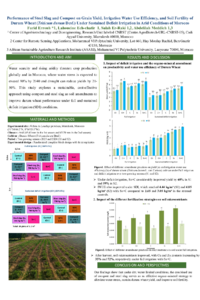
Water scarcity is a major limiting factor for crop production in arid regions, requiring sustainable strategies to improve productivity and resource efficiency. This study uniquely investigates the combined use of compost and steel slag, an underutilized industrial by-product, as soil amendments to improve the performance of durum wheat (Triticum durum Desf.) under both full and sustained deficit irrigation (SDI) conditions. Field trials were conducted over two growing seasons in an arid area of Morocco, with two irrigation regimes, full irrigation (100% ETc) and SDI at 30% ETc, applied from 21 days after sowing. Five treatments were tested: unamended control (Ct-), conventional agricultural practices (Ct+), compost (C, 4.0 t ha⁻¹), steel slag (Ss, 700 kg ha⁻¹), and the combination of steel slag and compost (Ss+C). Under full irrigation, the combined application of Ss+C significantly increased grain yield by 37% and 44% in the first (S1) and second (S2) growing seasons, respectively, compared to the control. Under deficit irrigation, Ss+C considerably improved yield by 68% in S1 and 59% in S2. The harvest index also improved in 2023, rising from 0.268 in the control to 0.285 with Ss+C. Furthermore, irrigation water use efficiency (IWUE) under SDI reached 4.44 kg/m³ (S1) and 4.85 kg/m³ (S2) with Ss+C compared to 2.65 and 3.05 kg/m³ in the stressed controls. Vegetative development, measured by the Normalized Difference Vegetation Index (NDVI) during the dough stage, increased by 66% (S1) and 51% (S2) with Ss+C. Soil micronutrients also improved, with Cu and Zn contents increasing by 35% and 52%, respectively, under full irrigation with Ss+C. These results indicate that combining compost and steel slag is an effective and sustainable soil management strategy to enhance wheat productivity, water use efficiency, and soil quality under arid and water-limited conditions.
Keywords
Arid environment
Bio-based amendments
Water shortage
Sustainable agriculture
Water productivity
Wheat resilience
Poster
sciforum-139310_Farid_ERROUH.pdf
Performance Assessment of DRL-Based Irrigation Agents in AquaCrop Using Local Data from Tensift Al Haouz: Toward Profit-Oriented Water Management
Integrated hydroponic bioelectrochemical wastewater treatment process for sustainable agriculture