Event submissions
Published
This submission belongs to the session S1. Climate-Smart Agriculture: Practices, Determinants, Productivity, and Efficiency of the event The 3rd International Online Conference on Agriculture
Published date
20 Oct, 2025
Academic Editor
'%3e%3cpath%20d='M12.6657%2010.9104C12.4185%2010.325%2012.0599%209.79327%2011.6097%209.34482C11.1609%208.89508%2010.6293%208.5365%2010.0442%208.28888C10.0389%208.28626%2010.0337%208.28495%2010.0285%208.28233C10.8446%207.69279%2011.3752%206.73249%2011.3752%205.64904C11.3752%203.8542%209.92103%202.39999%208.1262%202.39999C6.33136%202.39999%204.87715%203.8542%204.87715%205.64904C4.87715%206.73249%205.40774%207.69279%206.22393%208.28364C6.21869%208.28626%206.21345%208.28757%206.20821%208.29019C5.62129%208.5378%205.09463%208.89284%204.64265%209.34613C4.1929%209.79493%203.83432%2010.3266%203.58671%2010.9117C3.34345%2011.4845%203.21226%2012.0987%203.20023%2012.7209C3.19988%2012.7349%203.20233%2012.7488%203.20744%2012.7619C3.21255%2012.7749%203.22022%2012.7867%203.22998%2012.7968C3.23975%2012.8068%203.25142%2012.8147%203.26431%2012.8202C3.2772%2012.8256%203.29105%2012.8284%203.30504%2012.8284H4.09109C4.14874%2012.8284%204.19459%2012.7825%204.1959%2012.7262C4.2221%2011.7148%204.62823%2010.7676%205.34617%2010.0497C6.08899%209.30683%207.0755%208.89808%208.1262%208.89808C9.17689%208.89808%2010.1634%209.30683%2010.9062%2010.0497C11.6242%2010.7676%2012.0303%2011.7148%2012.0565%2012.7262C12.0578%2012.7838%2012.1037%2012.8284%2012.1613%2012.8284H12.9474C12.9613%2012.8284%2012.9752%2012.8256%2012.9881%2012.8202C13.001%2012.8147%2013.0126%2012.8068%2013.0224%2012.7968C13.0322%2012.7867%2013.0398%2012.7749%2013.0449%2012.7619C13.0501%2012.7488%2013.0525%2012.7349%2013.0522%2012.7209C13.0391%2012.0947%2012.9094%2011.4855%2012.6657%2010.9104ZM8.1262%207.9024C7.52486%207.9024%206.9589%207.6679%206.53312%207.24211C6.10733%206.81633%205.87283%206.25037%205.87283%205.64904C5.87283%205.0477%206.10733%204.48174%206.53312%204.05596C6.9589%203.63018%207.52486%203.39567%208.1262%203.39567C8.72753%203.39567%209.29349%203.63018%209.71927%204.05596C10.1451%204.48174%2010.3796%205.0477%2010.3796%205.64904C10.3796%206.25037%2010.1451%206.81633%209.71927%207.24211C9.29349%207.6679%208.72753%207.9024%208.1262%207.9024Z'%20fill='%235D1EE1'/%3e%3c/g%3e%3c/svg%3e) Bin Gao
Bin GaoCitation
Tatenda Chapman, Rudo Masango, Linda Muusha, Victor Chingwara, Perfomance of pepper under different vermicompost regimes, in Proceedings of The 3rd International Online Conference on Agriculture, 22 October–24 October 2025, MDPI: Basel, Switzerland
Share
Email
Facebook
Twitter
LinkedIn
Perfomance of pepper under different vermicompost regimes
'%3e%3cpath%20d='M12.6647%2010.9104C12.4176%2010.325%2012.0589%209.7933%2011.6088%209.34485C11.16%208.89511%2010.6283%208.53653%2010.0432%208.28891C10.038%208.28629%2010.0327%208.28498%2010.0275%208.28236C10.8437%207.69282%2011.3743%206.73252%2011.3743%205.64907C11.3743%203.85423%209.92005%202.40002%208.12522%202.40002C6.33038%202.40002%204.87618%203.85423%204.87618%205.64907C4.87618%206.73252%205.40677%207.69282%206.22296%208.28367C6.21772%208.28629%206.21248%208.2876%206.20724%208.29022C5.62031%208.53783%205.09365%208.89287%204.64167%209.34616C4.19192%209.79496%203.83334%2010.3266%203.58573%2010.9117C3.34247%2011.4846%203.21128%2012.0987%203.19925%2012.721C3.1989%2012.735%203.20135%2012.7489%203.20646%2012.7619C3.21157%2012.7749%203.21924%2012.7868%203.22901%2012.7968C3.23877%2012.8068%203.25045%2012.8148%203.26334%2012.8202C3.27623%2012.8256%203.29007%2012.8284%203.30406%2012.8284H4.09012C4.14776%2012.8284%204.19362%2012.7825%204.19493%2012.7262C4.22113%2011.7148%204.62726%2010.7676%205.34519%2010.0497C6.08802%209.30686%207.07452%208.89811%208.12522%208.89811C9.17592%208.89811%2010.1624%209.30686%2010.9052%2010.0497C11.6232%2010.7676%2012.0293%2011.7148%2012.0555%2012.7262C12.0568%2012.7839%2012.1027%2012.8284%2012.1603%2012.8284H12.9464C12.9604%2012.8284%2012.9742%2012.8256%2012.9871%2012.8202C13%2012.8148%2013.0117%2012.8068%2013.0214%2012.7968C13.0312%2012.7868%2013.0389%2012.7749%2013.044%2012.7619C13.0491%2012.7489%2013.0515%2012.735%2013.0512%2012.721C13.0381%2012.0947%2012.9084%2011.4856%2012.6647%2010.9104ZM8.12522%207.90243C7.52388%207.90243%206.95792%207.66793%206.53214%207.24215C6.10636%206.81636%205.87185%206.2504%205.87185%205.64907C5.87185%205.04773%206.10636%204.48177%206.53214%204.05599C6.95792%203.63021%207.52388%203.3957%208.12522%203.3957C8.72655%203.3957%209.29252%203.63021%209.7183%204.05599C10.1441%204.48177%2010.3786%205.04773%2010.3786%205.64907C10.3786%206.2504%2010.1441%206.81636%209.7183%207.24215C9.29252%207.66793%208.72655%207.90243%208.12522%207.90243Z'%20fill='%235D1EE1'/%3e%3c/g%3e%3c/svg%3e)
Tatenda Chapman 1
Rudo Masango 2
Linda Muusha 1
Victor Chingwara 3
1. Department of Agriculture Research and Innovation, Horticulture Research Institute, Marondera, P Bag 810, Zimbabwe
2. Department of Crop Science, Marondera university of Agriculture Science, 15 Longlands Road Marondera , Zimbabwe
3. Department of Agriculture Research and innovation, Harare Agricultural Research center, fifth street extension, P O Box CY594, Causeway, Harare, Zimbabwe
Abstract
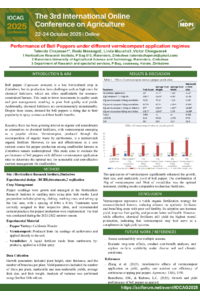
A field trial was conducted at Horticulture Research Institute, in Marondera Zimbabwe, to investigate the effect of vermicompost (as a basal fertiliser) and vermifoliar (as a top dressing) on bell pepper (Capsicum annum cv. California wonder). The experiment was set up as a Randomized Complete block design (RCBD) with three replications and six treatments: (1) no fertiliser applied (negative control) ; (2) 20g vermicompost and 3 weekly sprays of 50mg vemifoliar; (3) 30g vermicompost and 3 weekly sprays of 50mg vermifoliar ; (4) 40g Vermicompost and 3 weekly sprays of 50mg vermifoliar; (5) 50g vermicompost and 3 weekly sprays of 50mg vemifoliar ; (6) 20g compound C and 10g ammonium nitrate (positive control). The objective of the study was to evaluate the potential of using vermicompost as a sole nutrient source for pepper production and to determine optimal application rates that can be recommend to smallholder farmers in Zimbabwe. Data was collected on plant growth, yield and fruit quality parameters. Significant differences (P ≤ 0.05) were observed across all treatments. The positive control, 20g compound C basal fertiliser application and 10g ammonium nitrate as top dressing recorded the highest performance in all the measured parameters. However, increasing rates of vermicompost (from 20g to 50g/plant) resulted in a positive dose response, with improvements in the marketable fruit number, average fruit weight, average fruit diameter, marketable yield and total yield. Notably, 50g vermicompost treatment was the second-best performer and demonstrated potential as an organic alternative for nutrient management in pepper production. The findings from the study suggest that vermicompost can partially substitute chemical fertilisers, particularly at higher application rate and can be recommended as a viable option for smallholder farmers.
Keywords
Crop yield
nutrient management
Vermicompost
sustainable agriculture
plant growth
Poster
Chapman vermicompost poster.pdf
Growth model for vertical towers in greenhouse based on use efficiency of radiation and plant position
High-Temperature Effects on Phenology, Growth, and Yield of Wheat Varieties under Late-Sown Conditions