Event submissions
Published
This submission belongs to the session S9. Farm Animal Production of the event The 3rd International Online Conference on Agriculture
Published date
20 Oct, 2025
Academic Editor
'%3e%3cpath%20d='M12.6657%2010.9104C12.4185%2010.325%2012.0599%209.79327%2011.6097%209.34482C11.1609%208.89508%2010.6293%208.5365%2010.0442%208.28888C10.0389%208.28626%2010.0337%208.28495%2010.0285%208.28233C10.8446%207.69279%2011.3752%206.73249%2011.3752%205.64904C11.3752%203.8542%209.92103%202.39999%208.1262%202.39999C6.33136%202.39999%204.87715%203.8542%204.87715%205.64904C4.87715%206.73249%205.40774%207.69279%206.22393%208.28364C6.21869%208.28626%206.21345%208.28757%206.20821%208.29019C5.62129%208.5378%205.09463%208.89284%204.64265%209.34613C4.1929%209.79493%203.83432%2010.3266%203.58671%2010.9117C3.34345%2011.4845%203.21226%2012.0987%203.20023%2012.7209C3.19988%2012.7349%203.20233%2012.7488%203.20744%2012.7619C3.21255%2012.7749%203.22022%2012.7867%203.22998%2012.7968C3.23975%2012.8068%203.25142%2012.8147%203.26431%2012.8202C3.2772%2012.8256%203.29105%2012.8284%203.30504%2012.8284H4.09109C4.14874%2012.8284%204.19459%2012.7825%204.1959%2012.7262C4.2221%2011.7148%204.62823%2010.7676%205.34617%2010.0497C6.08899%209.30683%207.0755%208.89808%208.1262%208.89808C9.17689%208.89808%2010.1634%209.30683%2010.9062%2010.0497C11.6242%2010.7676%2012.0303%2011.7148%2012.0565%2012.7262C12.0578%2012.7838%2012.1037%2012.8284%2012.1613%2012.8284H12.9474C12.9613%2012.8284%2012.9752%2012.8256%2012.9881%2012.8202C13.001%2012.8147%2013.0126%2012.8068%2013.0224%2012.7968C13.0322%2012.7867%2013.0398%2012.7749%2013.0449%2012.7619C13.0501%2012.7488%2013.0525%2012.7349%2013.0522%2012.7209C13.0391%2012.0947%2012.9094%2011.4855%2012.6657%2010.9104ZM8.1262%207.9024C7.52486%207.9024%206.9589%207.6679%206.53312%207.24211C6.10733%206.81633%205.87283%206.25037%205.87283%205.64904C5.87283%205.0477%206.10733%204.48174%206.53312%204.05596C6.9589%203.63018%207.52486%203.39567%208.1262%203.39567C8.72753%203.39567%209.29349%203.63018%209.71927%204.05596C10.1451%204.48174%2010.3796%205.0477%2010.3796%205.64904C10.3796%206.25037%2010.1451%206.81633%209.71927%207.24211C9.29349%207.6679%208.72753%207.9024%208.1262%207.9024Z'%20fill='%235D1EE1'/%3e%3c/g%3e%3c/svg%3e) Jalil Ghassemi Nejad
Jalil Ghassemi NejadCitation
Isaac Oluseun Adejumo, A.O. Akintayo, Immunotherapeutic potentials of immunogenic peptides for sustainable livestock production, in Proceedings of The 3rd International Online Conference on Agriculture, 22 October–24 October 2025, MDPI: Basel, Switzerland
Share
Email
Facebook
Twitter
LinkedIn
Immunotherapeutic potentials of immunogenic peptides for sustainable livestock production

Isaac Oluseun Adejumo 1
'%3e%3cpath%20d='M12.6647%2010.9104C12.4176%2010.325%2012.0589%209.7933%2011.6088%209.34485C11.16%208.89511%2010.6283%208.53653%2010.0432%208.28891C10.038%208.28629%2010.0327%208.28498%2010.0275%208.28236C10.8437%207.69282%2011.3743%206.73252%2011.3743%205.64907C11.3743%203.85423%209.92005%202.40002%208.12522%202.40002C6.33038%202.40002%204.87618%203.85423%204.87618%205.64907C4.87618%206.73252%205.40677%207.69282%206.22296%208.28367C6.21772%208.28629%206.21248%208.2876%206.20724%208.29022C5.62031%208.53783%205.09365%208.89287%204.64167%209.34616C4.19192%209.79496%203.83334%2010.3266%203.58573%2010.9117C3.34247%2011.4846%203.21128%2012.0987%203.19925%2012.721C3.1989%2012.735%203.20135%2012.7489%203.20646%2012.7619C3.21157%2012.7749%203.21924%2012.7868%203.22901%2012.7968C3.23877%2012.8068%203.25045%2012.8148%203.26334%2012.8202C3.27623%2012.8256%203.29007%2012.8284%203.30406%2012.8284H4.09012C4.14776%2012.8284%204.19362%2012.7825%204.19493%2012.7262C4.22113%2011.7148%204.62726%2010.7676%205.34519%2010.0497C6.08802%209.30686%207.07452%208.89811%208.12522%208.89811C9.17592%208.89811%2010.1624%209.30686%2010.9052%2010.0497C11.6232%2010.7676%2012.0293%2011.7148%2012.0555%2012.7262C12.0568%2012.7839%2012.1027%2012.8284%2012.1603%2012.8284H12.9464C12.9604%2012.8284%2012.9742%2012.8256%2012.9871%2012.8202C13%2012.8148%2013.0117%2012.8068%2013.0214%2012.7968C13.0312%2012.7868%2013.0389%2012.7749%2013.044%2012.7619C13.0491%2012.7489%2013.0515%2012.735%2013.0512%2012.721C13.0381%2012.0947%2012.9084%2011.4856%2012.6647%2010.9104ZM8.12522%207.90243C7.52388%207.90243%206.95792%207.66793%206.53214%207.24215C6.10636%206.81636%205.87185%206.2504%205.87185%205.64907C5.87185%205.04773%206.10636%204.48177%206.53214%204.05599C6.95792%203.63021%207.52388%203.3957%208.12522%203.3957C8.72655%203.3957%209.29252%203.63021%209.7183%204.05599C10.1441%204.48177%2010.3786%205.04773%2010.3786%205.64907C10.3786%206.2504%2010.1441%206.81636%209.7183%207.24215C9.29252%207.66793%208.72655%207.90243%208.12522%207.90243Z'%20fill='%235D1EE1'/%3e%3c/g%3e%3c/svg%3e)
A.O. Akintayo 2
1. Department of Animal Science, University of Ibadan, Ibadan, 200005, Nigeria
2. Department of Aquaculture and Fisheries Management, University of Ibadan, Ibadan, Nigeria
Abstract
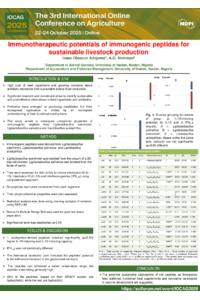
The important roles animal foods, particularly pork and chicken, play across the globe cannot be overstated. However, the high cost of feed ingredients and growing concerns about antibiotic resistance are limiting their sustainable production. With these growing concerns, significant research and investment have focused on identifying sustainable and cost-effective alternatives to feed ingredients and antibiotics. Probiotics have emerged as promising candidates for replacing antibiotics in both human health and livestock production. However, their widespread application is limited, owing to an incomplete understanding of their functional mechanisms. In this study, immunogenic peptides derived from probiotic bacterial species, Ligilactobacillus saerimneri (isolated from the cecum of a 20-day-old chicken), Ligilactobacillus salivarius (isolated from the feces of swine) and Lactobacillus acidophilus, were investigated for their ability to induce interleukin-10 (IL-10), interleukin-13 (IL-13), and interferon-gamma (IFN_γ) using a computational approach, based on their essential functions in immune modulation in this preliminary study. Six peptides each were considered from each organism. Their physico-chemical properties were also assessed. Ligilactobacillus salivarius-derived peptides obtained the highest IL-10-inducing capacity, which was statistically similar to Ligilactobacillus saerimneri-derived peptides but significantly (p<0.05) higher than Lactobacillus acidophilus-derived peptides. IL-13-inducing potential was significantly (p<0.05) higher for L. acidophilus-derived peptides when compared with both L. salivarius-derived peptides and L. saerimneri-derived peptides. IFN_γ was statistically not different across the groups. The theoretical isoelectric point ranged between 4.00 and 12.01, indicating their potential to be well-accommodated in the gastrointestinal tract. The instability index ranged between -31.32 and 107.81. Out of the peptides considered, four (22%) are regarded as unstable. The peptides can withstand a varied temperature range, with the aliphatic index being generally high. The GRAVY score ranged between -2.065 and 1.110. 22% of the peptides, and based on their GRAVY scores, most are hydrophobic, while the rest are hydrophilic. These findings reveal a deeper understanding of probiotic immune pathways and highlight their potential for sustainable applications as therapeutic feed additives, functional food supplements, and innovative candidates in vaccine development.
Keywords
antibiotics
animal nutrition
functional foods
immune modulation
probiotics
sustainable livestock production
Poster
IOCAG_Adejumo_&_Akintayo.pdf
Enhancing Germination of Stored Adlai (Coix lacryma-jobi) Seeds Using Black Soldier Fly Frass Tea as an Organic Biofertilizer
An Evaluation of Machine Learning Algorithm Performance in Crop Recognition Using Remote Sensing: A Case Study in Southern Ukraine