Event submissions
Published
This submission belongs to the session S6. Smart Farming: From Sensor to Artificial Intelligence of the event The 3rd International Online Conference on Agriculture
Published date
20 Oct, 2025
Academic Editor
'%3e%3cpath%20d='M12.6657%2010.9104C12.4185%2010.325%2012.0599%209.79327%2011.6097%209.34482C11.1609%208.89508%2010.6293%208.5365%2010.0442%208.28888C10.0389%208.28626%2010.0337%208.28495%2010.0285%208.28233C10.8446%207.69279%2011.3752%206.73249%2011.3752%205.64904C11.3752%203.8542%209.92103%202.39999%208.1262%202.39999C6.33136%202.39999%204.87715%203.8542%204.87715%205.64904C4.87715%206.73249%205.40774%207.69279%206.22393%208.28364C6.21869%208.28626%206.21345%208.28757%206.20821%208.29019C5.62129%208.5378%205.09463%208.89284%204.64265%209.34613C4.1929%209.79493%203.83432%2010.3266%203.58671%2010.9117C3.34345%2011.4845%203.21226%2012.0987%203.20023%2012.7209C3.19988%2012.7349%203.20233%2012.7488%203.20744%2012.7619C3.21255%2012.7749%203.22022%2012.7867%203.22998%2012.7968C3.23975%2012.8068%203.25142%2012.8147%203.26431%2012.8202C3.2772%2012.8256%203.29105%2012.8284%203.30504%2012.8284H4.09109C4.14874%2012.8284%204.19459%2012.7825%204.1959%2012.7262C4.2221%2011.7148%204.62823%2010.7676%205.34617%2010.0497C6.08899%209.30683%207.0755%208.89808%208.1262%208.89808C9.17689%208.89808%2010.1634%209.30683%2010.9062%2010.0497C11.6242%2010.7676%2012.0303%2011.7148%2012.0565%2012.7262C12.0578%2012.7838%2012.1037%2012.8284%2012.1613%2012.8284H12.9474C12.9613%2012.8284%2012.9752%2012.8256%2012.9881%2012.8202C13.001%2012.8147%2013.0126%2012.8068%2013.0224%2012.7968C13.0322%2012.7867%2013.0398%2012.7749%2013.0449%2012.7619C13.0501%2012.7488%2013.0525%2012.7349%2013.0522%2012.7209C13.0391%2012.0947%2012.9094%2011.4855%2012.6657%2010.9104ZM8.1262%207.9024C7.52486%207.9024%206.9589%207.6679%206.53312%207.24211C6.10733%206.81633%205.87283%206.25037%205.87283%205.64904C5.87283%205.0477%206.10733%204.48174%206.53312%204.05596C6.9589%203.63018%207.52486%203.39567%208.1262%203.39567C8.72753%203.39567%209.29349%203.63018%209.71927%204.05596C10.1451%204.48174%2010.3796%205.0477%2010.3796%205.64904C10.3796%206.25037%2010.1451%206.81633%209.71927%207.24211C9.29349%207.6679%208.72753%207.9024%208.1262%207.9024Z'%20fill='%235D1EE1'/%3e%3c/g%3e%3c/svg%3e) Rui C. Martins
Rui C. MartinsCitation
Patricia Iweka, Shuso Kawamura, Tomohiro Mitani, Takashi Kawaguchi, Influence of Cow Parity on the Precision of Near-Infrared Spectroscopic Sensing System for Assessing Milk Quality During Milking, in Proceedings of The 3rd International Online Conference on Agriculture, 22 October–24 October 2025, MDPI: Basel, Switzerland
Share
Email
Facebook
Twitter
LinkedIn
Influence of Cow Parity on the Precision of Near-Infrared Spectroscopic Sensing System for Assessing Milk Quality During Milking
'%3e%3cpath%20d='M12.6647%2010.9104C12.4176%2010.325%2012.0589%209.7933%2011.6088%209.34485C11.16%208.89511%2010.6283%208.53653%2010.0432%208.28891C10.038%208.28629%2010.0327%208.28498%2010.0275%208.28236C10.8437%207.69282%2011.3743%206.73252%2011.3743%205.64907C11.3743%203.85423%209.92005%202.40002%208.12522%202.40002C6.33038%202.40002%204.87618%203.85423%204.87618%205.64907C4.87618%206.73252%205.40677%207.69282%206.22296%208.28367C6.21772%208.28629%206.21248%208.2876%206.20724%208.29022C5.62031%208.53783%205.09365%208.89287%204.64167%209.34616C4.19192%209.79496%203.83334%2010.3266%203.58573%2010.9117C3.34247%2011.4846%203.21128%2012.0987%203.19925%2012.721C3.1989%2012.735%203.20135%2012.7489%203.20646%2012.7619C3.21157%2012.7749%203.21924%2012.7868%203.22901%2012.7968C3.23877%2012.8068%203.25045%2012.8148%203.26334%2012.8202C3.27623%2012.8256%203.29007%2012.8284%203.30406%2012.8284H4.09012C4.14776%2012.8284%204.19362%2012.7825%204.19493%2012.7262C4.22113%2011.7148%204.62726%2010.7676%205.34519%2010.0497C6.08802%209.30686%207.07452%208.89811%208.12522%208.89811C9.17592%208.89811%2010.1624%209.30686%2010.9052%2010.0497C11.6232%2010.7676%2012.0293%2011.7148%2012.0555%2012.7262C12.0568%2012.7839%2012.1027%2012.8284%2012.1603%2012.8284H12.9464C12.9604%2012.8284%2012.9742%2012.8256%2012.9871%2012.8202C13%2012.8148%2013.0117%2012.8068%2013.0214%2012.7968C13.0312%2012.7868%2013.0389%2012.7749%2013.044%2012.7619C13.0491%2012.7489%2013.0515%2012.735%2013.0512%2012.721C13.0381%2012.0947%2012.9084%2011.4856%2012.6647%2010.9104ZM8.12522%207.90243C7.52388%207.90243%206.95792%207.66793%206.53214%207.24215C6.10636%206.81636%205.87185%206.2504%205.87185%205.64907C5.87185%205.04773%206.10636%204.48177%206.53214%204.05599C6.95792%203.63021%207.52388%203.3957%208.12522%203.3957C8.72655%203.3957%209.29252%203.63021%209.7183%204.05599C10.1441%204.48177%2010.3786%205.04773%2010.3786%205.64907C10.3786%206.2504%2010.1441%206.81636%209.7183%207.24215C9.29252%207.66793%208.72655%207.90243%208.12522%207.90243Z'%20fill='%235D1EE1'/%3e%3c/g%3e%3c/svg%3e)
Patricia Iweka 1
Shuso Kawamura 1
Tomohiro Mitani 2
Takashi Kawaguchi 3
1. Graduate School of Agricultural Science, Hokkaido University, Sapporo, 060-8589, Japan
2. Field Science Center for Northern Biosphere, Hokkaido University, Sapporo, 060-0811, Japan
3. Orion Machinery Co. Ltd, Nagano, 382-8502, Japan
Abstract
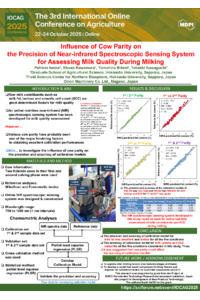
The precise and accurate real-time assessment of raw milk quality during the milking process through a near-infrared spectroscopic sensing system has not been performed, and is potentially hindered by elements likes cow parity. Therefore, this research focused on the influence of cow parity, or the number of times a cow has calved, on the reliability and exactness of a near-infrared (NIR) spectral detection system in assessing three key milk quality indicators: fat content, lactose, and somatic cell count (SCC). This study was conducted with two cows in their second calving phase at the dairy facility of Hokkaido University. We gathered milk absorbance spectra with the NIR system across a wavelength spectrum from 700 to 1050 nm. Milk fat and lactose levels were measured through a MilkoScan device, while SCC measurements were taken with a Fossomatic device. Calibration models were developed using three groups of sample data, including one from the first parity trial, another from the second parity trial, and a combined set from both trials. These calibration models employed partial least square regression analysis, and the accuracy and reliability of these models were subsequently tested. The coefficient of determination and standard error of prediction values obtained for both the first and second parity, alongside the combined data, were comparable for the parameters of milk fat and SCC, with the exception of lactose. Additionally, the first parity data set was utilized for validating the second parity data set, and vice versa. The findings showed that the measurements, particularly for lactose levels, were notably influenced. This indicates that a cow’s parity could affect the precision of NIR sensing systems in evaluating the quality of cow milk during milking sessions.
Keywords
Near-infrared spectroscopy
Sensing system
Cow parity
Calibration models
Accuracy
Milk quality
Smart dairy farming
Poster
_IOCAG2025_Patricia Iweka_Poster_.pdf
Awareness and Adoption patterns of improved sorghum varieties: cultivation practices among young farmers in Moro local government Area of Kwara state, Nigeria
Climate Extremes and Agriculture: Addressing the Impacts of Droughts, Floods, and Storms on Farming Systems and Environmental Sustainability