Event submissions
Published
This submission belongs to the session S11. Crop Genetics, Genomics and Breeding of the event The 3rd International Online Conference on Agriculture
Published date
20 Oct, 2025
Academic Editor
'%3e%3cpath%20d='M12.6657%2010.9104C12.4185%2010.325%2012.0599%209.79327%2011.6097%209.34482C11.1609%208.89508%2010.6293%208.5365%2010.0442%208.28888C10.0389%208.28626%2010.0337%208.28495%2010.0285%208.28233C10.8446%207.69279%2011.3752%206.73249%2011.3752%205.64904C11.3752%203.8542%209.92103%202.39999%208.1262%202.39999C6.33136%202.39999%204.87715%203.8542%204.87715%205.64904C4.87715%206.73249%205.40774%207.69279%206.22393%208.28364C6.21869%208.28626%206.21345%208.28757%206.20821%208.29019C5.62129%208.5378%205.09463%208.89284%204.64265%209.34613C4.1929%209.79493%203.83432%2010.3266%203.58671%2010.9117C3.34345%2011.4845%203.21226%2012.0987%203.20023%2012.7209C3.19988%2012.7349%203.20233%2012.7488%203.20744%2012.7619C3.21255%2012.7749%203.22022%2012.7867%203.22998%2012.7968C3.23975%2012.8068%203.25142%2012.8147%203.26431%2012.8202C3.2772%2012.8256%203.29105%2012.8284%203.30504%2012.8284H4.09109C4.14874%2012.8284%204.19459%2012.7825%204.1959%2012.7262C4.2221%2011.7148%204.62823%2010.7676%205.34617%2010.0497C6.08899%209.30683%207.0755%208.89808%208.1262%208.89808C9.17689%208.89808%2010.1634%209.30683%2010.9062%2010.0497C11.6242%2010.7676%2012.0303%2011.7148%2012.0565%2012.7262C12.0578%2012.7838%2012.1037%2012.8284%2012.1613%2012.8284H12.9474C12.9613%2012.8284%2012.9752%2012.8256%2012.9881%2012.8202C13.001%2012.8147%2013.0126%2012.8068%2013.0224%2012.7968C13.0322%2012.7867%2013.0398%2012.7749%2013.0449%2012.7619C13.0501%2012.7488%2013.0525%2012.7349%2013.0522%2012.7209C13.0391%2012.0947%2012.9094%2011.4855%2012.6657%2010.9104ZM8.1262%207.9024C7.52486%207.9024%206.9589%207.6679%206.53312%207.24211C6.10733%206.81633%205.87283%206.25037%205.87283%205.64904C5.87283%205.0477%206.10733%204.48174%206.53312%204.05596C6.9589%203.63018%207.52486%203.39567%208.1262%203.39567C8.72753%203.39567%209.29349%203.63018%209.71927%204.05596C10.1451%204.48174%2010.3796%205.0477%2010.3796%205.64904C10.3796%206.25037%2010.1451%206.81633%209.71927%207.24211C9.29349%207.6679%208.72753%207.9024%208.1262%207.9024Z'%20fill='%235D1EE1'/%3e%3c/g%3e%3c/svg%3e) Rodomiro Ortiz
Rodomiro OrtizCitation
Fishua José Upuere Dango, Darllan Santos Oliveira, Geissiane Neves Toledo, Erika Arroyo Martinez, Oscar Carmona Wilches, Edvaldo Litos Nhanombe, Pablo Forlan Vargas, Distinguishability of Homogeneity Stability in sweet potato genotypes, in Proceedings of The 3rd International Online Conference on Agriculture, 22 October–24 October 2025, MDPI: Basel, Switzerland
Share
Email
Facebook
Twitter
LinkedIn
Distinguishability of Homogeneity Stability in sweet potato genotypes
'%3e%3cpath%20d='M12.6647%2010.9104C12.4176%2010.325%2012.0589%209.7933%2011.6088%209.34485C11.16%208.89511%2010.6283%208.53653%2010.0432%208.28891C10.038%208.28629%2010.0327%208.28498%2010.0275%208.28236C10.8437%207.69282%2011.3743%206.73252%2011.3743%205.64907C11.3743%203.85423%209.92005%202.40002%208.12522%202.40002C6.33038%202.40002%204.87618%203.85423%204.87618%205.64907C4.87618%206.73252%205.40677%207.69282%206.22296%208.28367C6.21772%208.28629%206.21248%208.2876%206.20724%208.29022C5.62031%208.53783%205.09365%208.89287%204.64167%209.34616C4.19192%209.79496%203.83334%2010.3266%203.58573%2010.9117C3.34247%2011.4846%203.21128%2012.0987%203.19925%2012.721C3.1989%2012.735%203.20135%2012.7489%203.20646%2012.7619C3.21157%2012.7749%203.21924%2012.7868%203.22901%2012.7968C3.23877%2012.8068%203.25045%2012.8148%203.26334%2012.8202C3.27623%2012.8256%203.29007%2012.8284%203.30406%2012.8284H4.09012C4.14776%2012.8284%204.19362%2012.7825%204.19493%2012.7262C4.22113%2011.7148%204.62726%2010.7676%205.34519%2010.0497C6.08802%209.30686%207.07452%208.89811%208.12522%208.89811C9.17592%208.89811%2010.1624%209.30686%2010.9052%2010.0497C11.6232%2010.7676%2012.0293%2011.7148%2012.0555%2012.7262C12.0568%2012.7839%2012.1027%2012.8284%2012.1603%2012.8284H12.9464C12.9604%2012.8284%2012.9742%2012.8256%2012.9871%2012.8202C13%2012.8148%2013.0117%2012.8068%2013.0214%2012.7968C13.0312%2012.7868%2013.0389%2012.7749%2013.044%2012.7619C13.0491%2012.7489%2013.0515%2012.735%2013.0512%2012.721C13.0381%2012.0947%2012.9084%2011.4856%2012.6647%2010.9104ZM8.12522%207.90243C7.52388%207.90243%206.95792%207.66793%206.53214%207.24215C6.10636%206.81636%205.87185%206.2504%205.87185%205.64907C5.87185%205.04773%206.10636%204.48177%206.53214%204.05599C6.95792%203.63021%207.52388%203.3957%208.12522%203.3957C8.72655%203.3957%209.29252%203.63021%209.7183%204.05599C10.1441%204.48177%2010.3786%205.04773%2010.3786%205.64907C10.3786%206.2504%2010.1441%206.81636%209.7183%207.24215C9.29252%207.66793%208.72655%207.90243%208.12522%207.90243Z'%20fill='%235D1EE1'/%3e%3c/g%3e%3c/svg%3e)
Fishua José Upuere Dango 1
Darllan Santos Oliveira 1
Geissiane Neves Toledo 1
Erika Arroyo Martinez 1
Oscar Carmona Wilches 1
Edvaldo Litos Nhanombe 1

Pablo Forlan Vargas 2
1. Faculty of Agricultural and Veterinary Sciences, São Paulo State University (UNESP), Jaboticabal, São Paulo, Brazil
2. Department of Agronomy and Natural Resources, São Paulo State University, VA Nelson Brihi Badur, Vila Tupy, 11.900-000, Registro, SP, Brazil
Abstract
The sweet potato (Ipomoea batatas (L.)) is a herbaceous, perennial plant belonging to the Convolvulaceae family, native to Central America. It is a cosmopolitan plant of worldwide importance. The evaluation of Distinctness, Uniformity, and Stability is an important step for the protection of cultivars, aiming to assess whether the selected genotypes meet technical requirements. These must be clearly distinguishable, with relevant homogeneous characteristics in the population, including standard features and uniformity, to maintain their traits. The objective was to carry out Distinctness, Uniformity, and Stability assessments in sweet potato genotypes for the purposes of registration and protection of cultivars. The trial was set up in an area belonging to UNESP, on the Jaboticabal campus, from September 2022 to December 2023, in a randomized block design with three repetitions. Five experimental genotypes and five sweet potato cultivars were evaluated: Cerat25-01, Cerat35-11, Cerat51-30, Cerat60-22, Cerat60-25, Amélia, Brasilândia Roxa, Beauregard, Gaita, Princesa, and Rubissol. The useful area of the plot corresponded to 40 plants, with 30 central plants being evaluated, and harvesting was performed 90 days after planting. The variables assessed included root shape, flesh color, number of lobes in the leaf, and anthocyanin pigmentation in the internode. Data analysis was conducted using the Genes Software through mean tests. In both the genotypes and the cultivars, there was no significant difference in the means, indicating standard behavior of the genotypes and cultivars. The general shape characteristic of the root was such that 99% of the genotypes showed a table market shape and 1% showed an industrial market shape. Of these, 54% had orange flesh and 46% had white and yellow flesh. Among the evaluated genotypes, 73% had between five and seven lobes and 27% had no lobes. Regarding anthocyanin pigmentation in the internode, 18% of the genotypes had a medium-to-strong presence of pigmentation and 82% had no pigmentation. The results obtained highlight the differences between genotypes and cultivars, meeting the requirements of the Ministry of Agriculture, Livestock and Supply (MAPA) for intellectual protection.
Keywords
Ipomoea batatas
agronomic and physiological characteristics.
Poster
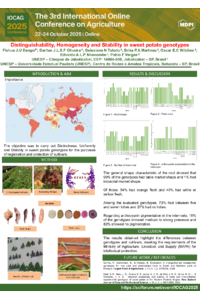
Banner - Conferência Internacional Agricultura MDPI online 22-24 Outuber - Fishua.pdf
From the zoonotic risk to the economic losses: a serosurvey of ten pathogens in pig farms in the Campania region
Smart Farming and Digital Divide: Structural Inequalities in Access to AI and Digital Technologies among Smallholder Farmers