Event submissions
Published
This submission belongs to the session S9. Farm Animal Production of the event The 3rd International Online Conference on Agriculture
Published date
20 Oct, 2025
Academic Editor
'%3e%3cpath%20d='M12.6657%2010.9104C12.4185%2010.325%2012.0599%209.79327%2011.6097%209.34482C11.1609%208.89508%2010.6293%208.5365%2010.0442%208.28888C10.0389%208.28626%2010.0337%208.28495%2010.0285%208.28233C10.8446%207.69279%2011.3752%206.73249%2011.3752%205.64904C11.3752%203.8542%209.92103%202.39999%208.1262%202.39999C6.33136%202.39999%204.87715%203.8542%204.87715%205.64904C4.87715%206.73249%205.40774%207.69279%206.22393%208.28364C6.21869%208.28626%206.21345%208.28757%206.20821%208.29019C5.62129%208.5378%205.09463%208.89284%204.64265%209.34613C4.1929%209.79493%203.83432%2010.3266%203.58671%2010.9117C3.34345%2011.4845%203.21226%2012.0987%203.20023%2012.7209C3.19988%2012.7349%203.20233%2012.7488%203.20744%2012.7619C3.21255%2012.7749%203.22022%2012.7867%203.22998%2012.7968C3.23975%2012.8068%203.25142%2012.8147%203.26431%2012.8202C3.2772%2012.8256%203.29105%2012.8284%203.30504%2012.8284H4.09109C4.14874%2012.8284%204.19459%2012.7825%204.1959%2012.7262C4.2221%2011.7148%204.62823%2010.7676%205.34617%2010.0497C6.08899%209.30683%207.0755%208.89808%208.1262%208.89808C9.17689%208.89808%2010.1634%209.30683%2010.9062%2010.0497C11.6242%2010.7676%2012.0303%2011.7148%2012.0565%2012.7262C12.0578%2012.7838%2012.1037%2012.8284%2012.1613%2012.8284H12.9474C12.9613%2012.8284%2012.9752%2012.8256%2012.9881%2012.8202C13.001%2012.8147%2013.0126%2012.8068%2013.0224%2012.7968C13.0322%2012.7867%2013.0398%2012.7749%2013.0449%2012.7619C13.0501%2012.7488%2013.0525%2012.7349%2013.0522%2012.7209C13.0391%2012.0947%2012.9094%2011.4855%2012.6657%2010.9104ZM8.1262%207.9024C7.52486%207.9024%206.9589%207.6679%206.53312%207.24211C6.10733%206.81633%205.87283%206.25037%205.87283%205.64904C5.87283%205.0477%206.10733%204.48174%206.53312%204.05596C6.9589%203.63018%207.52486%203.39567%208.1262%203.39567C8.72753%203.39567%209.29349%203.63018%209.71927%204.05596C10.1451%204.48174%2010.3796%205.0477%2010.3796%205.64904C10.3796%206.25037%2010.1451%206.81633%209.71927%207.24211C9.29349%207.6679%208.72753%207.9024%208.1262%207.9024Z'%20fill='%235D1EE1'/%3e%3c/g%3e%3c/svg%3e) Jalil Ghassemi Nejad
Jalil Ghassemi NejadCitation
Angelo Francis Fausto Atole, Jade Dhapnee Z Compendio, Oscar B Posas, Lijueraj J Cuadra, Manuel D Gacutan, Jr., In situ Rumen Degradation of Fresh and Ensiled Guinea Grass (Megathyrsus maximus Jacq.) Cultivars Harvested at 30 and 45 Days, in Proceedings of The 3rd International Online Conference on Agriculture, 22 October–24 October 2025, MDPI: Basel, Switzerland
Share
Email
Facebook
Twitter
LinkedIn
In situ Rumen Degradation of Fresh and Ensiled Guinea Grass (Megathyrsus maximus Jacq.) Cultivars Harvested at 30 and 45 Days
'%3e%3cpath%20d='M12.6647%2010.9104C12.4176%2010.325%2012.0589%209.7933%2011.6088%209.34485C11.16%208.89511%2010.6283%208.53653%2010.0432%208.28891C10.038%208.28629%2010.0327%208.28498%2010.0275%208.28236C10.8437%207.69282%2011.3743%206.73252%2011.3743%205.64907C11.3743%203.85423%209.92005%202.40002%208.12522%202.40002C6.33038%202.40002%204.87618%203.85423%204.87618%205.64907C4.87618%206.73252%205.40677%207.69282%206.22296%208.28367C6.21772%208.28629%206.21248%208.2876%206.20724%208.29022C5.62031%208.53783%205.09365%208.89287%204.64167%209.34616C4.19192%209.79496%203.83334%2010.3266%203.58573%2010.9117C3.34247%2011.4846%203.21128%2012.0987%203.19925%2012.721C3.1989%2012.735%203.20135%2012.7489%203.20646%2012.7619C3.21157%2012.7749%203.21924%2012.7868%203.22901%2012.7968C3.23877%2012.8068%203.25045%2012.8148%203.26334%2012.8202C3.27623%2012.8256%203.29007%2012.8284%203.30406%2012.8284H4.09012C4.14776%2012.8284%204.19362%2012.7825%204.19493%2012.7262C4.22113%2011.7148%204.62726%2010.7676%205.34519%2010.0497C6.08802%209.30686%207.07452%208.89811%208.12522%208.89811C9.17592%208.89811%2010.1624%209.30686%2010.9052%2010.0497C11.6232%2010.7676%2012.0293%2011.7148%2012.0555%2012.7262C12.0568%2012.7839%2012.1027%2012.8284%2012.1603%2012.8284H12.9464C12.9604%2012.8284%2012.9742%2012.8256%2012.9871%2012.8202C13%2012.8148%2013.0117%2012.8068%2013.0214%2012.7968C13.0312%2012.7868%2013.0389%2012.7749%2013.044%2012.7619C13.0491%2012.7489%2013.0515%2012.735%2013.0512%2012.721C13.0381%2012.0947%2012.9084%2011.4856%2012.6647%2010.9104ZM8.12522%207.90243C7.52388%207.90243%206.95792%207.66793%206.53214%207.24215C6.10636%206.81636%205.87185%206.2504%205.87185%205.64907C5.87185%205.04773%206.10636%204.48177%206.53214%204.05599C6.95792%203.63021%207.52388%203.3957%208.12522%203.3957C8.72655%203.3957%209.29252%203.63021%209.7183%204.05599C10.1441%204.48177%2010.3786%205.04773%2010.3786%205.64907C10.3786%206.2504%2010.1441%206.81636%209.7183%207.24215C9.29252%207.66793%208.72655%207.90243%208.12522%207.90243Z'%20fill='%235D1EE1'/%3e%3c/g%3e%3c/svg%3e)
Angelo Francis Fausto Atole 1
Jade Dhapnee Z Compendio 2
Oscar B Posas 2
Lijueraj J Cuadra 2
Manuel D Gacutan, Jr. 2
1. Department of Animal Science, College of Agriculture & Natural Resources, Central Bicol State University of Agriculture, San Jose, Pili, Camarines Sur, Philippines 4418
2. Department of Animal Science, Visayas State University, Visca, Baybay City, Leyte, 6521, Philippines
Abstract
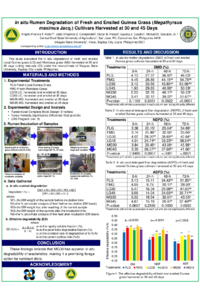
No prior studies have compared the in situ degradation of fresh and ensiled Guinea grass cultivars grown in the microclimate of Visayas State University, Baybay City, Leyte, the Philippines. This study evaluated the in situ degradation characteristics of two Guinea grass cultivars—Local Guinea grass (LG) and Mombasa grass (MG)—harvested at 30 and 45 days. Six test diets were prepared: fresh LG (FLG), fresh MG (FMG), and ensiled LG and MG harvested at 30 and 45 days (LG30, LG45, MG30, and MG45, respectively). Three rumen-fistulated Brahman heifers (180 ± 10 kg bodyweight) were dewormed, pre-conditioned, and incubated with the test diets using the sequential addition method at 0, 24, 48, and 72 hours. At 0 and 24 hours, all treatments showed a comparable degradation of DM and ADF (p>0.05). The NDF degradation of all treatments was comparable only at 0 hours. At 24 hours, MG30 showed significantly greater NDF degradation compared to most other treatments (p<0.01). At 48 and 72 hours, MG30 showed a significantly greater degradation of DM, NDF, and ADF compared to most other treatments (p<0.01). MG30 showed a significantly greater effective degradability of DM, NDF, and ADF compared to most other treatments (p<0.01). These findings indicate that MG30 has superior in situ degradability characteristics, making it a promising forage option for ruminant diets.
Keywords
Harvest age
in situ degradation
local guinea grass
mombasa grass
Poster
Angelo Francis F Atole Poster sciforum-137708.pdf
Smart Farming and Digital Divide: Structural Inequalities in Access to AI and Digital Technologies among Smallholder Farmers
Seasonal dynamics of in vitro fermentation of two woody plants, Phillyrea media and Rubus fruticosus: kinetic and methanogenic profiles