Event submissions
Published
This submission belongs to the session S2. Ecosystem, Environment, and Climate Change in Agriculture of the event The 3rd International Online Conference on Agriculture
Published date
20 Oct, 2025
Academic Editor
'%3e%3cpath%20d='M12.6657%2010.9104C12.4185%2010.325%2012.0599%209.79327%2011.6097%209.34482C11.1609%208.89508%2010.6293%208.5365%2010.0442%208.28888C10.0389%208.28626%2010.0337%208.28495%2010.0285%208.28233C10.8446%207.69279%2011.3752%206.73249%2011.3752%205.64904C11.3752%203.8542%209.92103%202.39999%208.1262%202.39999C6.33136%202.39999%204.87715%203.8542%204.87715%205.64904C4.87715%206.73249%205.40774%207.69279%206.22393%208.28364C6.21869%208.28626%206.21345%208.28757%206.20821%208.29019C5.62129%208.5378%205.09463%208.89284%204.64265%209.34613C4.1929%209.79493%203.83432%2010.3266%203.58671%2010.9117C3.34345%2011.4845%203.21226%2012.0987%203.20023%2012.7209C3.19988%2012.7349%203.20233%2012.7488%203.20744%2012.7619C3.21255%2012.7749%203.22022%2012.7867%203.22998%2012.7968C3.23975%2012.8068%203.25142%2012.8147%203.26431%2012.8202C3.2772%2012.8256%203.29105%2012.8284%203.30504%2012.8284H4.09109C4.14874%2012.8284%204.19459%2012.7825%204.1959%2012.7262C4.2221%2011.7148%204.62823%2010.7676%205.34617%2010.0497C6.08899%209.30683%207.0755%208.89808%208.1262%208.89808C9.17689%208.89808%2010.1634%209.30683%2010.9062%2010.0497C11.6242%2010.7676%2012.0303%2011.7148%2012.0565%2012.7262C12.0578%2012.7838%2012.1037%2012.8284%2012.1613%2012.8284H12.9474C12.9613%2012.8284%2012.9752%2012.8256%2012.9881%2012.8202C13.001%2012.8147%2013.0126%2012.8068%2013.0224%2012.7968C13.0322%2012.7867%2013.0398%2012.7749%2013.0449%2012.7619C13.0501%2012.7488%2013.0525%2012.7349%2013.0522%2012.7209C13.0391%2012.0947%2012.9094%2011.4855%2012.6657%2010.9104ZM8.1262%207.9024C7.52486%207.9024%206.9589%207.6679%206.53312%207.24211C6.10733%206.81633%205.87283%206.25037%205.87283%205.64904C5.87283%205.0477%206.10733%204.48174%206.53312%204.05596C6.9589%203.63018%207.52486%203.39567%208.1262%203.39567C8.72753%203.39567%209.29349%203.63018%209.71927%204.05596C10.1451%204.48174%2010.3796%205.0477%2010.3796%205.64904C10.3796%206.25037%2010.1451%206.81633%209.71927%207.24211C9.29349%207.6679%208.72753%207.9024%208.1262%207.9024Z'%20fill='%235D1EE1'/%3e%3c/g%3e%3c/svg%3e) Bin Gao
Bin GaoCitation
Yassine Mouniane, Mohamed El Bakkali, Issam El-Khadir, Ahmed Chriqui, Yassine Kadmi, Driss Hmouni, Resilience Strategies of Carob (Ceratonia siliqua L.) to Salt Stress: Multivariate Approaches and Artificial Intelligence for Sustainable Agriculture, in Proceedings of The 3rd International Online Conference on Agriculture, 22 October–24 October 2025, MDPI: Basel, Switzerland
Share
Email
Facebook
Twitter
LinkedIn
Resilience Strategies of Carob (Ceratonia siliqua L.) to Salt Stress: Multivariate Approaches and Artificial Intelligence for Sustainable Agriculture
'%3e%3cpath%20d='M12.6647%2010.9104C12.4176%2010.325%2012.0589%209.7933%2011.6088%209.34485C11.16%208.89511%2010.6283%208.53653%2010.0432%208.28891C10.038%208.28629%2010.0327%208.28498%2010.0275%208.28236C10.8437%207.69282%2011.3743%206.73252%2011.3743%205.64907C11.3743%203.85423%209.92005%202.40002%208.12522%202.40002C6.33038%202.40002%204.87618%203.85423%204.87618%205.64907C4.87618%206.73252%205.40677%207.69282%206.22296%208.28367C6.21772%208.28629%206.21248%208.2876%206.20724%208.29022C5.62031%208.53783%205.09365%208.89287%204.64167%209.34616C4.19192%209.79496%203.83334%2010.3266%203.58573%2010.9117C3.34247%2011.4846%203.21128%2012.0987%203.19925%2012.721C3.1989%2012.735%203.20135%2012.7489%203.20646%2012.7619C3.21157%2012.7749%203.21924%2012.7868%203.22901%2012.7968C3.23877%2012.8068%203.25045%2012.8148%203.26334%2012.8202C3.27623%2012.8256%203.29007%2012.8284%203.30406%2012.8284H4.09012C4.14776%2012.8284%204.19362%2012.7825%204.19493%2012.7262C4.22113%2011.7148%204.62726%2010.7676%205.34519%2010.0497C6.08802%209.30686%207.07452%208.89811%208.12522%208.89811C9.17592%208.89811%2010.1624%209.30686%2010.9052%2010.0497C11.6232%2010.7676%2012.0293%2011.7148%2012.0555%2012.7262C12.0568%2012.7839%2012.1027%2012.8284%2012.1603%2012.8284H12.9464C12.9604%2012.8284%2012.9742%2012.8256%2012.9871%2012.8202C13%2012.8148%2013.0117%2012.8068%2013.0214%2012.7968C13.0312%2012.7868%2013.0389%2012.7749%2013.044%2012.7619C13.0491%2012.7489%2013.0515%2012.735%2013.0512%2012.721C13.0381%2012.0947%2012.9084%2011.4856%2012.6647%2010.9104ZM8.12522%207.90243C7.52388%207.90243%206.95792%207.66793%206.53214%207.24215C6.10636%206.81636%205.87185%206.2504%205.87185%205.64907C5.87185%205.04773%206.10636%204.48177%206.53214%204.05599C6.95792%203.63021%207.52388%203.3957%208.12522%203.3957C8.72655%203.3957%209.29252%203.63021%209.7183%204.05599C10.1441%204.48177%2010.3786%205.04773%2010.3786%205.64907C10.3786%206.2504%2010.1441%206.81636%209.7183%207.24215C9.29252%207.66793%208.72655%207.90243%208.12522%207.90243Z'%20fill='%235D1EE1'/%3e%3c/g%3e%3c/svg%3e)
Yassine Mouniane 1
Mohamed El Bakkali 2,3
Issam El-Khadir 4
Ahmed Chriqui 4

Yassine Kadmi 5,6
Driss Hmouni 4
1. Laboratory of Natural Resources and Sustainable Development, Faculty of Sciences, University Ibn TofaIl, Kenitra, Morocco
2. Biology and Health Laboratory, Higher Institute of Nursing and Health Techniques Faculty of Science, Ibn Tofail University, Kenitra 14000, Morocco
3. Natural Resources and Sustainable Development laboratory, Faculty of Sciences, Ibn Tofail University, Ke-nitra, Morocco
4. Laboratory of Natural Resources and Sustainable Development, Faculty of Sciences, Ibn Tofaïl University—KENITRA-University Campus, Kenitra 14000, Morocco
5. LASIRE, Equipe Physico-Chimie de l’Environnement, CNRS UMR 8516, Université Lille, Sciences et Tech-nologies, CEDEX, 59655 Villeneuve d′Ascq, France
6. Department of Chemistry, Université d’Artois, IUT de Béthune, 62400 Béthune, France
Abstract
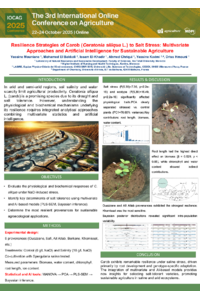
In arid and semi-arid regions, where water scarcity and soil salinization are major challenges, carob (Ceratonia siliqua L.) has gained attention as a potential drought- and salt-tolerant crop. However, its ability to withstand salt stress is determined by a complex interplay of genetic, physiological, and environmental factors, which requires a comprehensive approach to fully understand. This study aims to explore the resilience of carob to salt stress by integrating advanced multivariate methods, Partial Least Squares Structural Equation Modeling (PLS-SEM), and Artificial Intelligence-assisted Bayesian Inference to identify key determinants of stress tolerance. Through a Multivariate Analysis of Variance (MANOVA), we found significant effects of salt stress (F(5,30) = 7.3637, p < 2.2e-16) and ecotype (F(5,30) = 16.4968, p < 2.2e-16) on physiological and biochemical traits. The Principal Component Analysis (PCA) revealed a distinct separation between stressed and control plants, with the first principal component (PC1) explaining 76.66% of the variance, which was closely related to biomass, water content, and root length. The PLS-SEM model identified root length as the primary factor influencing biomass (coefficient = 0.629, p < 0.05), while water content and chlorophyll had no direct significant effect. Hierarchical Bayesian Inference allowed for the assessment of intra-population variability, showing that the Ouazzane provenance exhibited the highest salt resistance, followed by Safi and Aït Attab, while Khemissat proved the most vulnerable. Additionally, specific environmental effects (E[i]) demonstrated that certain provenances, such as Berkane and Aït Attab, benefitted significantly from co-cultivation with Spergularia salina under 10 g/L NaCl. These findings underline the importance of varietal selection and biotic interactions as effective strategies to mitigate salt stress, highlighting the potential for agroecological adaptation of carob to increasingly saline environments, offering valuable insights for sustainable agricultural practices in areas affected by salinity.
Keywords
Salt stress resilience
multivariate analysis
PLS-SEM modeling
Bayesian inference
agroecological adaptation.
Poster
poster .pdf
how exogenously administered ascorbic acid may reduce the negative effects of NaCl on maize (Zea mays).
In Vitro Gas Production, Methanogenesis, Dry Matter Degradability, and Rumen Metabolites of Ripe and Abscised Unripe Mango Fruits of Three Varieties