Event submissions
Published
This submission belongs to the session S11. Crop Genetics, Genomics and Breeding of the event The 3rd International Online Conference on Agriculture
Published date
20 Oct, 2025
Academic Editor
'%3e%3cpath%20d='M12.6657%2010.9104C12.4185%2010.325%2012.0599%209.79327%2011.6097%209.34482C11.1609%208.89508%2010.6293%208.5365%2010.0442%208.28888C10.0389%208.28626%2010.0337%208.28495%2010.0285%208.28233C10.8446%207.69279%2011.3752%206.73249%2011.3752%205.64904C11.3752%203.8542%209.92103%202.39999%208.1262%202.39999C6.33136%202.39999%204.87715%203.8542%204.87715%205.64904C4.87715%206.73249%205.40774%207.69279%206.22393%208.28364C6.21869%208.28626%206.21345%208.28757%206.20821%208.29019C5.62129%208.5378%205.09463%208.89284%204.64265%209.34613C4.1929%209.79493%203.83432%2010.3266%203.58671%2010.9117C3.34345%2011.4845%203.21226%2012.0987%203.20023%2012.7209C3.19988%2012.7349%203.20233%2012.7488%203.20744%2012.7619C3.21255%2012.7749%203.22022%2012.7867%203.22998%2012.7968C3.23975%2012.8068%203.25142%2012.8147%203.26431%2012.8202C3.2772%2012.8256%203.29105%2012.8284%203.30504%2012.8284H4.09109C4.14874%2012.8284%204.19459%2012.7825%204.1959%2012.7262C4.2221%2011.7148%204.62823%2010.7676%205.34617%2010.0497C6.08899%209.30683%207.0755%208.89808%208.1262%208.89808C9.17689%208.89808%2010.1634%209.30683%2010.9062%2010.0497C11.6242%2010.7676%2012.0303%2011.7148%2012.0565%2012.7262C12.0578%2012.7838%2012.1037%2012.8284%2012.1613%2012.8284H12.9474C12.9613%2012.8284%2012.9752%2012.8256%2012.9881%2012.8202C13.001%2012.8147%2013.0126%2012.8068%2013.0224%2012.7968C13.0322%2012.7867%2013.0398%2012.7749%2013.0449%2012.7619C13.0501%2012.7488%2013.0525%2012.7349%2013.0522%2012.7209C13.0391%2012.0947%2012.9094%2011.4855%2012.6657%2010.9104ZM8.1262%207.9024C7.52486%207.9024%206.9589%207.6679%206.53312%207.24211C6.10733%206.81633%205.87283%206.25037%205.87283%205.64904C5.87283%205.0477%206.10733%204.48174%206.53312%204.05596C6.9589%203.63018%207.52486%203.39567%208.1262%203.39567C8.72753%203.39567%209.29349%203.63018%209.71927%204.05596C10.1451%204.48174%2010.3796%205.0477%2010.3796%205.64904C10.3796%206.25037%2010.1451%206.81633%209.71927%207.24211C9.29349%207.6679%208.72753%207.9024%208.1262%207.9024Z'%20fill='%235D1EE1'/%3e%3c/g%3e%3c/svg%3e) Rodomiro Ortiz
Rodomiro OrtizCitation
Nor'Aishah Hasan, NORFARAH NADHIRAH AHMAD NORUDDIN, Muhammad Nabil Haqiem Hisham, Alif Ihsaan Mohd Akmal Shukri, ABDUL RAHIM HARUN, Genotype × Environment Interaction and Yield Stability of UiTM Advanced Rice Lines, in Proceedings of The 3rd International Online Conference on Agriculture, 22 October–24 October 2025, MDPI: Basel, Switzerland
Share
Email
Facebook
Twitter
LinkedIn
Genotype × Environment Interaction and Yield Stability of UiTM Advanced Rice Lines
'%3e%3cpath%20d='M12.6647%2010.9104C12.4176%2010.325%2012.0589%209.7933%2011.6088%209.34485C11.16%208.89511%2010.6283%208.53653%2010.0432%208.28891C10.038%208.28629%2010.0327%208.28498%2010.0275%208.28236C10.8437%207.69282%2011.3743%206.73252%2011.3743%205.64907C11.3743%203.85423%209.92005%202.40002%208.12522%202.40002C6.33038%202.40002%204.87618%203.85423%204.87618%205.64907C4.87618%206.73252%205.40677%207.69282%206.22296%208.28367C6.21772%208.28629%206.21248%208.2876%206.20724%208.29022C5.62031%208.53783%205.09365%208.89287%204.64167%209.34616C4.19192%209.79496%203.83334%2010.3266%203.58573%2010.9117C3.34247%2011.4846%203.21128%2012.0987%203.19925%2012.721C3.1989%2012.735%203.20135%2012.7489%203.20646%2012.7619C3.21157%2012.7749%203.21924%2012.7868%203.22901%2012.7968C3.23877%2012.8068%203.25045%2012.8148%203.26334%2012.8202C3.27623%2012.8256%203.29007%2012.8284%203.30406%2012.8284H4.09012C4.14776%2012.8284%204.19362%2012.7825%204.19493%2012.7262C4.22113%2011.7148%204.62726%2010.7676%205.34519%2010.0497C6.08802%209.30686%207.07452%208.89811%208.12522%208.89811C9.17592%208.89811%2010.1624%209.30686%2010.9052%2010.0497C11.6232%2010.7676%2012.0293%2011.7148%2012.0555%2012.7262C12.0568%2012.7839%2012.1027%2012.8284%2012.1603%2012.8284H12.9464C12.9604%2012.8284%2012.9742%2012.8256%2012.9871%2012.8202C13%2012.8148%2013.0117%2012.8068%2013.0214%2012.7968C13.0312%2012.7868%2013.0389%2012.7749%2013.044%2012.7619C13.0491%2012.7489%2013.0515%2012.735%2013.0512%2012.721C13.0381%2012.0947%2012.9084%2011.4856%2012.6647%2010.9104ZM8.12522%207.90243C7.52388%207.90243%206.95792%207.66793%206.53214%207.24215C6.10636%206.81636%205.87185%206.2504%205.87185%205.64907C5.87185%205.04773%206.10636%204.48177%206.53214%204.05599C6.95792%203.63021%207.52388%203.3957%208.12522%203.3957C8.72655%203.3957%209.29252%203.63021%209.7183%204.05599C10.1441%204.48177%2010.3786%205.04773%2010.3786%205.64907C10.3786%206.2504%2010.1441%206.81636%209.7183%207.24215C9.29252%207.66793%208.72655%207.90243%208.12522%207.90243Z'%20fill='%235D1EE1'/%3e%3c/g%3e%3c/svg%3e)
Nor'Aishah Hasan 1
NORFARAH NADHIRAH AHMAD NORUDDIN 1
Muhammad Nabil Haqiem Hisham 1
Alif Ihsaan Mohd Akmal Shukri 1
ABDUL RAHIM HARUN 2
1. Department of Fakulti Sains Gunaan, Universiti Teknologi MARA (UiTM), Shah Alam 40450, Selangor, Malaysia
2. PERTAMA PAI (Malaysia) Sdn. Bhd., Kedah, Malaysia
Abstract
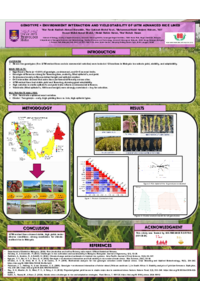
Genotype × environment (G×E) interaction plays a pivotal role in determining the stability and adaptability of rice cultivars under diverse agro-ecological conditions. This study evaluated five gamma-irradiation-derived UiTM advanced rice mutant lines and six commercial varieties across 12 locations in Malaysia to assess yield performance, phenotypic variability, and stability. The two-way ANOVA revealed highly significant (p < 0.001) effects of genotype, environment, and their interaction on most agronomic traits. Notably, substantial genotypic variation was observed in days to 50% flowering (DTF50), days to maturity (DTM85), number of filled spikelets (NFS), and yield per plant (YLDPLT), while environmental effects were dominant for plant height (PH) and number of spikelets (NOS), highlighting the influence of location-specific factors such as rainfall and soil fertility.
Significant G×E interactions for traits including NFS, YLDPLT, and seed length-to-width ratio (SLSWR) indicated crossover performance among genotypes across environments. Several UiTM mutant lines demonstrated consistent flowering times and stable yield expression, suggesting their suitability for broad or specific adaptation. Descriptive statistics revealed high coefficients of variation in sterile spikelets (CV = 54.91%) and yield traits, indicating environmental sensitivity. The correlation analysis showed strong positive associations between yield components such as NFS, TSW, and YLDPLT, supporting their role as key selection criteria.
The principal component analysis (PCA) identified yield traits as major contributors to phenotypic variability (PC1 = 45.8%), while grain morphology traits loaded strongly onto PC2 (22.8%). The cluster analysis grouped the genotypes into two categories: early-maturing, high-yielding lines and late-maturing types with greater spikelet numbers. These findings emphasize the need for multi-location trials and a G×E analysis to guide varietal selection. The stable performance of the UiTM lines under varying conditions underscores their potential as candidates for climate-resilient rice cultivation in Malaysia.
Keywords
Genotype × environment interaction
yield stability
UiTM rice lines
gamma irradiation
multi-location trials
climate-resilient cultivars
Poster
POSTER MDPI Conference.pdf
Symbiotic AI for Resilient Agriculture: A Federated Co-learning Framework with Interactive Counterfactual Explanations for Crop Disease Management
Exploring the Biochemical Dynamics of Rice and Rice Leaf Folder (Cnaphalocrocis medinalis) Under Elevated CO₂ Conditions