Event submissions
Published
This submission belongs to the session S2. Ecosystem, Environment, and Climate Change in Agriculture of the event The 3rd International Online Conference on Agriculture
Published date
20 Oct, 2025
Academic Editor
'%3e%3cpath%20d='M12.6657%2010.9104C12.4185%2010.325%2012.0599%209.79327%2011.6097%209.34482C11.1609%208.89508%2010.6293%208.5365%2010.0442%208.28888C10.0389%208.28626%2010.0337%208.28495%2010.0285%208.28233C10.8446%207.69279%2011.3752%206.73249%2011.3752%205.64904C11.3752%203.8542%209.92103%202.39999%208.1262%202.39999C6.33136%202.39999%204.87715%203.8542%204.87715%205.64904C4.87715%206.73249%205.40774%207.69279%206.22393%208.28364C6.21869%208.28626%206.21345%208.28757%206.20821%208.29019C5.62129%208.5378%205.09463%208.89284%204.64265%209.34613C4.1929%209.79493%203.83432%2010.3266%203.58671%2010.9117C3.34345%2011.4845%203.21226%2012.0987%203.20023%2012.7209C3.19988%2012.7349%203.20233%2012.7488%203.20744%2012.7619C3.21255%2012.7749%203.22022%2012.7867%203.22998%2012.7968C3.23975%2012.8068%203.25142%2012.8147%203.26431%2012.8202C3.2772%2012.8256%203.29105%2012.8284%203.30504%2012.8284H4.09109C4.14874%2012.8284%204.19459%2012.7825%204.1959%2012.7262C4.2221%2011.7148%204.62823%2010.7676%205.34617%2010.0497C6.08899%209.30683%207.0755%208.89808%208.1262%208.89808C9.17689%208.89808%2010.1634%209.30683%2010.9062%2010.0497C11.6242%2010.7676%2012.0303%2011.7148%2012.0565%2012.7262C12.0578%2012.7838%2012.1037%2012.8284%2012.1613%2012.8284H12.9474C12.9613%2012.8284%2012.9752%2012.8256%2012.9881%2012.8202C13.001%2012.8147%2013.0126%2012.8068%2013.0224%2012.7968C13.0322%2012.7867%2013.0398%2012.7749%2013.0449%2012.7619C13.0501%2012.7488%2013.0525%2012.7349%2013.0522%2012.7209C13.0391%2012.0947%2012.9094%2011.4855%2012.6657%2010.9104ZM8.1262%207.9024C7.52486%207.9024%206.9589%207.6679%206.53312%207.24211C6.10733%206.81633%205.87283%206.25037%205.87283%205.64904C5.87283%205.0477%206.10733%204.48174%206.53312%204.05596C6.9589%203.63018%207.52486%203.39567%208.1262%203.39567C8.72753%203.39567%209.29349%203.63018%209.71927%204.05596C10.1451%204.48174%2010.3796%205.0477%2010.3796%205.64904C10.3796%206.25037%2010.1451%206.81633%209.71927%207.24211C9.29349%207.6679%208.72753%207.9024%208.1262%207.9024Z'%20fill='%235D1EE1'/%3e%3c/g%3e%3c/svg%3e) Bin Gao
Bin GaoCitation
Arya PS, Subhash Chander, Rajna Salim, Sachin Suroshe, Prabhulinga T, Yogesh Yele, Exploring the Biochemical Dynamics of Rice and Rice Leaf Folder (Cnaphalocrocis medinalis) Under Elevated CO₂ Conditions, in Proceedings of The 3rd International Online Conference on Agriculture, 22 October–24 October 2025, MDPI: Basel, Switzerland
Share
Email
Facebook
Twitter
LinkedIn
Exploring the Biochemical Dynamics of Rice and Rice Leaf Folder (Cnaphalocrocis medinalis) Under Elevated CO₂ Conditions
'%3e%3cpath%20d='M12.6647%2010.9104C12.4176%2010.325%2012.0589%209.7933%2011.6088%209.34485C11.16%208.89511%2010.6283%208.53653%2010.0432%208.28891C10.038%208.28629%2010.0327%208.28498%2010.0275%208.28236C10.8437%207.69282%2011.3743%206.73252%2011.3743%205.64907C11.3743%203.85423%209.92005%202.40002%208.12522%202.40002C6.33038%202.40002%204.87618%203.85423%204.87618%205.64907C4.87618%206.73252%205.40677%207.69282%206.22296%208.28367C6.21772%208.28629%206.21248%208.2876%206.20724%208.29022C5.62031%208.53783%205.09365%208.89287%204.64167%209.34616C4.19192%209.79496%203.83334%2010.3266%203.58573%2010.9117C3.34247%2011.4846%203.21128%2012.0987%203.19925%2012.721C3.1989%2012.735%203.20135%2012.7489%203.20646%2012.7619C3.21157%2012.7749%203.21924%2012.7868%203.22901%2012.7968C3.23877%2012.8068%203.25045%2012.8148%203.26334%2012.8202C3.27623%2012.8256%203.29007%2012.8284%203.30406%2012.8284H4.09012C4.14776%2012.8284%204.19362%2012.7825%204.19493%2012.7262C4.22113%2011.7148%204.62726%2010.7676%205.34519%2010.0497C6.08802%209.30686%207.07452%208.89811%208.12522%208.89811C9.17592%208.89811%2010.1624%209.30686%2010.9052%2010.0497C11.6232%2010.7676%2012.0293%2011.7148%2012.0555%2012.7262C12.0568%2012.7839%2012.1027%2012.8284%2012.1603%2012.8284H12.9464C12.9604%2012.8284%2012.9742%2012.8256%2012.9871%2012.8202C13%2012.8148%2013.0117%2012.8068%2013.0214%2012.7968C13.0312%2012.7868%2013.0389%2012.7749%2013.044%2012.7619C13.0491%2012.7489%2013.0515%2012.735%2013.0512%2012.721C13.0381%2012.0947%2012.9084%2011.4856%2012.6647%2010.9104ZM8.12522%207.90243C7.52388%207.90243%206.95792%207.66793%206.53214%207.24215C6.10636%206.81636%205.87185%206.2504%205.87185%205.64907C5.87185%205.04773%206.10636%204.48177%206.53214%204.05599C6.95792%203.63021%207.52388%203.3957%208.12522%203.3957C8.72655%203.3957%209.29252%203.63021%209.7183%204.05599C10.1441%204.48177%2010.3786%205.04773%2010.3786%205.64907C10.3786%206.2504%2010.1441%206.81636%209.7183%207.24215C9.29252%207.66793%208.72655%207.90243%208.12522%207.90243Z'%20fill='%235D1EE1'/%3e%3c/g%3e%3c/svg%3e)
Arya PS 1
Subhash Chander 2
Rajna Salim 3
Sachin Suroshe 3
Prabhulinga T 4
Yogesh Yele 5
1. Assistant Professor, Department of Entomology, CCR(PG) College, Muzaffarnagar, Uttar Pradesh, India
2. Director (Retired), ICAR-National Research Centre for Integrated Pest Management, New Delhi, India
3. Scientist, Division of Entomology, ICAR- Indian Agricultural Research Institute, New Delhi, India
4. Scientist, ICAR- National Bureau of Agricultural Insect Resources, Bengaluru, India
5. Scientist, ICAR- National Institute of Biotic Stress Management, Raipur, India
Abstract
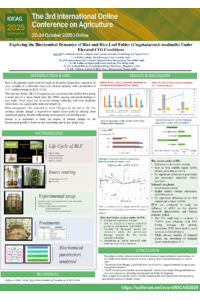
Rice (Oryza sativa L.) is a vital cereal crop that is significantly impacted by biotic and abiotic stresses. Insect pests, causing 21% of annual yield losses, are the primary biotic stressors. Among them, the rice leaf folder (Cnaphalocrocis medinalis), a major foliage feeder, is the most devastating one. Abiotic stresses, including rising temperatures and CO₂ levels, also threaten rice yield. Atmospheric CO₂ levels are projected to reach 570 ppm by 2050 due to increased greenhouse gas emissions, exacerbating the stress on rice production. An experiment was conducted to study the effect of elevated CO2 (eCO₂) on biochemical changes in rice leaf folder. This study was conducted in Open-Top Chambers (OTCs), provided by the Division of Plant Physiology, Indian Agricultural Research Institute, New Delhi, India. Under eCO2 conditions, the rice plants showed a 26.47% increase in the total number of leaves and improved yield; however, leaf folder infestation reduced the leaf increase to 22.69% and led to a decline in yield. Biochemical changes in the rice plants included a reduced protein content, increased carbon-based compounds (TSS and phenols), elevated catalase activity, and stable peroxidase and SOD activities. The eCO2 conditions had a significant impact on the rice leaf folder as well, as the larval duration was found to be increased, the percentage survival was reduced, and the larval weight increased. The biochemical analysis of the larval population revealed that the protein content had reduced significantly, while the defense enzymes, viz. catalase, peroxidase, and SOD, were found to have increased. While the effects of eCO₂ and rice leaf folder infestation on the morpho-chemical traits of rice are well studied, their combined impact remains less explored. Hence, principal component analysis (PCA) was employed to reduce the complexity of the dataset, revealing that eCO₂ enhanced the growth and yield of rice but negatively affected rice leaf folder survival and development, although the larvae's damage capacity increased.
Keywords
Rice leaf folder
elevated CO₂
Open Top Chamber
biochemical analysis
principal component analysis
Poster
poster IOCAG.pdf
Genotype × Environment Interaction and Yield Stability of UiTM Advanced Rice Lines
Sericulture for Economic Empowerment: Evidence from Community-Based Projects in Binalonan, Pangasinan, Philippines