Event submissions
Published
This submission belongs to the session S9. Farm Animal Production of the event The 3rd International Online Conference on Agriculture
Published date
20 Oct, 2025
Academic Editor
'%3e%3cpath%20d='M12.6657%2010.9104C12.4185%2010.325%2012.0599%209.79327%2011.6097%209.34482C11.1609%208.89508%2010.6293%208.5365%2010.0442%208.28888C10.0389%208.28626%2010.0337%208.28495%2010.0285%208.28233C10.8446%207.69279%2011.3752%206.73249%2011.3752%205.64904C11.3752%203.8542%209.92103%202.39999%208.1262%202.39999C6.33136%202.39999%204.87715%203.8542%204.87715%205.64904C4.87715%206.73249%205.40774%207.69279%206.22393%208.28364C6.21869%208.28626%206.21345%208.28757%206.20821%208.29019C5.62129%208.5378%205.09463%208.89284%204.64265%209.34613C4.1929%209.79493%203.83432%2010.3266%203.58671%2010.9117C3.34345%2011.4845%203.21226%2012.0987%203.20023%2012.7209C3.19988%2012.7349%203.20233%2012.7488%203.20744%2012.7619C3.21255%2012.7749%203.22022%2012.7867%203.22998%2012.7968C3.23975%2012.8068%203.25142%2012.8147%203.26431%2012.8202C3.2772%2012.8256%203.29105%2012.8284%203.30504%2012.8284H4.09109C4.14874%2012.8284%204.19459%2012.7825%204.1959%2012.7262C4.2221%2011.7148%204.62823%2010.7676%205.34617%2010.0497C6.08899%209.30683%207.0755%208.89808%208.1262%208.89808C9.17689%208.89808%2010.1634%209.30683%2010.9062%2010.0497C11.6242%2010.7676%2012.0303%2011.7148%2012.0565%2012.7262C12.0578%2012.7838%2012.1037%2012.8284%2012.1613%2012.8284H12.9474C12.9613%2012.8284%2012.9752%2012.8256%2012.9881%2012.8202C13.001%2012.8147%2013.0126%2012.8068%2013.0224%2012.7968C13.0322%2012.7867%2013.0398%2012.7749%2013.0449%2012.7619C13.0501%2012.7488%2013.0525%2012.7349%2013.0522%2012.7209C13.0391%2012.0947%2012.9094%2011.4855%2012.6657%2010.9104ZM8.1262%207.9024C7.52486%207.9024%206.9589%207.6679%206.53312%207.24211C6.10733%206.81633%205.87283%206.25037%205.87283%205.64904C5.87283%205.0477%206.10733%204.48174%206.53312%204.05596C6.9589%203.63018%207.52486%203.39567%208.1262%203.39567C8.72753%203.39567%209.29349%203.63018%209.71927%204.05596C10.1451%204.48174%2010.3796%205.0477%2010.3796%205.64904C10.3796%206.25037%2010.1451%206.81633%209.71927%207.24211C9.29349%207.6679%208.72753%207.9024%208.1262%207.9024Z'%20fill='%235D1EE1'/%3e%3c/g%3e%3c/svg%3e) Jalil Ghassemi Nejad
Jalil Ghassemi NejadCitation
Edwina Valdez Garcia, Rodolfo Gaon Nillo, Elizabeth Padonan Obra, Sericulture for Economic Empowerment: Evidence from Community-Based Projects in Binalonan, Pangasinan, Philippines, in Proceedings of The 3rd International Online Conference on Agriculture, 22 October–24 October 2025, MDPI: Basel, Switzerland
Share
Email
Facebook
Twitter
LinkedIn
Sericulture for Economic Empowerment: Evidence from Community-Based Projects in Binalonan, Pangasinan, Philippines
'%3e%3cpath%20d='M12.6647%2010.9104C12.4176%2010.325%2012.0589%209.7933%2011.6088%209.34485C11.16%208.89511%2010.6283%208.53653%2010.0432%208.28891C10.038%208.28629%2010.0327%208.28498%2010.0275%208.28236C10.8437%207.69282%2011.3743%206.73252%2011.3743%205.64907C11.3743%203.85423%209.92005%202.40002%208.12522%202.40002C6.33038%202.40002%204.87618%203.85423%204.87618%205.64907C4.87618%206.73252%205.40677%207.69282%206.22296%208.28367C6.21772%208.28629%206.21248%208.2876%206.20724%208.29022C5.62031%208.53783%205.09365%208.89287%204.64167%209.34616C4.19192%209.79496%203.83334%2010.3266%203.58573%2010.9117C3.34247%2011.4846%203.21128%2012.0987%203.19925%2012.721C3.1989%2012.735%203.20135%2012.7489%203.20646%2012.7619C3.21157%2012.7749%203.21924%2012.7868%203.22901%2012.7968C3.23877%2012.8068%203.25045%2012.8148%203.26334%2012.8202C3.27623%2012.8256%203.29007%2012.8284%203.30406%2012.8284H4.09012C4.14776%2012.8284%204.19362%2012.7825%204.19493%2012.7262C4.22113%2011.7148%204.62726%2010.7676%205.34519%2010.0497C6.08802%209.30686%207.07452%208.89811%208.12522%208.89811C9.17592%208.89811%2010.1624%209.30686%2010.9052%2010.0497C11.6232%2010.7676%2012.0293%2011.7148%2012.0555%2012.7262C12.0568%2012.7839%2012.1027%2012.8284%2012.1603%2012.8284H12.9464C12.9604%2012.8284%2012.9742%2012.8256%2012.9871%2012.8202C13%2012.8148%2013.0117%2012.8068%2013.0214%2012.7968C13.0312%2012.7868%2013.0389%2012.7749%2013.044%2012.7619C13.0491%2012.7489%2013.0515%2012.735%2013.0512%2012.721C13.0381%2012.0947%2012.9084%2011.4856%2012.6647%2010.9104ZM8.12522%207.90243C7.52388%207.90243%206.95792%207.66793%206.53214%207.24215C6.10636%206.81636%205.87185%206.2504%205.87185%205.64907C5.87185%205.04773%206.10636%204.48177%206.53214%204.05599C6.95792%203.63021%207.52388%203.3957%208.12522%203.3957C8.72655%203.3957%209.29252%203.63021%209.7183%204.05599C10.1441%204.48177%2010.3786%205.04773%2010.3786%205.64907C10.3786%206.2504%2010.1441%206.81636%209.7183%207.24215C9.29252%207.66793%208.72655%207.90243%208.12522%207.90243Z'%20fill='%235D1EE1'/%3e%3c/g%3e%3c/svg%3e)
Edwina Valdez Garcia 1
Rodolfo Gaon Nillo 2
Elizabeth Padonan Obra 1
1. Sericulture Research and Development Institute, Don Mariano Marcos Memorial State University, Bacnotan, La Union 2515, Philippines
2. Don Mariano Marcos Memorial State University – North La Union Campus, Bacnotan, La Union 2515, Philippines
Abstract
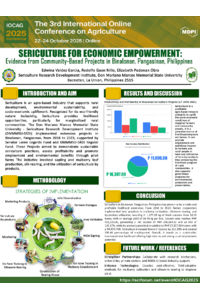
Sericulture is an agro-based industry that supports rural development, environmental sustainability, and socio-economic upliftment. Recognized for its eco-friendly nature and inclusivity, sericulture provides livelihood opportunities, particularly for marginalized rural communities. The Don Mariano Marcos Memorial State University–Sericulture Research and Development Institute (DMMMSU-SRDI) in the Philippines implemented extension projects in Binalonan, Pangasinan, from 2018 to 2023, supported by the Senator Loren Legarda Fund and DMMMSU-SRDI Regular Fund. These projects aimed to demonstrate sustainable sericulture practices, assess profitability, and promote employment and environmental benefits through pilot farms. The initiative involved sapling and mulberry leaf production, silkworm rearing, and the utilization of sericulture by-products. Best practices included sapling propagation (pot and plot methods), rainfed mulberry establishment (0.9 ha), rearing house construction, synchronized silkworm rearing, and value-adding activities. Over five years, 69 silkworm batches were reared using 52.05 boxes of fourth-instar larvae, fed with over 144,000 kg of mulberry leaves. This resulted in 1,377.19 kg of fresh cocoons, generating PHP 411,320.00 in sales and a net income of PHP 248,164.10 with a return on investment (ROI) of 155.17%. Furthermore, additional income was generated through sericulture by-products (PHP 27,307.00; ROI: 94.93%). Overall, farmer income increased by 131.38%, and the projects created 306.46 person-days of employment valued at PHP 75,372.50. These findings underscore the viability of sericulture as a low-capital, high-return rural enterprise, contributing to agricultural diversification, environmental restoration, and rural socio-economic resilience.
Keywords
Sericulture
Rural Development
Income Generation
Mulberry Cultivation
Sustainable Agriculture
Poster
Sericulture for Economic Empowerment Evidence from Community-Based Projects in Binalonan, Pangasinan, Philippines.pdf
Exploring the Biochemical Dynamics of Rice and Rice Leaf Folder (Cnaphalocrocis medinalis) Under Elevated CO₂ Conditions
Greenhouse Gas Fluxes from the Furrow and the Bed in Furrow-irrigated Soybean on a Silt loam Soil in Southeast Arkansas