Event submissions
Published
This submission belongs to the session S8. Crop Production of the event The 3rd International Online Conference on Agriculture
Published date
20 Oct, 2025
Academic Editor
'%3e%3cpath%20d='M12.6657%2010.9104C12.4185%2010.325%2012.0599%209.79327%2011.6097%209.34482C11.1609%208.89508%2010.6293%208.5365%2010.0442%208.28888C10.0389%208.28626%2010.0337%208.28495%2010.0285%208.28233C10.8446%207.69279%2011.3752%206.73249%2011.3752%205.64904C11.3752%203.8542%209.92103%202.39999%208.1262%202.39999C6.33136%202.39999%204.87715%203.8542%204.87715%205.64904C4.87715%206.73249%205.40774%207.69279%206.22393%208.28364C6.21869%208.28626%206.21345%208.28757%206.20821%208.29019C5.62129%208.5378%205.09463%208.89284%204.64265%209.34613C4.1929%209.79493%203.83432%2010.3266%203.58671%2010.9117C3.34345%2011.4845%203.21226%2012.0987%203.20023%2012.7209C3.19988%2012.7349%203.20233%2012.7488%203.20744%2012.7619C3.21255%2012.7749%203.22022%2012.7867%203.22998%2012.7968C3.23975%2012.8068%203.25142%2012.8147%203.26431%2012.8202C3.2772%2012.8256%203.29105%2012.8284%203.30504%2012.8284H4.09109C4.14874%2012.8284%204.19459%2012.7825%204.1959%2012.7262C4.2221%2011.7148%204.62823%2010.7676%205.34617%2010.0497C6.08899%209.30683%207.0755%208.89808%208.1262%208.89808C9.17689%208.89808%2010.1634%209.30683%2010.9062%2010.0497C11.6242%2010.7676%2012.0303%2011.7148%2012.0565%2012.7262C12.0578%2012.7838%2012.1037%2012.8284%2012.1613%2012.8284H12.9474C12.9613%2012.8284%2012.9752%2012.8256%2012.9881%2012.8202C13.001%2012.8147%2013.0126%2012.8068%2013.0224%2012.7968C13.0322%2012.7867%2013.0398%2012.7749%2013.0449%2012.7619C13.0501%2012.7488%2013.0525%2012.7349%2013.0522%2012.7209C13.0391%2012.0947%2012.9094%2011.4855%2012.6657%2010.9104ZM8.1262%207.9024C7.52486%207.9024%206.9589%207.6679%206.53312%207.24211C6.10733%206.81633%205.87283%206.25037%205.87283%205.64904C5.87283%205.0477%206.10733%204.48174%206.53312%204.05596C6.9589%203.63018%207.52486%203.39567%208.1262%203.39567C8.72753%203.39567%209.29349%203.63018%209.71927%204.05596C10.1451%204.48174%2010.3796%205.0477%2010.3796%205.64904C10.3796%206.25037%2010.1451%206.81633%209.71927%207.24211C9.29349%207.6679%208.72753%207.9024%208.1262%207.9024Z'%20fill='%235D1EE1'/%3e%3c/g%3e%3c/svg%3e) Isabel Lara
Isabel LaraCitation
John Mark R. Francisco, Catherine C. Arradaza, Effects of Different Nutrient Media on Mycelial Growth Quality During Pure Culture and Spawn Production Stages of White Oyster Mushroom (Pleurotus ostreatus var. Florida), in Proceedings of The 3rd International Online Conference on Agriculture, 22 October–24 October 2025, MDPI: Basel, Switzerland
Share
Email
Facebook
Twitter
LinkedIn
Effects of Different Nutrient Media on Mycelial Growth Quality During Pure Culture and Spawn Production Stages of White Oyster Mushroom (Pleurotus ostreatus var. Florida)

John Mark R. Francisco 1
'%3e%3cpath%20d='M12.6647%2010.9104C12.4176%2010.325%2012.0589%209.7933%2011.6088%209.34485C11.16%208.89511%2010.6283%208.53653%2010.0432%208.28891C10.038%208.28629%2010.0327%208.28498%2010.0275%208.28236C10.8437%207.69282%2011.3743%206.73252%2011.3743%205.64907C11.3743%203.85423%209.92005%202.40002%208.12522%202.40002C6.33038%202.40002%204.87618%203.85423%204.87618%205.64907C4.87618%206.73252%205.40677%207.69282%206.22296%208.28367C6.21772%208.28629%206.21248%208.2876%206.20724%208.29022C5.62031%208.53783%205.09365%208.89287%204.64167%209.34616C4.19192%209.79496%203.83334%2010.3266%203.58573%2010.9117C3.34247%2011.4846%203.21128%2012.0987%203.19925%2012.721C3.1989%2012.735%203.20135%2012.7489%203.20646%2012.7619C3.21157%2012.7749%203.21924%2012.7868%203.22901%2012.7968C3.23877%2012.8068%203.25045%2012.8148%203.26334%2012.8202C3.27623%2012.8256%203.29007%2012.8284%203.30406%2012.8284H4.09012C4.14776%2012.8284%204.19362%2012.7825%204.19493%2012.7262C4.22113%2011.7148%204.62726%2010.7676%205.34519%2010.0497C6.08802%209.30686%207.07452%208.89811%208.12522%208.89811C9.17592%208.89811%2010.1624%209.30686%2010.9052%2010.0497C11.6232%2010.7676%2012.0293%2011.7148%2012.0555%2012.7262C12.0568%2012.7839%2012.1027%2012.8284%2012.1603%2012.8284H12.9464C12.9604%2012.8284%2012.9742%2012.8256%2012.9871%2012.8202C13%2012.8148%2013.0117%2012.8068%2013.0214%2012.7968C13.0312%2012.7868%2013.0389%2012.7749%2013.044%2012.7619C13.0491%2012.7489%2013.0515%2012.735%2013.0512%2012.721C13.0381%2012.0947%2012.9084%2011.4856%2012.6647%2010.9104ZM8.12522%207.90243C7.52388%207.90243%206.95792%207.66793%206.53214%207.24215C6.10636%206.81636%205.87185%206.2504%205.87185%205.64907C5.87185%205.04773%206.10636%204.48177%206.53214%204.05599C6.95792%203.63021%207.52388%203.3957%208.12522%203.3957C8.72655%203.3957%209.29252%203.63021%209.7183%204.05599C10.1441%204.48177%2010.3786%205.04773%2010.3786%205.64907C10.3786%206.2504%2010.1441%206.81636%209.7183%207.24215C9.29252%207.66793%208.72655%207.90243%208.12522%207.90243Z'%20fill='%235D1EE1'/%3e%3c/g%3e%3c/svg%3e)
Catherine C. Arradaza 2
1. Department of Horticulture, Faculty of Agriculture and Food Science,
Visayas State University, Baybay City, Leyte 6521-A, Philippines
2. Plant Tissue Culture Laboratory, Department of Horticulture, Faculty of Agriculture and Food Science, Visayas State University, Baybay City, Leyte 6521-A, Philippines
Abstract
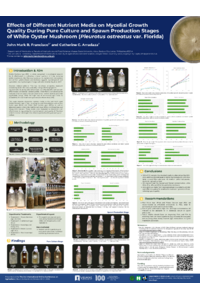
Potato Dextrose Agar (PDA) has been widely recognized in mycological research for its effectiveness in cultivating a broad spectrum of fungi, including edible mushrooms such as Pleurotus ostreatus. However, the high cost of commercial agar limits its accessibility for local mushroom growers. Therefore, this study aims to investigate the potential of low-cost agar formulations and other alternatives to PDA in a laboratory setting. Five treatments were applied: PDA (control), Malt Extract Agar (MEA), Murashige and Skoog (MS), Rice Water Agar (RWA), and Potato Sucrose Agar (PSA). The experiment was arranged in a complete block design with three replications. Data were collected at two stages of oyster mushroom cultivation: pure and spawn culture. The mycelial growth quality was determined. Results revealed that, at the pure culture stage, RWA had the highest mycelial growth rate at 9 days after inoculation (DAI) with 7.73 cm, but there was no statistical difference compared to PSA and PDA. MEA obtained the highest mycelial weight at 1.08 g. PSA, MEA, and RWA favored mycelial visual parameters, while PDA, PSA, and MEA favored thickness. RWA showed the highest growth vigor, and MEA and PDA the highest mycelial density. RWA completed the stage in 9.30 days, including the time mycelium appears at 1.03 days. No contamination occurred at RWA. At the spawn culture stage, RWA had the highest mycelial growth rate at 11.50 cm in 12 DAI. RWA was also high at mycelial visual parameters. MEA completed the stage in 14.87 days with comparable results in mycelial germination in all treatments except MS. Contamination occurred at the spawn stage, with high contamination observed in MS at 26.67%. Contamination during spawn and culture stages is influenced by inoculation technique and environmental conditions, not just the media. Temperature and RH significantly affected weight and color score. The MS medium showed the least favorable performance, likely due to its high salt content being unsuitable for fungal growth. This study provides a reference for mycelial growth quality on how mycelium behaves across two stages of oyster mushroom production.
Keywords
Pleurotus ostreatus
mycelial growth quality
nutrient media
potato dextrose agar
rice water agar
temperature
relative humidity
Poster
SciForum 134812.pdf
UAV-Based Nitrogen and Phosphorus Content Estimation for Early-Season Nutrient Mapping Using Vegetation Indices and Machine Learning Techniques
Integrating IoT Sensors and Artificial Intelligence for Irrigation Optimization in Organic Farming Systems