Event submissions
Published
This submission belongs to the session S11. Crop Genetics, Genomics and Breeding of the event The 3rd International Online Conference on Agriculture
Published date
20 Oct, 2025
Academic Editor
'%3e%3cpath%20d='M12.6657%2010.9104C12.4185%2010.325%2012.0599%209.79327%2011.6097%209.34482C11.1609%208.89508%2010.6293%208.5365%2010.0442%208.28888C10.0389%208.28626%2010.0337%208.28495%2010.0285%208.28233C10.8446%207.69279%2011.3752%206.73249%2011.3752%205.64904C11.3752%203.8542%209.92103%202.39999%208.1262%202.39999C6.33136%202.39999%204.87715%203.8542%204.87715%205.64904C4.87715%206.73249%205.40774%207.69279%206.22393%208.28364C6.21869%208.28626%206.21345%208.28757%206.20821%208.29019C5.62129%208.5378%205.09463%208.89284%204.64265%209.34613C4.1929%209.79493%203.83432%2010.3266%203.58671%2010.9117C3.34345%2011.4845%203.21226%2012.0987%203.20023%2012.7209C3.19988%2012.7349%203.20233%2012.7488%203.20744%2012.7619C3.21255%2012.7749%203.22022%2012.7867%203.22998%2012.7968C3.23975%2012.8068%203.25142%2012.8147%203.26431%2012.8202C3.2772%2012.8256%203.29105%2012.8284%203.30504%2012.8284H4.09109C4.14874%2012.8284%204.19459%2012.7825%204.1959%2012.7262C4.2221%2011.7148%204.62823%2010.7676%205.34617%2010.0497C6.08899%209.30683%207.0755%208.89808%208.1262%208.89808C9.17689%208.89808%2010.1634%209.30683%2010.9062%2010.0497C11.6242%2010.7676%2012.0303%2011.7148%2012.0565%2012.7262C12.0578%2012.7838%2012.1037%2012.8284%2012.1613%2012.8284H12.9474C12.9613%2012.8284%2012.9752%2012.8256%2012.9881%2012.8202C13.001%2012.8147%2013.0126%2012.8068%2013.0224%2012.7968C13.0322%2012.7867%2013.0398%2012.7749%2013.0449%2012.7619C13.0501%2012.7488%2013.0525%2012.7349%2013.0522%2012.7209C13.0391%2012.0947%2012.9094%2011.4855%2012.6657%2010.9104ZM8.1262%207.9024C7.52486%207.9024%206.9589%207.6679%206.53312%207.24211C6.10733%206.81633%205.87283%206.25037%205.87283%205.64904C5.87283%205.0477%206.10733%204.48174%206.53312%204.05596C6.9589%203.63018%207.52486%203.39567%208.1262%203.39567C8.72753%203.39567%209.29349%203.63018%209.71927%204.05596C10.1451%204.48174%2010.3796%205.0477%2010.3796%205.64904C10.3796%206.25037%2010.1451%206.81633%209.71927%207.24211C9.29349%207.6679%208.72753%207.9024%208.1262%207.9024Z'%20fill='%235D1EE1'/%3e%3c/g%3e%3c/svg%3e) Rodomiro Ortiz
Rodomiro OrtizCitation
Felix Frimpong, Believer Norsi, Mary Otiwaa Osei Asante, Kirpal Agyemang Ofosu, Daniel Dzorkpe Gamenyah, Yameen Huss Cole, Richard Kofi Peprah, Jacob Kporku, Kenneth Korfeator, Elizabeth Norkor Nartey, Maxwell Darko Asante, Systematic Assessment of Seedling-Stage Salinity Tolerance in Rice Genotypes under Controlled Stress Conditions in Ghana, in Proceedings of The 3rd International Online Conference on Agriculture, 22 October–24 October 2025, MDPI: Basel, Switzerland
Share
Email
Facebook
Twitter
LinkedIn
Systematic Assessment of Seedling-Stage Salinity Tolerance in Rice Genotypes under Controlled Stress Conditions in Ghana

Felix Frimpong 1,2
'%3e%3cpath%20d='M12.6647%2010.9104C12.4176%2010.325%2012.0589%209.7933%2011.6088%209.34485C11.16%208.89511%2010.6283%208.53653%2010.0432%208.28891C10.038%208.28629%2010.0327%208.28498%2010.0275%208.28236C10.8437%207.69282%2011.3743%206.73252%2011.3743%205.64907C11.3743%203.85423%209.92005%202.40002%208.12522%202.40002C6.33038%202.40002%204.87618%203.85423%204.87618%205.64907C4.87618%206.73252%205.40677%207.69282%206.22296%208.28367C6.21772%208.28629%206.21248%208.2876%206.20724%208.29022C5.62031%208.53783%205.09365%208.89287%204.64167%209.34616C4.19192%209.79496%203.83334%2010.3266%203.58573%2010.9117C3.34247%2011.4846%203.21128%2012.0987%203.19925%2012.721C3.1989%2012.735%203.20135%2012.7489%203.20646%2012.7619C3.21157%2012.7749%203.21924%2012.7868%203.22901%2012.7968C3.23877%2012.8068%203.25045%2012.8148%203.26334%2012.8202C3.27623%2012.8256%203.29007%2012.8284%203.30406%2012.8284H4.09012C4.14776%2012.8284%204.19362%2012.7825%204.19493%2012.7262C4.22113%2011.7148%204.62726%2010.7676%205.34519%2010.0497C6.08802%209.30686%207.07452%208.89811%208.12522%208.89811C9.17592%208.89811%2010.1624%209.30686%2010.9052%2010.0497C11.6232%2010.7676%2012.0293%2011.7148%2012.0555%2012.7262C12.0568%2012.7839%2012.1027%2012.8284%2012.1603%2012.8284H12.9464C12.9604%2012.8284%2012.9742%2012.8256%2012.9871%2012.8202C13%2012.8148%2013.0117%2012.8068%2013.0214%2012.7968C13.0312%2012.7868%2013.0389%2012.7749%2013.044%2012.7619C13.0491%2012.7489%2013.0515%2012.735%2013.0512%2012.721C13.0381%2012.0947%2012.9084%2011.4856%2012.6647%2010.9104ZM8.12522%207.90243C7.52388%207.90243%206.95792%207.66793%206.53214%207.24215C6.10636%206.81636%205.87185%206.2504%205.87185%205.64907C5.87185%205.04773%206.10636%204.48177%206.53214%204.05599C6.95792%203.63021%207.52388%203.3957%208.12522%203.3957C8.72655%203.3957%209.29252%203.63021%209.7183%204.05599C10.1441%204.48177%2010.3786%205.04773%2010.3786%205.64907C10.3786%206.2504%2010.1441%206.81636%209.7183%207.24215C9.29252%207.66793%208.72655%207.90243%208.12522%207.90243Z'%20fill='%235D1EE1'/%3e%3c/g%3e%3c/svg%3e)
Believer Norsi 1
Mary Otiwaa Osei Asante 3
Kirpal Agyemang Ofosu 1
Daniel Dzorkpe Gamenyah 1
Yameen Huss Cole 1
Richard Kofi Peprah 1
Jacob Kporku 1
Kenneth Korfeator 1
Elizabeth Norkor Nartey 1
Maxwell Darko Asante 1,2
1. CSIR-Crops Research Institute, P. O. Box 3785, Fumesua–Kumasi, Ghana
2. Department of Plant Resources Development, Faculty of Natural Sciences and Environmental Management, CSIR-College of Science and Technology, Kumasi, Ghana
3. Faculty of Agriculture, College of Agriculture and Natural Resources, Kwame Nkrumah University of Science and Technology, Kumasi, Ghana
Abstract
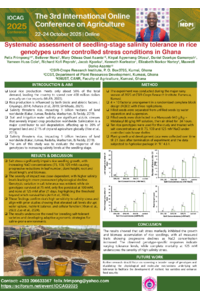
Salt stress is a major abiotic constraint limiting rice productivity in coastal and inland regions of Ghana, particularly at the seedling stage, where it severely impairs plant establishment and growth. Despite its significance, to the best of our knowledge, no salt-tolerant rice varieties have been formally released in Ghana. This study aimed to evaluate the seedling-stage responses of ten rice genotypes to varying levels of salinity stress and identify genotypes for future breeding efforts. A 4 × 10 factorial experiment was conducted in a Randomized Complete Block Design (RCBD) with six replications, under rain-sheltered conditions at the CSIR-Crops Research Institute, Kumasi, Ghana. Ten rice genotypes were exposed to four salinity treatments (0, 75, 100, and 125 mM NaCl) for 21 days. Key parameters, including shoot and root length, fresh and dry biomass, leaf area, and salinity tolerance indices, were assessed. Tolerance was determined using visual scoring, an analysis of variance, and eight calculated indices: the Fresh Weight Stress Tolerance Index (FWSI), Dry Weight Stress Tolerance Index (DWSI), Root Length Salinity Index (RLSI), Shoot Length Salinity Index (SLSI), Salinity Tolerance Index (STI), Salinity Susceptibility Index (SSI), Tolerance Index (TI), and Percent Reduction. Significant genotypic variation was observed under salt stress. ARICA 11 exhibited the highest FWSI (29.19) and STI (1.28), indicating superior tolerance, followed by LEGON 1 and HR32051F1-2-33-1. In contrast, AGRA and AGYAPA recorded the lowest tolerance indices. Salinity stress substantially inhibited growth, especially at 125 mM, where complete seedling mortality was observed. Survival declined progressively with increasing salinity: six genotypes survived at 75 mM, five at 100 mM, and none at 125 mM, highlighting a threshold for genotype resilience. This study provides evidence of moderate salt tolerance among selected genotypes and confirms the absence of highly tolerant varieties under severe salinity. The findings underscore the urgent need for breeding programs targeting salinity resilience in rice to sustain productivity in salt-prone areas of Ghana.
Keywords
Abiotic stress
genotype screening
Ghana
rice
salinity tolerance
seedling stage
salinity indices
Poster
rice slinity poster_frimpong et l 2025 (1) (1).pdf
ADDRESSING SEAWATER INTRUSION AT DIFFERENT GROWTH STAGES OF RICE (Oryza sativa L.) USING SELECTED SALINE-TOLERANT VARIETIES
IN VITRO SHOOT INDUCTION AND MULTIPLICATION OF JACKFRUIT (Artocarpus heterophyllus Lam.) 'EVIARC SWEET’ VARIETY SUPPLEMENTED WITH PLANT GROWTH REGULATORS (PGRS)