Event submissions
Published
This submission belongs to the session S11. Crop Genetics, Genomics and Breeding of the event The 3rd International Online Conference on Agriculture
Published date
20 Oct, 2025
Academic Editor
'%3e%3cpath%20d='M12.6657%2010.9104C12.4185%2010.325%2012.0599%209.79327%2011.6097%209.34482C11.1609%208.89508%2010.6293%208.5365%2010.0442%208.28888C10.0389%208.28626%2010.0337%208.28495%2010.0285%208.28233C10.8446%207.69279%2011.3752%206.73249%2011.3752%205.64904C11.3752%203.8542%209.92103%202.39999%208.1262%202.39999C6.33136%202.39999%204.87715%203.8542%204.87715%205.64904C4.87715%206.73249%205.40774%207.69279%206.22393%208.28364C6.21869%208.28626%206.21345%208.28757%206.20821%208.29019C5.62129%208.5378%205.09463%208.89284%204.64265%209.34613C4.1929%209.79493%203.83432%2010.3266%203.58671%2010.9117C3.34345%2011.4845%203.21226%2012.0987%203.20023%2012.7209C3.19988%2012.7349%203.20233%2012.7488%203.20744%2012.7619C3.21255%2012.7749%203.22022%2012.7867%203.22998%2012.7968C3.23975%2012.8068%203.25142%2012.8147%203.26431%2012.8202C3.2772%2012.8256%203.29105%2012.8284%203.30504%2012.8284H4.09109C4.14874%2012.8284%204.19459%2012.7825%204.1959%2012.7262C4.2221%2011.7148%204.62823%2010.7676%205.34617%2010.0497C6.08899%209.30683%207.0755%208.89808%208.1262%208.89808C9.17689%208.89808%2010.1634%209.30683%2010.9062%2010.0497C11.6242%2010.7676%2012.0303%2011.7148%2012.0565%2012.7262C12.0578%2012.7838%2012.1037%2012.8284%2012.1613%2012.8284H12.9474C12.9613%2012.8284%2012.9752%2012.8256%2012.9881%2012.8202C13.001%2012.8147%2013.0126%2012.8068%2013.0224%2012.7968C13.0322%2012.7867%2013.0398%2012.7749%2013.0449%2012.7619C13.0501%2012.7488%2013.0525%2012.7349%2013.0522%2012.7209C13.0391%2012.0947%2012.9094%2011.4855%2012.6657%2010.9104ZM8.1262%207.9024C7.52486%207.9024%206.9589%207.6679%206.53312%207.24211C6.10733%206.81633%205.87283%206.25037%205.87283%205.64904C5.87283%205.0477%206.10733%204.48174%206.53312%204.05596C6.9589%203.63018%207.52486%203.39567%208.1262%203.39567C8.72753%203.39567%209.29349%203.63018%209.71927%204.05596C10.1451%204.48174%2010.3796%205.0477%2010.3796%205.64904C10.3796%206.25037%2010.1451%206.81633%209.71927%207.24211C9.29349%207.6679%208.72753%207.9024%208.1262%207.9024Z'%20fill='%235D1EE1'/%3e%3c/g%3e%3c/svg%3e) Rodomiro Ortiz
Rodomiro OrtizCitation
Mohd. Kamran Khan, Anamika Pandey, Mehmet Hamurcu, Zuhal Zeynep Avsaroglu, Ali Topal, Sait Gezgin, Physiological Responses of Wild and Cultivated Diploid Wheat Genotypes towards Salinity Stress, in Proceedings of The 3rd International Online Conference on Agriculture, 22 October–24 October 2025, MDPI: Basel, Switzerland
Share
Email
Facebook
Twitter
LinkedIn
Physiological Responses of Wild and Cultivated Diploid Wheat Genotypes towards Salinity Stress

Mohd. Kamran Khan 1

Anamika Pandey 1
'%3e%3cpath%20d='M12.6647%2010.9104C12.4176%2010.325%2012.0589%209.7933%2011.6088%209.34485C11.16%208.89511%2010.6283%208.53653%2010.0432%208.28891C10.038%208.28629%2010.0327%208.28498%2010.0275%208.28236C10.8437%207.69282%2011.3743%206.73252%2011.3743%205.64907C11.3743%203.85423%209.92005%202.40002%208.12522%202.40002C6.33038%202.40002%204.87618%203.85423%204.87618%205.64907C4.87618%206.73252%205.40677%207.69282%206.22296%208.28367C6.21772%208.28629%206.21248%208.2876%206.20724%208.29022C5.62031%208.53783%205.09365%208.89287%204.64167%209.34616C4.19192%209.79496%203.83334%2010.3266%203.58573%2010.9117C3.34247%2011.4846%203.21128%2012.0987%203.19925%2012.721C3.1989%2012.735%203.20135%2012.7489%203.20646%2012.7619C3.21157%2012.7749%203.21924%2012.7868%203.22901%2012.7968C3.23877%2012.8068%203.25045%2012.8148%203.26334%2012.8202C3.27623%2012.8256%203.29007%2012.8284%203.30406%2012.8284H4.09012C4.14776%2012.8284%204.19362%2012.7825%204.19493%2012.7262C4.22113%2011.7148%204.62726%2010.7676%205.34519%2010.0497C6.08802%209.30686%207.07452%208.89811%208.12522%208.89811C9.17592%208.89811%2010.1624%209.30686%2010.9052%2010.0497C11.6232%2010.7676%2012.0293%2011.7148%2012.0555%2012.7262C12.0568%2012.7839%2012.1027%2012.8284%2012.1603%2012.8284H12.9464C12.9604%2012.8284%2012.9742%2012.8256%2012.9871%2012.8202C13%2012.8148%2013.0117%2012.8068%2013.0214%2012.7968C13.0312%2012.7868%2013.0389%2012.7749%2013.044%2012.7619C13.0491%2012.7489%2013.0515%2012.735%2013.0512%2012.721C13.0381%2012.0947%2012.9084%2011.4856%2012.6647%2010.9104ZM8.12522%207.90243C7.52388%207.90243%206.95792%207.66793%206.53214%207.24215C6.10636%206.81636%205.87185%206.2504%205.87185%205.64907C5.87185%205.04773%206.10636%204.48177%206.53214%204.05599C6.95792%203.63021%207.52388%203.3957%208.12522%203.3957C8.72655%203.3957%209.29252%203.63021%209.7183%204.05599C10.1441%204.48177%2010.3786%205.04773%2010.3786%205.64907C10.3786%206.2504%2010.1441%206.81636%209.7183%207.24215C9.29252%207.66793%208.72655%207.90243%208.12522%207.90243Z'%20fill='%235D1EE1'/%3e%3c/g%3e%3c/svg%3e)
Mehmet Hamurcu 1
Zuhal Zeynep Avsaroglu 1
Ali Topal 2
Sait Gezgin 1
1. Department of Soil Science and Plant Nutrition, Faculty of Agriculture, Selcuk University, Konya-42130, Turkiye
2. Department of Field Crops, Faculty of Agriculture, Selcuk University, Konya 42130, Turkiye
Abstract
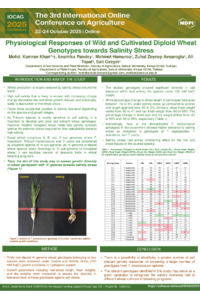
Wheat production is largely reduced by salinity stress around the world. High soil salinity that is likely to worsen with increasing climate change decreases the root–shoot growth and tissues, and, eventually, leads to the destruction of wheat crops. Plants show substantial variation in salinity tolerance depending on the species and growth stages. As Triticum species is mostly sensitive to soil salinity, it is important to develop and grow salt-tolerant wheat genotypes. However, modern hexaploid wheat holds less genetic variation, lacking the potential alleles required for their adaptability towards high salinity. Thus, it is crucial to assess the genetic diversity of different germplasms for the selection of potential genotypes with desirable traits against stressed conditions. Bread wheat comprises A, B, and D subgenomes, where Triticum boeoticum, T. monococcum, and T. urartu are considered as ancestral species of their ‘A’ sub-genome. As ‘A’ genomes of diploid wheat species share homology to ‘A’ sub-genomes of hexaploid wheat, they can facilitate the transfer of desirable traits in wheat breeding programs. Here, we screened 31 diploid A-genome wheat genotypes belonging to four species to understand their response towards control and salinity stress (150 mM NaCl) conditions in terms of growth parameters. Interestingly, domesticated T. monococcum genotypes in the experiment showed higher tolerance to salinity stress compared to genotypes of T. aegilopoides, T. boeoticum, and T. urartu. Salinity stress equally affected the root and shoot tissues of the studied species. The identified tolerant genotypes may serve as a good candidate to introgress the salinity tolerance trait in different wheat species.
Acknowledgements: We are thankful to TUBITAK 1001 (No. 123R072) for providing funding to perform this research work.
Keywords
climate change
einkorn wheat
genetic diversity
salt stress
wheat progenitors
Poster
MKK IOCAG Poster_19.10.2025.pdf
Optimizing Microclimate for Maize–Mushroom Intercropping under Semi-Arid Conditions: A Climate-Smart Farming Approach
Role of Chitosan in Enhancing Secondary Metabolism and Stress Tolerance in Rosemary under Drought/Heat Combined Stress