Event submissions
Published
This submission belongs to the session S11. Crop Genetics, Genomics and Breeding of the event The 3rd International Online Conference on Agriculture
Published date
20 Oct, 2025
Academic Editor
'%3e%3cpath%20d='M12.6657%2010.9104C12.4185%2010.325%2012.0599%209.79327%2011.6097%209.34482C11.1609%208.89508%2010.6293%208.5365%2010.0442%208.28888C10.0389%208.28626%2010.0337%208.28495%2010.0285%208.28233C10.8446%207.69279%2011.3752%206.73249%2011.3752%205.64904C11.3752%203.8542%209.92103%202.39999%208.1262%202.39999C6.33136%202.39999%204.87715%203.8542%204.87715%205.64904C4.87715%206.73249%205.40774%207.69279%206.22393%208.28364C6.21869%208.28626%206.21345%208.28757%206.20821%208.29019C5.62129%208.5378%205.09463%208.89284%204.64265%209.34613C4.1929%209.79493%203.83432%2010.3266%203.58671%2010.9117C3.34345%2011.4845%203.21226%2012.0987%203.20023%2012.7209C3.19988%2012.7349%203.20233%2012.7488%203.20744%2012.7619C3.21255%2012.7749%203.22022%2012.7867%203.22998%2012.7968C3.23975%2012.8068%203.25142%2012.8147%203.26431%2012.8202C3.2772%2012.8256%203.29105%2012.8284%203.30504%2012.8284H4.09109C4.14874%2012.8284%204.19459%2012.7825%204.1959%2012.7262C4.2221%2011.7148%204.62823%2010.7676%205.34617%2010.0497C6.08899%209.30683%207.0755%208.89808%208.1262%208.89808C9.17689%208.89808%2010.1634%209.30683%2010.9062%2010.0497C11.6242%2010.7676%2012.0303%2011.7148%2012.0565%2012.7262C12.0578%2012.7838%2012.1037%2012.8284%2012.1613%2012.8284H12.9474C12.9613%2012.8284%2012.9752%2012.8256%2012.9881%2012.8202C13.001%2012.8147%2013.0126%2012.8068%2013.0224%2012.7968C13.0322%2012.7867%2013.0398%2012.7749%2013.0449%2012.7619C13.0501%2012.7488%2013.0525%2012.7349%2013.0522%2012.7209C13.0391%2012.0947%2012.9094%2011.4855%2012.6657%2010.9104ZM8.1262%207.9024C7.52486%207.9024%206.9589%207.6679%206.53312%207.24211C6.10733%206.81633%205.87283%206.25037%205.87283%205.64904C5.87283%205.0477%206.10733%204.48174%206.53312%204.05596C6.9589%203.63018%207.52486%203.39567%208.1262%203.39567C8.72753%203.39567%209.29349%203.63018%209.71927%204.05596C10.1451%204.48174%2010.3796%205.0477%2010.3796%205.64904C10.3796%206.25037%2010.1451%206.81633%209.71927%207.24211C9.29349%207.6679%208.72753%207.9024%208.1262%207.9024Z'%20fill='%235D1EE1'/%3e%3c/g%3e%3c/svg%3e) Rodomiro Ortiz
Rodomiro OrtizCitation
Boraiah KM, Harisha CB, Basavaraj PS, Hanumanth M Halli, Santosh HB, Bhojaraja Naik, Sammi Reddy K, Enhancing Genetic Variability and Yield Potential in Chia (Salvia hispanica L.) through Gamma-Irradiation-Induced Mutation Breeding, in Proceedings of The 3rd International Online Conference on Agriculture, 22 October–24 October 2025, MDPI: Basel, Switzerland
Share
Email
Facebook
Twitter
LinkedIn
Enhancing Genetic Variability and Yield Potential in Chia (Salvia hispanica L.) through Gamma-Irradiation-Induced Mutation Breeding
'%3e%3cpath%20d='M12.6647%2010.9104C12.4176%2010.325%2012.0589%209.7933%2011.6088%209.34485C11.16%208.89511%2010.6283%208.53653%2010.0432%208.28891C10.038%208.28629%2010.0327%208.28498%2010.0275%208.28236C10.8437%207.69282%2011.3743%206.73252%2011.3743%205.64907C11.3743%203.85423%209.92005%202.40002%208.12522%202.40002C6.33038%202.40002%204.87618%203.85423%204.87618%205.64907C4.87618%206.73252%205.40677%207.69282%206.22296%208.28367C6.21772%208.28629%206.21248%208.2876%206.20724%208.29022C5.62031%208.53783%205.09365%208.89287%204.64167%209.34616C4.19192%209.79496%203.83334%2010.3266%203.58573%2010.9117C3.34247%2011.4846%203.21128%2012.0987%203.19925%2012.721C3.1989%2012.735%203.20135%2012.7489%203.20646%2012.7619C3.21157%2012.7749%203.21924%2012.7868%203.22901%2012.7968C3.23877%2012.8068%203.25045%2012.8148%203.26334%2012.8202C3.27623%2012.8256%203.29007%2012.8284%203.30406%2012.8284H4.09012C4.14776%2012.8284%204.19362%2012.7825%204.19493%2012.7262C4.22113%2011.7148%204.62726%2010.7676%205.34519%2010.0497C6.08802%209.30686%207.07452%208.89811%208.12522%208.89811C9.17592%208.89811%2010.1624%209.30686%2010.9052%2010.0497C11.6232%2010.7676%2012.0293%2011.7148%2012.0555%2012.7262C12.0568%2012.7839%2012.1027%2012.8284%2012.1603%2012.8284H12.9464C12.9604%2012.8284%2012.9742%2012.8256%2012.9871%2012.8202C13%2012.8148%2013.0117%2012.8068%2013.0214%2012.7968C13.0312%2012.7868%2013.0389%2012.7749%2013.044%2012.7619C13.0491%2012.7489%2013.0515%2012.735%2013.0512%2012.721C13.0381%2012.0947%2012.9084%2011.4856%2012.6647%2010.9104ZM8.12522%207.90243C7.52388%207.90243%206.95792%207.66793%206.53214%207.24215C6.10636%206.81636%205.87185%206.2504%205.87185%205.64907C5.87185%205.04773%206.10636%204.48177%206.53214%204.05599C6.95792%203.63021%207.52388%203.3957%208.12522%203.3957C8.72655%203.3957%209.29252%203.63021%209.7183%204.05599C10.1441%204.48177%2010.3786%205.04773%2010.3786%205.64907C10.3786%206.2504%2010.1441%206.81636%209.7183%207.24215C9.29252%207.66793%208.72655%207.90243%208.12522%207.90243Z'%20fill='%235D1EE1'/%3e%3c/g%3e%3c/svg%3e)
Boraiah KM 1
Harisha CB 1
Basavaraj PS 1
Hanumanth M Halli 1
Santosh HB 2
Bhojaraja Naik 3
Sammi Reddy K 1
1. ICAR-National Institute of Abiotic Stress Management, Malegaon-413 115, Baramati, Pune, India
2. ICAR - Central Research Institute for Dryland Agriculture, Santosh Nagar-500059, Hyderabad, India
3. ICAR-Indian Institute of Seed Science, Reginal Station, Bengaluru-560065, India
Abstract
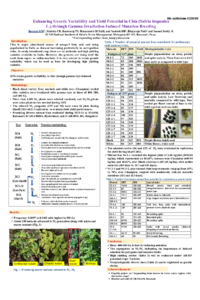
Chia (Salvia hispanica L.), a rich plant-based source of omega-3 fatty acids, is being explored as a climate-resilient alternative crop in India. However, limited genetic variability and the absence of high-yielding cultivars constrain its wider adoption. To address this, a mutation breeding program was initiated using gamma irradiation (400, 500, and 600 Gy) on seeds of two varieties: white-seeded ‘Champion’ and black-seeded ‘Black selection-1’. The M1 generation evaluation showed that increasing radiation doses led to reduced germination, delayed emergence, and suppressed seedling vigour, particularly in the black-seeded variety. Germination in Champion decreased from 88.50% (0 Gy) to 57.75% (600 Gy), and it decreased from 86.25% to 56.50% in Black selection-1. Successive mutant generations (M2–M6) revealed novel phenotypes, including bold seeds, pigmentation changes, crinkled foliage, altered spike architecture, and early flowering. Importantly, several M6 lines exhibited a superior agronomic performance. Mutant line 94-1-1 recorded the highest yield of 2.46 kg/plot (1094.81 kg/ha), which represented an 80.68% increase over Champion (605.93 kg/ha) and 28.52% over Black selection-1 (851.85 kg/ha), with earlier maturity (104 days vs. 117 and 115 days). Other high-performing lines, such as 94-3-3 and 94-3-1, also showed yield improvements ranging from 65% to 70% over Champion, coupled with moderately reduced maturity durations (111–113 days). These findings highlight the effectiveness of gamma irradiation for inducing stable genetic variability and developing high-yielding, early-maturing varieties. This study underscores the potential of mutation breeding to develop superior Chia cultivars suited to Indian dryland and climate-vulnerable regions.
Keywords
Chia
mutation breeding
early flowering
gamma irradiation
genetic variability.
Poster
Poster_IOCAG25_Boraiah KM.pdf
Diversity Assessment of Traditional Cowpea (Vigna unguiculata (L.) Walp.) Landraces in Morocco
Development of Drought-Resilient Rootstock Grafting and Cell-to-Cell Communications