Event submissions
Published
This submission belongs to the session S10. From Field to Consumers: Challenges and Approaches to High- Quality Agricultural Products of the event The 3rd International Online Conference on Agriculture
Published date
20 Oct, 2025
Academic Editor
'%3e%3cpath%20d='M12.6657%2010.9104C12.4185%2010.325%2012.0599%209.79327%2011.6097%209.34482C11.1609%208.89508%2010.6293%208.5365%2010.0442%208.28888C10.0389%208.28626%2010.0337%208.28495%2010.0285%208.28233C10.8446%207.69279%2011.3752%206.73249%2011.3752%205.64904C11.3752%203.8542%209.92103%202.39999%208.1262%202.39999C6.33136%202.39999%204.87715%203.8542%204.87715%205.64904C4.87715%206.73249%205.40774%207.69279%206.22393%208.28364C6.21869%208.28626%206.21345%208.28757%206.20821%208.29019C5.62129%208.5378%205.09463%208.89284%204.64265%209.34613C4.1929%209.79493%203.83432%2010.3266%203.58671%2010.9117C3.34345%2011.4845%203.21226%2012.0987%203.20023%2012.7209C3.19988%2012.7349%203.20233%2012.7488%203.20744%2012.7619C3.21255%2012.7749%203.22022%2012.7867%203.22998%2012.7968C3.23975%2012.8068%203.25142%2012.8147%203.26431%2012.8202C3.2772%2012.8256%203.29105%2012.8284%203.30504%2012.8284H4.09109C4.14874%2012.8284%204.19459%2012.7825%204.1959%2012.7262C4.2221%2011.7148%204.62823%2010.7676%205.34617%2010.0497C6.08899%209.30683%207.0755%208.89808%208.1262%208.89808C9.17689%208.89808%2010.1634%209.30683%2010.9062%2010.0497C11.6242%2010.7676%2012.0303%2011.7148%2012.0565%2012.7262C12.0578%2012.7838%2012.1037%2012.8284%2012.1613%2012.8284H12.9474C12.9613%2012.8284%2012.9752%2012.8256%2012.9881%2012.8202C13.001%2012.8147%2013.0126%2012.8068%2013.0224%2012.7968C13.0322%2012.7867%2013.0398%2012.7749%2013.0449%2012.7619C13.0501%2012.7488%2013.0525%2012.7349%2013.0522%2012.7209C13.0391%2012.0947%2012.9094%2011.4855%2012.6657%2010.9104ZM8.1262%207.9024C7.52486%207.9024%206.9589%207.6679%206.53312%207.24211C6.10733%206.81633%205.87283%206.25037%205.87283%205.64904C5.87283%205.0477%206.10733%204.48174%206.53312%204.05596C6.9589%203.63018%207.52486%203.39567%208.1262%203.39567C8.72753%203.39567%209.29349%203.63018%209.71927%204.05596C10.1451%204.48174%2010.3796%205.0477%2010.3796%205.64904C10.3796%206.25037%2010.1451%206.81633%209.71927%207.24211C9.29349%207.6679%208.72753%207.9024%208.1262%207.9024Z'%20fill='%235D1EE1'/%3e%3c/g%3e%3c/svg%3e) Isabel Lara
Isabel LaraCitation
Wellerson de Oliveira Alves da Silva, Leticia Carvalho Passos, Constância Consentino Teixeira Oliveira, Vitória da Silva Souza, Renata Cassia Campos, Action of rough lemon and sicilian lemon on arabica coffee husk fermentation regarding antioxidant, antimicrobial, and probiotic activities, in Proceedings of The 3rd International Online Conference on Agriculture, 22 October–24 October 2025, MDPI: Basel, Switzerland
Share
Email
Facebook
Twitter
LinkedIn
Action of rough lemon and sicilian lemon on arabica coffee husk fermentation regarding antioxidant, antimicrobial, and probiotic activities
'%3e%3cpath%20d='M12.6647%2010.9104C12.4176%2010.325%2012.0589%209.7933%2011.6088%209.34485C11.16%208.89511%2010.6283%208.53653%2010.0432%208.28891C10.038%208.28629%2010.0327%208.28498%2010.0275%208.28236C10.8437%207.69282%2011.3743%206.73252%2011.3743%205.64907C11.3743%203.85423%209.92005%202.40002%208.12522%202.40002C6.33038%202.40002%204.87618%203.85423%204.87618%205.64907C4.87618%206.73252%205.40677%207.69282%206.22296%208.28367C6.21772%208.28629%206.21248%208.2876%206.20724%208.29022C5.62031%208.53783%205.09365%208.89287%204.64167%209.34616C4.19192%209.79496%203.83334%2010.3266%203.58573%2010.9117C3.34247%2011.4846%203.21128%2012.0987%203.19925%2012.721C3.1989%2012.735%203.20135%2012.7489%203.20646%2012.7619C3.21157%2012.7749%203.21924%2012.7868%203.22901%2012.7968C3.23877%2012.8068%203.25045%2012.8148%203.26334%2012.8202C3.27623%2012.8256%203.29007%2012.8284%203.30406%2012.8284H4.09012C4.14776%2012.8284%204.19362%2012.7825%204.19493%2012.7262C4.22113%2011.7148%204.62726%2010.7676%205.34519%2010.0497C6.08802%209.30686%207.07452%208.89811%208.12522%208.89811C9.17592%208.89811%2010.1624%209.30686%2010.9052%2010.0497C11.6232%2010.7676%2012.0293%2011.7148%2012.0555%2012.7262C12.0568%2012.7839%2012.1027%2012.8284%2012.1603%2012.8284H12.9464C12.9604%2012.8284%2012.9742%2012.8256%2012.9871%2012.8202C13%2012.8148%2013.0117%2012.8068%2013.0214%2012.7968C13.0312%2012.7868%2013.0389%2012.7749%2013.044%2012.7619C13.0491%2012.7489%2013.0515%2012.735%2013.0512%2012.721C13.0381%2012.0947%2012.9084%2011.4856%2012.6647%2010.9104ZM8.12522%207.90243C7.52388%207.90243%206.95792%207.66793%206.53214%207.24215C6.10636%206.81636%205.87185%206.2504%205.87185%205.64907C5.87185%205.04773%206.10636%204.48177%206.53214%204.05599C6.95792%203.63021%207.52388%203.3957%208.12522%203.3957C8.72655%203.3957%209.29252%203.63021%209.7183%204.05599C10.1441%204.48177%2010.3786%205.04773%2010.3786%205.64907C10.3786%206.2504%2010.1441%206.81636%209.7183%207.24215C9.29252%207.66793%208.72655%207.90243%208.12522%207.90243Z'%20fill='%235D1EE1'/%3e%3c/g%3e%3c/svg%3e)
Wellerson de Oliveira Alves da Silva 1
Leticia Carvalho Passos 1
Constância Consentino Teixeira Oliveira 1
Vitória da Silva Souza 1
Renata Cassia Campos 1
1. Department of Agricultural Engineering, Federal University of Viçosa (UFV), Viçosa, Minas Gerais, 36570-900, Brazil
Abstract
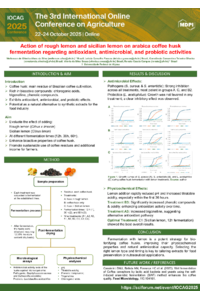
Coffee husk represents the largest residue from Brazilian coffee cultivation. However, it is rich in bioactive compounds such as chlorogenic acids, trigonelline, and phenolic compounds, which possess significant antioxidant, antimicrobial, and probiotic effects. These characteristics make the husk a natural alternative to synthetic extracts, valued by the food industry. This study aimed to analyze the impact of adding rough lemon (Citrus x limonia) and Sicilian lemon (Citrus limon), at different fermentation times, on the antioxidant, antimicrobial, and probiotic characteristics of coffee husk, aiming for sustainable use of this residue and promotion of additional income for coffee farmers. The coffee husk fermentation methods conducted were as follows: with rough lemon (A), coffee husk only (B), and with Sicilian lemon (C), over periods of 12 (1), 36 (2), and 60 hours (3), totaling nine methods (A1, A2, A3, B1, B2, B3, C1, C2, and C3). After fermentation, the husks were dried to 12.35% moisture content (dry basis) and analyzed for pH, titratable acidity, phenolic compounds, trigonelline, and chlorogenic acids. Additionally, antimicrobial capacity tests of the husks were performed using Staphylococcus aureus and Salmonella enteriditis as pathogenic microorganisms and Lactobacillus acidophilus as a probiotic. The results showed that the addition of lemon during husk fermentation acts as a pH reducer and increases the titratable acidity of the extracts, especially within the first 36 hours of fermentation. In general, phenolic compounds decreased during fermentation, except in treatment B3, which showed a significant increase in phenolic compounds and titratable acidity, indicating an improvement in the husk's antioxidant activity over time. Treatment A3 increased trigonelline content, suggesting higher antioxidant activity, although it reduced phenolic compounds and chlorogenic acids. Treatment C1 showed the best overall results, suggesting the positive effect of Sicilian lemon after 12 hours of fermentation. Regarding microbiological analyses, the addition of lemon provided an antimicrobial effect against the pathogens, but also against the probiotic bacteria. This effect was also observed in treatment B2, suggesting that 36 hours of husk fermentation benefited the antimicrobial effect. None of the treatments benefited the development of L. acidophilus. The use of lemon in fermentation proved to be a promising strategy for adding value to coffee residues, offering natural alternatives for industries. However, further studies are necessary to optimize the fermentative process and maximize the utilization of bioactive compounds.
Keywords
Coffee Husk
fermentation
sustainability
Poster
MDPI - Poster.pdf
Improving rice productivity and quality through optimum plant population and nitrogen management
AI-Driven wheat crop optimization and yield prediction tool