Event submissions
Published
This submission belongs to the session S6. Smart Farming: From Sensor to Artificial Intelligence of the event The 3rd International Online Conference on Agriculture
Published date
20 Oct, 2025
Academic Editor
'%3e%3cpath%20d='M12.6657%2010.9104C12.4185%2010.325%2012.0599%209.79327%2011.6097%209.34482C11.1609%208.89508%2010.6293%208.5365%2010.0442%208.28888C10.0389%208.28626%2010.0337%208.28495%2010.0285%208.28233C10.8446%207.69279%2011.3752%206.73249%2011.3752%205.64904C11.3752%203.8542%209.92103%202.39999%208.1262%202.39999C6.33136%202.39999%204.87715%203.8542%204.87715%205.64904C4.87715%206.73249%205.40774%207.69279%206.22393%208.28364C6.21869%208.28626%206.21345%208.28757%206.20821%208.29019C5.62129%208.5378%205.09463%208.89284%204.64265%209.34613C4.1929%209.79493%203.83432%2010.3266%203.58671%2010.9117C3.34345%2011.4845%203.21226%2012.0987%203.20023%2012.7209C3.19988%2012.7349%203.20233%2012.7488%203.20744%2012.7619C3.21255%2012.7749%203.22022%2012.7867%203.22998%2012.7968C3.23975%2012.8068%203.25142%2012.8147%203.26431%2012.8202C3.2772%2012.8256%203.29105%2012.8284%203.30504%2012.8284H4.09109C4.14874%2012.8284%204.19459%2012.7825%204.1959%2012.7262C4.2221%2011.7148%204.62823%2010.7676%205.34617%2010.0497C6.08899%209.30683%207.0755%208.89808%208.1262%208.89808C9.17689%208.89808%2010.1634%209.30683%2010.9062%2010.0497C11.6242%2010.7676%2012.0303%2011.7148%2012.0565%2012.7262C12.0578%2012.7838%2012.1037%2012.8284%2012.1613%2012.8284H12.9474C12.9613%2012.8284%2012.9752%2012.8256%2012.9881%2012.8202C13.001%2012.8147%2013.0126%2012.8068%2013.0224%2012.7968C13.0322%2012.7867%2013.0398%2012.7749%2013.0449%2012.7619C13.0501%2012.7488%2013.0525%2012.7349%2013.0522%2012.7209C13.0391%2012.0947%2012.9094%2011.4855%2012.6657%2010.9104ZM8.1262%207.9024C7.52486%207.9024%206.9589%207.6679%206.53312%207.24211C6.10733%206.81633%205.87283%206.25037%205.87283%205.64904C5.87283%205.0477%206.10733%204.48174%206.53312%204.05596C6.9589%203.63018%207.52486%203.39567%208.1262%203.39567C8.72753%203.39567%209.29349%203.63018%209.71927%204.05596C10.1451%204.48174%2010.3796%205.0477%2010.3796%205.64904C10.3796%206.25037%2010.1451%206.81633%209.71927%207.24211C9.29349%207.6679%208.72753%207.9024%208.1262%207.9024Z'%20fill='%235D1EE1'/%3e%3c/g%3e%3c/svg%3e) Sanzidur Rahman
Sanzidur RahmanCitation
Ajit Singh, Loke Kha Chun, Jiang Xiaoyu,
Influence of Red–Blue LED Spectra on Growth Dynamics and Phytochemical Enrichment of Chinese Kale (Brassica oleracea var. alboglabra) in Hydroponic Vertical Farming System
, in Proceedings of The 3rd International Online Conference on Agriculture, 22 October–24 October 2025, MDPI: Basel, Switzerland
Share
Email
Facebook
Twitter
LinkedIn
Influence of Red–Blue LED Spectra on Growth Dynamics and Phytochemical Enrichment of Chinese Kale (Brassica oleracea var. alboglabra) in Hydroponic Vertical Farming System

Ajit Singh 1
'%3e%3cpath%20d='M12.6647%2010.9104C12.4176%2010.325%2012.0589%209.7933%2011.6088%209.34485C11.16%208.89511%2010.6283%208.53653%2010.0432%208.28891C10.038%208.28629%2010.0327%208.28498%2010.0275%208.28236C10.8437%207.69282%2011.3743%206.73252%2011.3743%205.64907C11.3743%203.85423%209.92005%202.40002%208.12522%202.40002C6.33038%202.40002%204.87618%203.85423%204.87618%205.64907C4.87618%206.73252%205.40677%207.69282%206.22296%208.28367C6.21772%208.28629%206.21248%208.2876%206.20724%208.29022C5.62031%208.53783%205.09365%208.89287%204.64167%209.34616C4.19192%209.79496%203.83334%2010.3266%203.58573%2010.9117C3.34247%2011.4846%203.21128%2012.0987%203.19925%2012.721C3.1989%2012.735%203.20135%2012.7489%203.20646%2012.7619C3.21157%2012.7749%203.21924%2012.7868%203.22901%2012.7968C3.23877%2012.8068%203.25045%2012.8148%203.26334%2012.8202C3.27623%2012.8256%203.29007%2012.8284%203.30406%2012.8284H4.09012C4.14776%2012.8284%204.19362%2012.7825%204.19493%2012.7262C4.22113%2011.7148%204.62726%2010.7676%205.34519%2010.0497C6.08802%209.30686%207.07452%208.89811%208.12522%208.89811C9.17592%208.89811%2010.1624%209.30686%2010.9052%2010.0497C11.6232%2010.7676%2012.0293%2011.7148%2012.0555%2012.7262C12.0568%2012.7839%2012.1027%2012.8284%2012.1603%2012.8284H12.9464C12.9604%2012.8284%2012.9742%2012.8256%2012.9871%2012.8202C13%2012.8148%2013.0117%2012.8068%2013.0214%2012.7968C13.0312%2012.7868%2013.0389%2012.7749%2013.044%2012.7619C13.0491%2012.7489%2013.0515%2012.735%2013.0512%2012.721C13.0381%2012.0947%2012.9084%2011.4856%2012.6647%2010.9104ZM8.12522%207.90243C7.52388%207.90243%206.95792%207.66793%206.53214%207.24215C6.10636%206.81636%205.87185%206.2504%205.87185%205.64907C5.87185%205.04773%206.10636%204.48177%206.53214%204.05599C6.95792%203.63021%207.52388%203.3957%208.12522%203.3957C8.72655%203.3957%209.29252%203.63021%209.7183%204.05599C10.1441%204.48177%2010.3786%205.04773%2010.3786%205.64907C10.3786%206.2504%2010.1441%206.81636%209.7183%207.24215C9.29252%207.66793%208.72655%207.90243%208.12522%207.90243Z'%20fill='%235D1EE1'/%3e%3c/g%3e%3c/svg%3e)
Loke Kha Chun 1
Jiang Xiaoyu 1
1. School of Biosciences, University of Nottingham Malaysia, Semenyih 43500, Selangor, Malaysia
Abstract
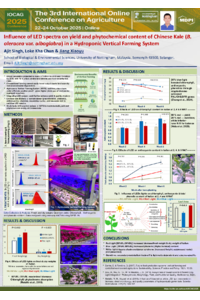
The rapid pace of global population growth and urbanization continues to deplete arable land, emphasizing the urgent need for sustainable food production systems. This study examines the effectiveness of hydroponic vertical farming systems (HVFSs) equipped with light-emitting diode (LED) technology in cultivating Chinese kale (Brassica oleracea var. alboglabra). Specifically, it evaluates the impact of three distinct LED treatments—white LEDs (WL), 20% red + 80% blue (20%RL:80%BL), and 80% red + 20% blue (80%RL:20%BL)—on morphological development and phytochemical accumulation.
Plants were grown under controlled conditions (pH 5.8–6.5, EC 2.0–3.0 dSm⁻¹) and assessed at weeks 2, 4, and 6 post-transplanting. The 80%RL:20%BL treatment yielded superior fresh weight, leaf area, root length, and dry biomass, indicating that higher red light proportions significantly enhance morphological growth (P<0.05). In contrast, the 20%RL:80%BL treatment resulted in the highest chlorophyll (53.60 mg/g), anthocyanin (11.30 units), and total phenolic content (1.46 mg GAE/g), suggesting blue-light dominance improves phytochemical profiles.
Interestingly, leaf number and maximum quantum yield (QY) remained statistically similar across treatments, though all QY values fell below the ideal benchmark of ~0.83, indicating light-induced stress across the board. Notably, Chinese kale grown under WL exhibited the greatest stem elongation, likely triggered by a low red to far-red ratio that induced shade avoidance responses.
Overall, an 80%-RL:20%-BL ratio emerges as the optimal treatment for promoting vegetative growth, whereas a 20%-RL:80%-BL ratio proves more effective for enhancing phytochemical enrichment. These insights offer practical guidance for optimizing LED configurations in HVFS, balancing yield and nutritional quality for future urban agricultural systems.
Keywords
Hydroponic vertical farming
Chinese kale (Brassica oleracea var. alboglabra)
LED light ratios
Phytochemical accumulation
Urban agriculture sustainability
Poster
Singh et al Poster Oct 2025.pdf
Morphological Characterization and Phytochemical Profiling of Specimens from the Peruvian Solanum muricatum Aiton Germplasm Bank at the UNSCH
Development of a Low-Cost, Solar-Powered Smart Evaporative Cooling Storage System to Extend the Shelf Life of Fruits and Vegetables in Tropical Regions