Event submissions
Published
This submission belongs to the session S10. From Field to Consumers: Challenges and Approaches to High- Quality Agricultural Products of the event The 3rd International Online Conference on Agriculture
Published date
20 Oct, 2025
Academic Editor
'%3e%3cpath%20d='M12.6657%2010.9104C12.4185%2010.325%2012.0599%209.79327%2011.6097%209.34482C11.1609%208.89508%2010.6293%208.5365%2010.0442%208.28888C10.0389%208.28626%2010.0337%208.28495%2010.0285%208.28233C10.8446%207.69279%2011.3752%206.73249%2011.3752%205.64904C11.3752%203.8542%209.92103%202.39999%208.1262%202.39999C6.33136%202.39999%204.87715%203.8542%204.87715%205.64904C4.87715%206.73249%205.40774%207.69279%206.22393%208.28364C6.21869%208.28626%206.21345%208.28757%206.20821%208.29019C5.62129%208.5378%205.09463%208.89284%204.64265%209.34613C4.1929%209.79493%203.83432%2010.3266%203.58671%2010.9117C3.34345%2011.4845%203.21226%2012.0987%203.20023%2012.7209C3.19988%2012.7349%203.20233%2012.7488%203.20744%2012.7619C3.21255%2012.7749%203.22022%2012.7867%203.22998%2012.7968C3.23975%2012.8068%203.25142%2012.8147%203.26431%2012.8202C3.2772%2012.8256%203.29105%2012.8284%203.30504%2012.8284H4.09109C4.14874%2012.8284%204.19459%2012.7825%204.1959%2012.7262C4.2221%2011.7148%204.62823%2010.7676%205.34617%2010.0497C6.08899%209.30683%207.0755%208.89808%208.1262%208.89808C9.17689%208.89808%2010.1634%209.30683%2010.9062%2010.0497C11.6242%2010.7676%2012.0303%2011.7148%2012.0565%2012.7262C12.0578%2012.7838%2012.1037%2012.8284%2012.1613%2012.8284H12.9474C12.9613%2012.8284%2012.9752%2012.8256%2012.9881%2012.8202C13.001%2012.8147%2013.0126%2012.8068%2013.0224%2012.7968C13.0322%2012.7867%2013.0398%2012.7749%2013.0449%2012.7619C13.0501%2012.7488%2013.0525%2012.7349%2013.0522%2012.7209C13.0391%2012.0947%2012.9094%2011.4855%2012.6657%2010.9104ZM8.1262%207.9024C7.52486%207.9024%206.9589%207.6679%206.53312%207.24211C6.10733%206.81633%205.87283%206.25037%205.87283%205.64904C5.87283%205.0477%206.10733%204.48174%206.53312%204.05596C6.9589%203.63018%207.52486%203.39567%208.1262%203.39567C8.72753%203.39567%209.29349%203.63018%209.71927%204.05596C10.1451%204.48174%2010.3796%205.0477%2010.3796%205.64904C10.3796%206.25037%2010.1451%206.81633%209.71927%207.24211C9.29349%207.6679%208.72753%207.9024%208.1262%207.9024Z'%20fill='%235D1EE1'/%3e%3c/g%3e%3c/svg%3e) Isabel Lara
Isabel LaraCitation
nacera TADJINE, Insecticidal effect of ethanolic extract from Zizyphus lotus L. against Tribolium castaneum (Herbst) (Coleoptera: Tenebrionidae), in Proceedings of The 3rd International Online Conference on Agriculture, 22 October–24 October 2025, MDPI: Basel, Switzerland
Share
Email
Facebook
Twitter
LinkedIn
Insecticidal effect of ethanolic extract from Zizyphus lotus L. against Tribolium castaneum (Herbst) (Coleoptera: Tenebrionidae)
'%3e%3cpath%20d='M12.6647%2010.9104C12.4176%2010.325%2012.0589%209.7933%2011.6088%209.34485C11.16%208.89511%2010.6283%208.53653%2010.0432%208.28891C10.038%208.28629%2010.0327%208.28498%2010.0275%208.28236C10.8437%207.69282%2011.3743%206.73252%2011.3743%205.64907C11.3743%203.85423%209.92005%202.40002%208.12522%202.40002C6.33038%202.40002%204.87618%203.85423%204.87618%205.64907C4.87618%206.73252%205.40677%207.69282%206.22296%208.28367C6.21772%208.28629%206.21248%208.2876%206.20724%208.29022C5.62031%208.53783%205.09365%208.89287%204.64167%209.34616C4.19192%209.79496%203.83334%2010.3266%203.58573%2010.9117C3.34247%2011.4846%203.21128%2012.0987%203.19925%2012.721C3.1989%2012.735%203.20135%2012.7489%203.20646%2012.7619C3.21157%2012.7749%203.21924%2012.7868%203.22901%2012.7968C3.23877%2012.8068%203.25045%2012.8148%203.26334%2012.8202C3.27623%2012.8256%203.29007%2012.8284%203.30406%2012.8284H4.09012C4.14776%2012.8284%204.19362%2012.7825%204.19493%2012.7262C4.22113%2011.7148%204.62726%2010.7676%205.34519%2010.0497C6.08802%209.30686%207.07452%208.89811%208.12522%208.89811C9.17592%208.89811%2010.1624%209.30686%2010.9052%2010.0497C11.6232%2010.7676%2012.0293%2011.7148%2012.0555%2012.7262C12.0568%2012.7839%2012.1027%2012.8284%2012.1603%2012.8284H12.9464C12.9604%2012.8284%2012.9742%2012.8256%2012.9871%2012.8202C13%2012.8148%2013.0117%2012.8068%2013.0214%2012.7968C13.0312%2012.7868%2013.0389%2012.7749%2013.044%2012.7619C13.0491%2012.7489%2013.0515%2012.735%2013.0512%2012.721C13.0381%2012.0947%2012.9084%2011.4856%2012.6647%2010.9104ZM8.12522%207.90243C7.52388%207.90243%206.95792%207.66793%206.53214%207.24215C6.10636%206.81636%205.87185%206.2504%205.87185%205.64907C5.87185%205.04773%206.10636%204.48177%206.53214%204.05599C6.95792%203.63021%207.52388%203.3957%208.12522%203.3957C8.72655%203.3957%209.29252%203.63021%209.7183%204.05599C10.1441%204.48177%2010.3786%205.04773%2010.3786%205.64907C10.3786%206.2504%2010.1441%206.81636%209.7183%207.24215C9.29252%207.66793%208.72655%207.90243%208.12522%207.90243Z'%20fill='%235D1EE1'/%3e%3c/g%3e%3c/svg%3e)
nacera TADJINE 1
1. Laboratory of Biotechnology of Medicinal and Aromatic Plants, Blida-1 University, Blida, Algeria
Abstract
Nacéra TADJINE
Author: Nacéra TADJINE
Laboratory of Biotechnology of Medicinal and Aromatic Plants, Blida-1 University, Algeria
naceratadjine@yahoo.fr
Abstract
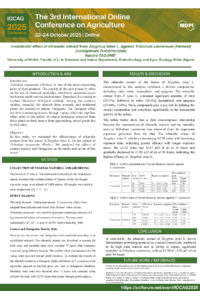
The study aims to determine the chemical composition of the ethanolic extract of Z. lotus L. leaves, as well as to evaluate its effectiveness in combating Tribolium castaneum (Herbst) (Coleoptera: Tenebrionidae), a pest of stored products. Rutin, robin, kaempferol, and apigenin have been identified as the main constituents of Z. lotus L. The tested ethanolic extract showed pronounced insecticidal activity against this harmful species, proportionally to the applied doses. The ethanolic extract of Z. lotus L. demonstrated high efficacy in the various treatments tested on T. castaneum. Regarding contact and fumigation assessments, the ethanolic extract of Z. lotus L. induced corrected mortality rates ranging from 37.5% to 100% in T. castaneum, with corresponding lethal concentrations (LC50) of 13.9 µl/ml and 16.9 µl/l of air, respectively, during contact and fumigation evaluations. Our results indicate that the ethanolic extract of Z. lotus L. exhibits very promising insecticidal activity against T. castaneum. The topical toxicity recorded ID10 and ID50 values of 1.45 and 2.77 µg per adult. These results clearly show that the ethanolic extract of Z. lotus L. has great potential for the development of new botanical insecticides as safe alternatives for controlling harmful insects.
Keywords
Keywords: Botanical insecticide
Ethanolic extract
Toxicity Tribolium castaneum (Herbst)
Poster
TADJINE_Nacéra_Poster.pdf
Irrigation, Ecology, and Agrarian transformation: a study of environmental degradation in Uttar Pradesh (1850-2000)
Enhancing Multi-Trait Genetic Gains in Durum Wheat (Triticum durum Desf.) Using Ideotype-Based Selection Indices