Event submissions
Published
This submission belongs to the session S11. Crop Genetics, Genomics and Breeding of the event The 3rd International Online Conference on Agriculture
Published date
20 Oct, 2025
Academic Editor
'%3e%3cpath%20d='M12.6657%2010.9104C12.4185%2010.325%2012.0599%209.79327%2011.6097%209.34482C11.1609%208.89508%2010.6293%208.5365%2010.0442%208.28888C10.0389%208.28626%2010.0337%208.28495%2010.0285%208.28233C10.8446%207.69279%2011.3752%206.73249%2011.3752%205.64904C11.3752%203.8542%209.92103%202.39999%208.1262%202.39999C6.33136%202.39999%204.87715%203.8542%204.87715%205.64904C4.87715%206.73249%205.40774%207.69279%206.22393%208.28364C6.21869%208.28626%206.21345%208.28757%206.20821%208.29019C5.62129%208.5378%205.09463%208.89284%204.64265%209.34613C4.1929%209.79493%203.83432%2010.3266%203.58671%2010.9117C3.34345%2011.4845%203.21226%2012.0987%203.20023%2012.7209C3.19988%2012.7349%203.20233%2012.7488%203.20744%2012.7619C3.21255%2012.7749%203.22022%2012.7867%203.22998%2012.7968C3.23975%2012.8068%203.25142%2012.8147%203.26431%2012.8202C3.2772%2012.8256%203.29105%2012.8284%203.30504%2012.8284H4.09109C4.14874%2012.8284%204.19459%2012.7825%204.1959%2012.7262C4.2221%2011.7148%204.62823%2010.7676%205.34617%2010.0497C6.08899%209.30683%207.0755%208.89808%208.1262%208.89808C9.17689%208.89808%2010.1634%209.30683%2010.9062%2010.0497C11.6242%2010.7676%2012.0303%2011.7148%2012.0565%2012.7262C12.0578%2012.7838%2012.1037%2012.8284%2012.1613%2012.8284H12.9474C12.9613%2012.8284%2012.9752%2012.8256%2012.9881%2012.8202C13.001%2012.8147%2013.0126%2012.8068%2013.0224%2012.7968C13.0322%2012.7867%2013.0398%2012.7749%2013.0449%2012.7619C13.0501%2012.7488%2013.0525%2012.7349%2013.0522%2012.7209C13.0391%2012.0947%2012.9094%2011.4855%2012.6657%2010.9104ZM8.1262%207.9024C7.52486%207.9024%206.9589%207.6679%206.53312%207.24211C6.10733%206.81633%205.87283%206.25037%205.87283%205.64904C5.87283%205.0477%206.10733%204.48174%206.53312%204.05596C6.9589%203.63018%207.52486%203.39567%208.1262%203.39567C8.72753%203.39567%209.29349%203.63018%209.71927%204.05596C10.1451%204.48174%2010.3796%205.0477%2010.3796%205.64904C10.3796%206.25037%2010.1451%206.81633%209.71927%207.24211C9.29349%207.6679%208.72753%207.9024%208.1262%207.9024Z'%20fill='%235D1EE1'/%3e%3c/g%3e%3c/svg%3e) Rodomiro Ortiz
Rodomiro OrtizCitation
Zine El Abidine Fellahi, Abou-bakr Rabti, Abderrahmane Hannachi, Nasreddine Louahdi, Enhancing Multi-Trait Genetic Gains in Durum Wheat (Triticum durum Desf.) Using Ideotype-Based Selection Indices, in Proceedings of The 3rd International Online Conference on Agriculture, 22 October–24 October 2025, MDPI: Basel, Switzerland
Share
Email
Facebook
Twitter
LinkedIn
Enhancing Multi-Trait Genetic Gains in Durum Wheat (Triticum durum Desf.) Using Ideotype-Based Selection Indices
'%3e%3cpath%20d='M12.6647%2010.9104C12.4176%2010.325%2012.0589%209.7933%2011.6088%209.34485C11.16%208.89511%2010.6283%208.53653%2010.0432%208.28891C10.038%208.28629%2010.0327%208.28498%2010.0275%208.28236C10.8437%207.69282%2011.3743%206.73252%2011.3743%205.64907C11.3743%203.85423%209.92005%202.40002%208.12522%202.40002C6.33038%202.40002%204.87618%203.85423%204.87618%205.64907C4.87618%206.73252%205.40677%207.69282%206.22296%208.28367C6.21772%208.28629%206.21248%208.2876%206.20724%208.29022C5.62031%208.53783%205.09365%208.89287%204.64167%209.34616C4.19192%209.79496%203.83334%2010.3266%203.58573%2010.9117C3.34247%2011.4846%203.21128%2012.0987%203.19925%2012.721C3.1989%2012.735%203.20135%2012.7489%203.20646%2012.7619C3.21157%2012.7749%203.21924%2012.7868%203.22901%2012.7968C3.23877%2012.8068%203.25045%2012.8148%203.26334%2012.8202C3.27623%2012.8256%203.29007%2012.8284%203.30406%2012.8284H4.09012C4.14776%2012.8284%204.19362%2012.7825%204.19493%2012.7262C4.22113%2011.7148%204.62726%2010.7676%205.34519%2010.0497C6.08802%209.30686%207.07452%208.89811%208.12522%208.89811C9.17592%208.89811%2010.1624%209.30686%2010.9052%2010.0497C11.6232%2010.7676%2012.0293%2011.7148%2012.0555%2012.7262C12.0568%2012.7839%2012.1027%2012.8284%2012.1603%2012.8284H12.9464C12.9604%2012.8284%2012.9742%2012.8256%2012.9871%2012.8202C13%2012.8148%2013.0117%2012.8068%2013.0214%2012.7968C13.0312%2012.7868%2013.0389%2012.7749%2013.044%2012.7619C13.0491%2012.7489%2013.0515%2012.735%2013.0512%2012.721C13.0381%2012.0947%2012.9084%2011.4856%2012.6647%2010.9104ZM8.12522%207.90243C7.52388%207.90243%206.95792%207.66793%206.53214%207.24215C6.10636%206.81636%205.87185%206.2504%205.87185%205.64907C5.87185%205.04773%206.10636%204.48177%206.53214%204.05599C6.95792%203.63021%207.52388%203.3957%208.12522%203.3957C8.72655%203.3957%209.29252%203.63021%209.7183%204.05599C10.1441%204.48177%2010.3786%205.04773%2010.3786%205.64907C10.3786%206.2504%2010.1441%206.81636%209.7183%207.24215C9.29252%207.66793%208.72655%207.90243%208.12522%207.90243Z'%20fill='%235D1EE1'/%3e%3c/g%3e%3c/svg%3e)
Zine El Abidine Fellahi 1
Abou-bakr Rabti 2
Abderrahmane Hannachi 3
Nasreddine Louahdi 4
1. Department of Agronomic Sciences, Faculty of Natural, Life, Earth and Universe Sciences, University Mohamed El Bachir El Ibrahimi of Bordj Bou Arreridj, El Anasser 34030, Algeria
2. Institute of Agriculture and Veterinary Sciences, University of Mohamed-Cherif Messaadia, Souk Ahras, 41000, Algeria
3. National Agronomic Research Institute of Algeria (INRAA), Setif Research Unit, 19000, Algeria
4. Experimental Farm, Field Crop Institute (ITGC), Farm Road-BP03, Setif 19000, Algeria
Abstract
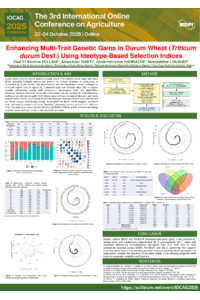
Durum wheat is a strategic crop for food security in semi-arid regions such as North Africa, where climate variability increasingly threatens agricultural productivity. Multi-trait selection represents a valuable approach to developing superior genotypes capable of maintaining high performance under such challenging conditions. This study aimed to compare the efficiency of traditional and modern multi-trait selection indices in identifying elite durum wheat genotypes. A total of 59 genotypes were evaluated under field conditions in Sétif, Algeria. Ten traits related to plant growth and agronomic performance were assessed, and a 15% selection intensity was applied. The classical Smith–Hazel (SH) selection index was implemented under two scenarios—retaining multicollinearity (SH_1) and removing multicollinearity (SH_2)—and compared with two modern ideotype-based indices: the Factor Analysis and Ideotype Design-Based BLUP (FAI-BLUP) and the Multi-Trait Genotype Ideotype Distance Index (MGIDI). Among the four indices, the MGIDI and FAI-BLUP achieved the highest total predicted selection gains (36.28%), substantially outperforming SH_2 (30.76%) and especially SH_1 (–35.98%), which was negatively affected by multicollinearity. Modern indices promoted substantial gains in key productivity-related traits, including biological yield (5.64%), grain yield (5.49%), and straw yield (15.1%). Notably, genotypes G42, G10, G26, and G4 were consistently selected across the MGIDI, FAI-BLUP, and SH_2, confirming their superior multi-trait performance and breeding potential. In contrast, SH_1 yielded inconsistent and negative results, highlighting the limitations of applying traditional indices without accounting for multicollinearity. These findings confirm the robustness, efficiency, and practical value of ideotype-based indices—particularly the MGIDI and FAI-BLUP—for multi-trait selection in durum wheat breeding programs, especially under semi-arid environmental conditions.
Keywords
durum wheat
Smith-Hazel
MGIDI
FAI-BLUP
multicollinearity
genetic gain
multi-trait analysis.
Poster
Poster MDPI Conference 2025 (1).pdf
Insecticidal effect of ethanolic extract from Zizyphus lotus L. against Tribolium castaneum (Herbst) (Coleoptera: Tenebrionidae)
An IoT-Based Anomaly Detection Framework for Smart Agriculture Using Hybrid PCA and Isolation Forest