Event submissions
Published
This submission belongs to the session S10. From Field to Consumers: Challenges and Approaches to High- Quality Agricultural Products of the event The 3rd International Online Conference on Agriculture
Published date
20 Oct, 2025
Academic Editor
'%3e%3cpath%20d='M12.6657%2010.9104C12.4185%2010.325%2012.0599%209.79327%2011.6097%209.34482C11.1609%208.89508%2010.6293%208.5365%2010.0442%208.28888C10.0389%208.28626%2010.0337%208.28495%2010.0285%208.28233C10.8446%207.69279%2011.3752%206.73249%2011.3752%205.64904C11.3752%203.8542%209.92103%202.39999%208.1262%202.39999C6.33136%202.39999%204.87715%203.8542%204.87715%205.64904C4.87715%206.73249%205.40774%207.69279%206.22393%208.28364C6.21869%208.28626%206.21345%208.28757%206.20821%208.29019C5.62129%208.5378%205.09463%208.89284%204.64265%209.34613C4.1929%209.79493%203.83432%2010.3266%203.58671%2010.9117C3.34345%2011.4845%203.21226%2012.0987%203.20023%2012.7209C3.19988%2012.7349%203.20233%2012.7488%203.20744%2012.7619C3.21255%2012.7749%203.22022%2012.7867%203.22998%2012.7968C3.23975%2012.8068%203.25142%2012.8147%203.26431%2012.8202C3.2772%2012.8256%203.29105%2012.8284%203.30504%2012.8284H4.09109C4.14874%2012.8284%204.19459%2012.7825%204.1959%2012.7262C4.2221%2011.7148%204.62823%2010.7676%205.34617%2010.0497C6.08899%209.30683%207.0755%208.89808%208.1262%208.89808C9.17689%208.89808%2010.1634%209.30683%2010.9062%2010.0497C11.6242%2010.7676%2012.0303%2011.7148%2012.0565%2012.7262C12.0578%2012.7838%2012.1037%2012.8284%2012.1613%2012.8284H12.9474C12.9613%2012.8284%2012.9752%2012.8256%2012.9881%2012.8202C13.001%2012.8147%2013.0126%2012.8068%2013.0224%2012.7968C13.0322%2012.7867%2013.0398%2012.7749%2013.0449%2012.7619C13.0501%2012.7488%2013.0525%2012.7349%2013.0522%2012.7209C13.0391%2012.0947%2012.9094%2011.4855%2012.6657%2010.9104ZM8.1262%207.9024C7.52486%207.9024%206.9589%207.6679%206.53312%207.24211C6.10733%206.81633%205.87283%206.25037%205.87283%205.64904C5.87283%205.0477%206.10733%204.48174%206.53312%204.05596C6.9589%203.63018%207.52486%203.39567%208.1262%203.39567C8.72753%203.39567%209.29349%203.63018%209.71927%204.05596C10.1451%204.48174%2010.3796%205.0477%2010.3796%205.64904C10.3796%206.25037%2010.1451%206.81633%209.71927%207.24211C9.29349%207.6679%208.72753%207.9024%208.1262%207.9024Z'%20fill='%235D1EE1'/%3e%3c/g%3e%3c/svg%3e) Isabel Lara
Isabel LaraCitation
Sumaiya Hassan, Saima Fariha, Suraiya Hassan Richi, Sumaiya Jalal, Formulation and Evaluation of Biodegradable Edible Coating from Pleurotus ostreatus Polysaccharides Integrated with Green-Synthesized Silver Nanoparticles for Postharvest Preservation, in Proceedings of The 3rd International Online Conference on Agriculture, 22 October–24 October 2025, MDPI: Basel, Switzerland
Share
Email
Facebook
Twitter
LinkedIn
Formulation and Evaluation of Biodegradable Edible Coating from Pleurotus ostreatus Polysaccharides Integrated with Green-Synthesized Silver Nanoparticles for Postharvest Preservation
'%3e%3cpath%20d='M12.6647%2010.9104C12.4176%2010.325%2012.0589%209.7933%2011.6088%209.34485C11.16%208.89511%2010.6283%208.53653%2010.0432%208.28891C10.038%208.28629%2010.0327%208.28498%2010.0275%208.28236C10.8437%207.69282%2011.3743%206.73252%2011.3743%205.64907C11.3743%203.85423%209.92005%202.40002%208.12522%202.40002C6.33038%202.40002%204.87618%203.85423%204.87618%205.64907C4.87618%206.73252%205.40677%207.69282%206.22296%208.28367C6.21772%208.28629%206.21248%208.2876%206.20724%208.29022C5.62031%208.53783%205.09365%208.89287%204.64167%209.34616C4.19192%209.79496%203.83334%2010.3266%203.58573%2010.9117C3.34247%2011.4846%203.21128%2012.0987%203.19925%2012.721C3.1989%2012.735%203.20135%2012.7489%203.20646%2012.7619C3.21157%2012.7749%203.21924%2012.7868%203.22901%2012.7968C3.23877%2012.8068%203.25045%2012.8148%203.26334%2012.8202C3.27623%2012.8256%203.29007%2012.8284%203.30406%2012.8284H4.09012C4.14776%2012.8284%204.19362%2012.7825%204.19493%2012.7262C4.22113%2011.7148%204.62726%2010.7676%205.34519%2010.0497C6.08802%209.30686%207.07452%208.89811%208.12522%208.89811C9.17592%208.89811%2010.1624%209.30686%2010.9052%2010.0497C11.6232%2010.7676%2012.0293%2011.7148%2012.0555%2012.7262C12.0568%2012.7839%2012.1027%2012.8284%2012.1603%2012.8284H12.9464C12.9604%2012.8284%2012.9742%2012.8256%2012.9871%2012.8202C13%2012.8148%2013.0117%2012.8068%2013.0214%2012.7968C13.0312%2012.7868%2013.0389%2012.7749%2013.044%2012.7619C13.0491%2012.7489%2013.0515%2012.735%2013.0512%2012.721C13.0381%2012.0947%2012.9084%2011.4856%2012.6647%2010.9104ZM8.12522%207.90243C7.52388%207.90243%206.95792%207.66793%206.53214%207.24215C6.10636%206.81636%205.87185%206.2504%205.87185%205.64907C5.87185%205.04773%206.10636%204.48177%206.53214%204.05599C6.95792%203.63021%207.52388%203.3957%208.12522%203.3957C8.72655%203.3957%209.29252%203.63021%209.7183%204.05599C10.1441%204.48177%2010.3786%205.04773%2010.3786%205.64907C10.3786%206.2504%2010.1441%206.81636%209.7183%207.24215C9.29252%207.66793%208.72655%207.90243%208.12522%207.90243Z'%20fill='%235D1EE1'/%3e%3c/g%3e%3c/svg%3e)
Sumaiya Hassan 1
Saima Fariha 1
Suraiya Hassan Richi 2
Sumaiya Jalal 3
1. Department of Applied Nutrition and Food Technology, Islamic University, Kushtia 7003, Bangladesh
2. Department of Biotechnology and Genetic Engineering, Khulna University, Khulna 9208, Bangladesh
3. North Western University, Khulna 9100, Bangladesh
Abstract
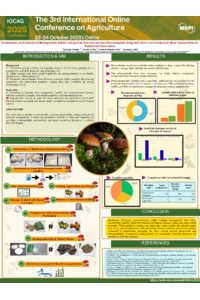
The current study aimed to develop and evaluate a biodegradable edible coating derived from Pleurotus ostreatus (oyster mushroom) polysaccharides, incorporating green-synthesized silver nanoparticles (AgNPs), for the postharvest preservation of fruits. Glycerol was used as a plasticizer in the film formulation, and the composite films were characterized using UV–Vis spectroscopy (peak at ~420 nm), X-ray diffraction (XRD), and scanning electron microscopy (SEM) analysis. The coating was applied to tomatoes and guavas and evaluated over 14 days at 25 °C for its impact on weight loss, firmness, decay incidence, microbial load, sensory attributes, vitamin C retention, and biodegradability. The AgNP-enhanced films exhibited improved physicochemical properties, including a reduction in water vapor permeability (from 3.75 to 2.89 × 10⁻¹¹ g/m·s·Pa) and enhanced antimicrobial activity, with inhibition zones of 16.5 mm for E. coli and 19.5 mm for Staphylococcus aureus. After 14 days, the coated fruits showed significantly lower weight loss (5.1 ± 0.5%), decay incidence (7%), and microbial load (3.5 CFU/g) compared to both uncoated and polyethylene-wrapped samples. Sensory evaluations showed high acceptability (scores >8.0), and nutritional quality was maintained, with vitamin C retention at 80%. The coating demonstrated approximately 90% biodegradability within 30 days under soil burial conditions and met safety standards regarding nanoparticle migration. These findings highlight the potential of mushroom-based AgNP films as a sustainable, safe, and effective alternative to conventional plastic packaging for extending the shelf life and preserving the quality of fresh produce.
Keywords
Pleurotus ostreatus
green synthesis
silver nanoparticles
biodegradable
edible film
postharvest preservation
packaging
Poster
Sumaiya Hassan Poster.pdf
E-Commerce Participation, Land Management Characteristics, and Farmers’ Fertilization Behaviors: Evidence from Apple Growers in China
Performance Evaluation of Small white common bean (Phaseolus vulgaris L.) Varieties at Buno Bedele and Ilu Aba Bora Zones, South-western Oromia