Event submissions
Published
This submission belongs to the session S6. Smart Farming: From Sensor to Artificial Intelligence of the event The 3rd International Online Conference on Agriculture
Published date
20 Oct, 2025
Academic Editor
'%3e%3cpath%20d='M12.6657%2010.9104C12.4185%2010.325%2012.0599%209.79327%2011.6097%209.34482C11.1609%208.89508%2010.6293%208.5365%2010.0442%208.28888C10.0389%208.28626%2010.0337%208.28495%2010.0285%208.28233C10.8446%207.69279%2011.3752%206.73249%2011.3752%205.64904C11.3752%203.8542%209.92103%202.39999%208.1262%202.39999C6.33136%202.39999%204.87715%203.8542%204.87715%205.64904C4.87715%206.73249%205.40774%207.69279%206.22393%208.28364C6.21869%208.28626%206.21345%208.28757%206.20821%208.29019C5.62129%208.5378%205.09463%208.89284%204.64265%209.34613C4.1929%209.79493%203.83432%2010.3266%203.58671%2010.9117C3.34345%2011.4845%203.21226%2012.0987%203.20023%2012.7209C3.19988%2012.7349%203.20233%2012.7488%203.20744%2012.7619C3.21255%2012.7749%203.22022%2012.7867%203.22998%2012.7968C3.23975%2012.8068%203.25142%2012.8147%203.26431%2012.8202C3.2772%2012.8256%203.29105%2012.8284%203.30504%2012.8284H4.09109C4.14874%2012.8284%204.19459%2012.7825%204.1959%2012.7262C4.2221%2011.7148%204.62823%2010.7676%205.34617%2010.0497C6.08899%209.30683%207.0755%208.89808%208.1262%208.89808C9.17689%208.89808%2010.1634%209.30683%2010.9062%2010.0497C11.6242%2010.7676%2012.0303%2011.7148%2012.0565%2012.7262C12.0578%2012.7838%2012.1037%2012.8284%2012.1613%2012.8284H12.9474C12.9613%2012.8284%2012.9752%2012.8256%2012.9881%2012.8202C13.001%2012.8147%2013.0126%2012.8068%2013.0224%2012.7968C13.0322%2012.7867%2013.0398%2012.7749%2013.0449%2012.7619C13.0501%2012.7488%2013.0525%2012.7349%2013.0522%2012.7209C13.0391%2012.0947%2012.9094%2011.4855%2012.6657%2010.9104ZM8.1262%207.9024C7.52486%207.9024%206.9589%207.6679%206.53312%207.24211C6.10733%206.81633%205.87283%206.25037%205.87283%205.64904C5.87283%205.0477%206.10733%204.48174%206.53312%204.05596C6.9589%203.63018%207.52486%203.39567%208.1262%203.39567C8.72753%203.39567%209.29349%203.63018%209.71927%204.05596C10.1451%204.48174%2010.3796%205.0477%2010.3796%205.64904C10.3796%206.25037%2010.1451%206.81633%209.71927%207.24211C9.29349%207.6679%208.72753%207.9024%208.1262%207.9024Z'%20fill='%235D1EE1'/%3e%3c/g%3e%3c/svg%3e) Sanzidur Rahman
Sanzidur RahmanCitation
Maria Feka, Panagiotis Oikonomou, Vasileios Tsoukas, Athanasios Kakarountas, A Telemetry-Based Precision Agriculture System for the Sustainable Cultivation of Stevia rebaudiana, in Proceedings of The 3rd International Online Conference on Agriculture, 22 October–24 October 2025, MDPI: Basel, Switzerland
Share
Email
Facebook
Twitter
LinkedIn
A Telemetry-Based Precision Agriculture System for the Sustainable Cultivation of Stevia rebaudiana
'%3e%3cpath%20d='M12.6647%2010.9104C12.4176%2010.325%2012.0589%209.7933%2011.6088%209.34485C11.16%208.89511%2010.6283%208.53653%2010.0432%208.28891C10.038%208.28629%2010.0327%208.28498%2010.0275%208.28236C10.8437%207.69282%2011.3743%206.73252%2011.3743%205.64907C11.3743%203.85423%209.92005%202.40002%208.12522%202.40002C6.33038%202.40002%204.87618%203.85423%204.87618%205.64907C4.87618%206.73252%205.40677%207.69282%206.22296%208.28367C6.21772%208.28629%206.21248%208.2876%206.20724%208.29022C5.62031%208.53783%205.09365%208.89287%204.64167%209.34616C4.19192%209.79496%203.83334%2010.3266%203.58573%2010.9117C3.34247%2011.4846%203.21128%2012.0987%203.19925%2012.721C3.1989%2012.735%203.20135%2012.7489%203.20646%2012.7619C3.21157%2012.7749%203.21924%2012.7868%203.22901%2012.7968C3.23877%2012.8068%203.25045%2012.8148%203.26334%2012.8202C3.27623%2012.8256%203.29007%2012.8284%203.30406%2012.8284H4.09012C4.14776%2012.8284%204.19362%2012.7825%204.19493%2012.7262C4.22113%2011.7148%204.62726%2010.7676%205.34519%2010.0497C6.08802%209.30686%207.07452%208.89811%208.12522%208.89811C9.17592%208.89811%2010.1624%209.30686%2010.9052%2010.0497C11.6232%2010.7676%2012.0293%2011.7148%2012.0555%2012.7262C12.0568%2012.7839%2012.1027%2012.8284%2012.1603%2012.8284H12.9464C12.9604%2012.8284%2012.9742%2012.8256%2012.9871%2012.8202C13%2012.8148%2013.0117%2012.8068%2013.0214%2012.7968C13.0312%2012.7868%2013.0389%2012.7749%2013.044%2012.7619C13.0491%2012.7489%2013.0515%2012.735%2013.0512%2012.721C13.0381%2012.0947%2012.9084%2011.4856%2012.6647%2010.9104ZM8.12522%207.90243C7.52388%207.90243%206.95792%207.66793%206.53214%207.24215C6.10636%206.81636%205.87185%206.2504%205.87185%205.64907C5.87185%205.04773%206.10636%204.48177%206.53214%204.05599C6.95792%203.63021%207.52388%203.3957%208.12522%203.3957C8.72655%203.3957%209.29252%203.63021%209.7183%204.05599C10.1441%204.48177%2010.3786%205.04773%2010.3786%205.64907C10.3786%206.2504%2010.1441%206.81636%209.7183%207.24215C9.29252%207.66793%208.72655%207.90243%208.12522%207.90243Z'%20fill='%235D1EE1'/%3e%3c/g%3e%3c/svg%3e)
Maria Feka 1
Panagiotis Oikonomou 2
Vasileios Tsoukas 1

Athanasios Kakarountas 1
1. Department of Computer Science and Biomedical Informatics, Intelligent Systems Laboratory, University of Thessaly, Lamia, 35131, Greece
2. Department of Informatics and Telecommunications, University of Thessaly, Lamia, 35100, Greece
Abstract
Abstract
Introduction:
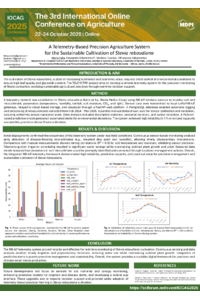
The cultivation of Stevia rebaudiana, a plant of increasing nutritional and economic value, requires strict control of environmental conditions to ensure high leaf quality and optimal glycoside content. The TELEMETRY project aims to develop a remote telemetry system for the precision monitoring of Stevia cultivation, enabling sustainable agricultural practices through real-time decision support. The system also supports proactive management through a rule-based alerting mechanism and neural networks, enabling the forecasting of future environmental and cultivation conditions.
Methods:
The system integrates Narrow Band IoT (NB-IoT) wireless sensors to measure critical environmental (temperature, humidity, rainfall, and soil moisture) parameters in a 4-hectare experimental plot managed by Stevia Hellas Coop. Sensor data are transmitted to central nodes and further relayed to a cloud-based storage and alert system. At the same time, local farmers perform traditional manual measurements (e.g., using analog hygrometers), which serve as a reference baseline for validating the sensor data. This comparative process enhances sensor reliability and contributes to the improvement of data accuracy for downstream machine learning models, including neural networks. The experimental layout ensures data uniformity across replicated plots.
Results:
Initial deployments confirmed the system's robustness under field conditions. Sensor-based monitoring enabled early identification of disease-favoring microclimates (e.g., high dew point and humidity), facilitating timely phytosanitary interventions. Compared to traditional irrigation scheduling, the telemetry-guided regime achieved significant water savings while maintaining efficient plant growth. Deviations in soil microclimate were detected and addressed through localized management.
Conclusions:
The TELEMETRY system demonstrates the potential of IoT-based solutions for precision agriculture in specialty crops such as Stevia. By integrating real-time data with grower decision-making, the system contributes to input reduction, disease prevention, and high-value product traceability. Future work will focus on increasing the monitored parameters and scaling up the system for broader deployment.
Keywords
Stevia rebaudiana
precision agriculture
smart farming
Poster
IOCAG2025_MARIA_FEKA.pdf
EXPLORING THE LIVED EXPERIENCES OF BANANA GROWERS BATTLING PANAMA DISEASE DURING THE COVID-19 PANDEMIC
Grant sparkling wines an identity: a strategy to address the wine sector crisis