Event submissions
Published
This submission belongs to the session S11. Crop Genetics, Genomics and Breeding of the event The 3rd International Online Conference on Agriculture
Published date
20 Oct, 2025
Academic Editor
'%3e%3cpath%20d='M12.6657%2010.9104C12.4185%2010.325%2012.0599%209.79327%2011.6097%209.34482C11.1609%208.89508%2010.6293%208.5365%2010.0442%208.28888C10.0389%208.28626%2010.0337%208.28495%2010.0285%208.28233C10.8446%207.69279%2011.3752%206.73249%2011.3752%205.64904C11.3752%203.8542%209.92103%202.39999%208.1262%202.39999C6.33136%202.39999%204.87715%203.8542%204.87715%205.64904C4.87715%206.73249%205.40774%207.69279%206.22393%208.28364C6.21869%208.28626%206.21345%208.28757%206.20821%208.29019C5.62129%208.5378%205.09463%208.89284%204.64265%209.34613C4.1929%209.79493%203.83432%2010.3266%203.58671%2010.9117C3.34345%2011.4845%203.21226%2012.0987%203.20023%2012.7209C3.19988%2012.7349%203.20233%2012.7488%203.20744%2012.7619C3.21255%2012.7749%203.22022%2012.7867%203.22998%2012.7968C3.23975%2012.8068%203.25142%2012.8147%203.26431%2012.8202C3.2772%2012.8256%203.29105%2012.8284%203.30504%2012.8284H4.09109C4.14874%2012.8284%204.19459%2012.7825%204.1959%2012.7262C4.2221%2011.7148%204.62823%2010.7676%205.34617%2010.0497C6.08899%209.30683%207.0755%208.89808%208.1262%208.89808C9.17689%208.89808%2010.1634%209.30683%2010.9062%2010.0497C11.6242%2010.7676%2012.0303%2011.7148%2012.0565%2012.7262C12.0578%2012.7838%2012.1037%2012.8284%2012.1613%2012.8284H12.9474C12.9613%2012.8284%2012.9752%2012.8256%2012.9881%2012.8202C13.001%2012.8147%2013.0126%2012.8068%2013.0224%2012.7968C13.0322%2012.7867%2013.0398%2012.7749%2013.0449%2012.7619C13.0501%2012.7488%2013.0525%2012.7349%2013.0522%2012.7209C13.0391%2012.0947%2012.9094%2011.4855%2012.6657%2010.9104ZM8.1262%207.9024C7.52486%207.9024%206.9589%207.6679%206.53312%207.24211C6.10733%206.81633%205.87283%206.25037%205.87283%205.64904C5.87283%205.0477%206.10733%204.48174%206.53312%204.05596C6.9589%203.63018%207.52486%203.39567%208.1262%203.39567C8.72753%203.39567%209.29349%203.63018%209.71927%204.05596C10.1451%204.48174%2010.3796%205.0477%2010.3796%205.64904C10.3796%206.25037%2010.1451%206.81633%209.71927%207.24211C9.29349%207.6679%208.72753%207.9024%208.1262%207.9024Z'%20fill='%235D1EE1'/%3e%3c/g%3e%3c/svg%3e) Rodomiro Ortiz
Rodomiro OrtizCitation
Moses Mutetwa, Pepukai Manjeru, Tendai Madanzi, Clapperton Mapwanyire, Tavagwisa Muziri, Agro-morphological characterization, phenotypic trait analysis, and breeding potential of horned melon (Cucumis metuliferus) germplasm for enhanced food security, in Proceedings of The 3rd International Online Conference on Agriculture, 22 October–24 October 2025, MDPI: Basel, Switzerland
Share
Email
Facebook
Twitter
LinkedIn
Agro-morphological characterization, phenotypic trait analysis, and breeding potential of horned melon (Cucumis metuliferus) germplasm for enhanced food security
'%3e%3cpath%20d='M12.6647%2010.9104C12.4176%2010.325%2012.0589%209.7933%2011.6088%209.34485C11.16%208.89511%2010.6283%208.53653%2010.0432%208.28891C10.038%208.28629%2010.0327%208.28498%2010.0275%208.28236C10.8437%207.69282%2011.3743%206.73252%2011.3743%205.64907C11.3743%203.85423%209.92005%202.40002%208.12522%202.40002C6.33038%202.40002%204.87618%203.85423%204.87618%205.64907C4.87618%206.73252%205.40677%207.69282%206.22296%208.28367C6.21772%208.28629%206.21248%208.2876%206.20724%208.29022C5.62031%208.53783%205.09365%208.89287%204.64167%209.34616C4.19192%209.79496%203.83334%2010.3266%203.58573%2010.9117C3.34247%2011.4846%203.21128%2012.0987%203.19925%2012.721C3.1989%2012.735%203.20135%2012.7489%203.20646%2012.7619C3.21157%2012.7749%203.21924%2012.7868%203.22901%2012.7968C3.23877%2012.8068%203.25045%2012.8148%203.26334%2012.8202C3.27623%2012.8256%203.29007%2012.8284%203.30406%2012.8284H4.09012C4.14776%2012.8284%204.19362%2012.7825%204.19493%2012.7262C4.22113%2011.7148%204.62726%2010.7676%205.34519%2010.0497C6.08802%209.30686%207.07452%208.89811%208.12522%208.89811C9.17592%208.89811%2010.1624%209.30686%2010.9052%2010.0497C11.6232%2010.7676%2012.0293%2011.7148%2012.0555%2012.7262C12.0568%2012.7839%2012.1027%2012.8284%2012.1603%2012.8284H12.9464C12.9604%2012.8284%2012.9742%2012.8256%2012.9871%2012.8202C13%2012.8148%2013.0117%2012.8068%2013.0214%2012.7968C13.0312%2012.7868%2013.0389%2012.7749%2013.044%2012.7619C13.0491%2012.7489%2013.0515%2012.735%2013.0512%2012.721C13.0381%2012.0947%2012.9084%2011.4856%2012.6647%2010.9104ZM8.12522%207.90243C7.52388%207.90243%206.95792%207.66793%206.53214%207.24215C6.10636%206.81636%205.87185%206.2504%205.87185%205.64907C5.87185%205.04773%206.10636%204.48177%206.53214%204.05599C6.95792%203.63021%207.52388%203.3957%208.12522%203.3957C8.72655%203.3957%209.29252%203.63021%209.7183%204.05599C10.1441%204.48177%2010.3786%205.04773%2010.3786%205.64907C10.3786%206.2504%2010.1441%206.81636%209.7183%207.24215C9.29252%207.66793%208.72655%207.90243%208.12522%207.90243Z'%20fill='%235D1EE1'/%3e%3c/g%3e%3c/svg%3e)
Moses Mutetwa 1
Pepukai Manjeru 1
Tendai Madanzi 1
Clapperton Mapwanyire 1
Tavagwisa Muziri 1
1. Department of Agronomy and Horticulture, Faculty of Agriculture, Environment and Natural Resources Management, Midlands State University, P. Bag 9055 Gweru, Zimbabwe
Abstract
Introduction: Horned melon (Cucumis metuliferus E. Mey. ex Naudin) remains an underutilized crop in Zimbabwe, despite its significant potential to bolster food and nutritional security in challenging environments due to its adaptive nature.
Methods: This study, conducted over two growing seasons (2024–2025) at Midlands State University, characterized the agro-morphological diversity of 24 landrace accessions collected from Mashonaland East using a Randomized Complete Block Design (RCBD).
Results: The research revealed substantial phenotypic variation (p < 0.001) across all measured traits. Certain accessions, notably Acc5, Acc8, Acc2, and Acc20, demonstrated superior agronomic performance, with Acc5 emerging as a particularly promising candidate for high-yield variety development or hybridization. Furthermore, Acc1 exhibited early maturity, a critical characteristic for developing climate-resilient cropping systems, while Acc24's thornless phenotype offers distinct advantages for handling and marketability. Yield displayed strong positive correlations with vine length (r = 0.58**), individual fruit weight (r = 0.59**), and the total number of fruits (r = 0.76**), underscoring these traits as primary determinants of productivity. A nearly perfect correlation (r = 0.99**) between the timing of male and female flowering indicated a tightly synchronized reproductive phase, which is essential for optimizing yield. Conversely, traits related to germination and seeds showed minimal impact on overall yield. A linear model (R² = 0.93) further confirmed that vine length, fruit weight, and fruit count significantly drive yield, while the number of thorns negatively influence it.
Conclusion: Yield is primarily influenced by vegetative vigor and reproductive efficiency. Breeding germplasm, such as high-yielding accessions (Acc5 and Acc8), an early-maturing line (Acc1), and a thornless variety (Acc24), emphasize the need to focus future breeding efforts on enhancing vegetative and reproductive characteristics.
Keywords
Cucumis metuliferus
Neglected and Underutilized species
Agro-morphological traits
Genetic conservation
Climate-smart breeding
Commercialization.
Poster
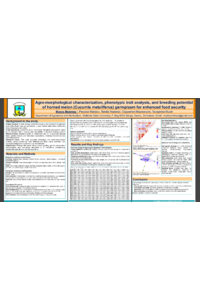
IOCAG2025 Poster (Moses Mutetwa).pdf
A soil pedotransfer function for the soils of Algeria: the search for the most suitable parameters for water retention
The Effect of Different Levels of Salinity Stress on Secondary Metabolite Production and Antioxidant Capacity of Hypericum perforatum Callus under In Vitro Culture Conditions