Event submissions
Published
This submission belongs to the session S7. Agricultural Soil of the event The 3rd International Online Conference on Agriculture
Published date
20 Oct, 2025
Academic Editor
'%3e%3cpath%20d='M12.6657%2010.9104C12.4185%2010.325%2012.0599%209.79327%2011.6097%209.34482C11.1609%208.89508%2010.6293%208.5365%2010.0442%208.28888C10.0389%208.28626%2010.0337%208.28495%2010.0285%208.28233C10.8446%207.69279%2011.3752%206.73249%2011.3752%205.64904C11.3752%203.8542%209.92103%202.39999%208.1262%202.39999C6.33136%202.39999%204.87715%203.8542%204.87715%205.64904C4.87715%206.73249%205.40774%207.69279%206.22393%208.28364C6.21869%208.28626%206.21345%208.28757%206.20821%208.29019C5.62129%208.5378%205.09463%208.89284%204.64265%209.34613C4.1929%209.79493%203.83432%2010.3266%203.58671%2010.9117C3.34345%2011.4845%203.21226%2012.0987%203.20023%2012.7209C3.19988%2012.7349%203.20233%2012.7488%203.20744%2012.7619C3.21255%2012.7749%203.22022%2012.7867%203.22998%2012.7968C3.23975%2012.8068%203.25142%2012.8147%203.26431%2012.8202C3.2772%2012.8256%203.29105%2012.8284%203.30504%2012.8284H4.09109C4.14874%2012.8284%204.19459%2012.7825%204.1959%2012.7262C4.2221%2011.7148%204.62823%2010.7676%205.34617%2010.0497C6.08899%209.30683%207.0755%208.89808%208.1262%208.89808C9.17689%208.89808%2010.1634%209.30683%2010.9062%2010.0497C11.6242%2010.7676%2012.0303%2011.7148%2012.0565%2012.7262C12.0578%2012.7838%2012.1037%2012.8284%2012.1613%2012.8284H12.9474C12.9613%2012.8284%2012.9752%2012.8256%2012.9881%2012.8202C13.001%2012.8147%2013.0126%2012.8068%2013.0224%2012.7968C13.0322%2012.7867%2013.0398%2012.7749%2013.0449%2012.7619C13.0501%2012.7488%2013.0525%2012.7349%2013.0522%2012.7209C13.0391%2012.0947%2012.9094%2011.4855%2012.6657%2010.9104ZM8.1262%207.9024C7.52486%207.9024%206.9589%207.6679%206.53312%207.24211C6.10733%206.81633%205.87283%206.25037%205.87283%205.64904C5.87283%205.0477%206.10733%204.48174%206.53312%204.05596C6.9589%203.63018%207.52486%203.39567%208.1262%203.39567C8.72753%203.39567%209.29349%203.63018%209.71927%204.05596C10.1451%204.48174%2010.3796%205.0477%2010.3796%205.64904C10.3796%206.25037%2010.1451%206.81633%209.71927%207.24211C9.29349%207.6679%208.72753%207.9024%208.1262%207.9024Z'%20fill='%235D1EE1'/%3e%3c/g%3e%3c/svg%3e) MARGA ROS
MARGA ROSCitation
Ifeoluwa Simeon Odesina, Ruth Oluyomi Onakanmi, Moses Adeniyi Osundina, CAN STAPLE CROPS CLEAN CONTAMINATED SOIL? PERCEPTIONS FROM THE PHYTOREMEDIATION POTENTIAL OF OGBOMOSO SOYBEAN LANDRACE, SOUTHWEST NIGERIA, in Proceedings of The 3rd International Online Conference on Agriculture, 22 October–24 October 2025, MDPI: Basel, Switzerland
Share
Email
Facebook
Twitter
LinkedIn
CAN STAPLE CROPS CLEAN CONTAMINATED SOIL? PERCEPTIONS FROM THE PHYTOREMEDIATION POTENTIAL OF OGBOMOSO SOYBEAN LANDRACE, SOUTHWEST NIGERIA

Ifeoluwa Simeon Odesina 1
'%3e%3cpath%20d='M12.6647%2010.9104C12.4176%2010.325%2012.0589%209.7933%2011.6088%209.34485C11.16%208.89511%2010.6283%208.53653%2010.0432%208.28891C10.038%208.28629%2010.0327%208.28498%2010.0275%208.28236C10.8437%207.69282%2011.3743%206.73252%2011.3743%205.64907C11.3743%203.85423%209.92005%202.40002%208.12522%202.40002C6.33038%202.40002%204.87618%203.85423%204.87618%205.64907C4.87618%206.73252%205.40677%207.69282%206.22296%208.28367C6.21772%208.28629%206.21248%208.2876%206.20724%208.29022C5.62031%208.53783%205.09365%208.89287%204.64167%209.34616C4.19192%209.79496%203.83334%2010.3266%203.58573%2010.9117C3.34247%2011.4846%203.21128%2012.0987%203.19925%2012.721C3.1989%2012.735%203.20135%2012.7489%203.20646%2012.7619C3.21157%2012.7749%203.21924%2012.7868%203.22901%2012.7968C3.23877%2012.8068%203.25045%2012.8148%203.26334%2012.8202C3.27623%2012.8256%203.29007%2012.8284%203.30406%2012.8284H4.09012C4.14776%2012.8284%204.19362%2012.7825%204.19493%2012.7262C4.22113%2011.7148%204.62726%2010.7676%205.34519%2010.0497C6.08802%209.30686%207.07452%208.89811%208.12522%208.89811C9.17592%208.89811%2010.1624%209.30686%2010.9052%2010.0497C11.6232%2010.7676%2012.0293%2011.7148%2012.0555%2012.7262C12.0568%2012.7839%2012.1027%2012.8284%2012.1603%2012.8284H12.9464C12.9604%2012.8284%2012.9742%2012.8256%2012.9871%2012.8202C13%2012.8148%2013.0117%2012.8068%2013.0214%2012.7968C13.0312%2012.7868%2013.0389%2012.7749%2013.044%2012.7619C13.0491%2012.7489%2013.0515%2012.735%2013.0512%2012.721C13.0381%2012.0947%2012.9084%2011.4856%2012.6647%2010.9104ZM8.12522%207.90243C7.52388%207.90243%206.95792%207.66793%206.53214%207.24215C6.10636%206.81636%205.87185%206.2504%205.87185%205.64907C5.87185%205.04773%206.10636%204.48177%206.53214%204.05599C6.95792%203.63021%207.52388%203.3957%208.12522%203.3957C8.72655%203.3957%209.29252%203.63021%209.7183%204.05599C10.1441%204.48177%2010.3786%205.04773%2010.3786%205.64907C10.3786%206.2504%2010.1441%206.81636%209.7183%207.24215C9.29252%207.66793%208.72655%207.90243%208.12522%207.90243Z'%20fill='%235D1EE1'/%3e%3c/g%3e%3c/svg%3e)
Ruth Oluyomi Onakanmi 1
Moses Adeniyi Osundina 1
1. Department of Pure and Applied Biology, Ladoke Akintola University of Technology (LAUTECH), Ogbomoso 210214, Oyo State, Nigeria
Abstract
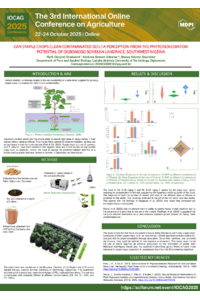
Industrialization has contributed largely to the non-availability of arable lands targeted for growing staple crops. The advent of phytoremediation has revealed the possibility of the deployment of eco-friendly and cost-effective alternatives to traditional remediation approaches, utilizing plants to reduce harmful substances from the soil. Although conventionally overlooked in this role, staple crops have shown emerging promise as dual-function plants, supporting both food production and agricultural soil recovery. This study aimed to assess the phytoremediation potential of a locally used soybean landrace, known to farmers in Ogbomoso as “ewa bimpe”. The experiment was carried out at the Botanical Gardens of the Department of Pure and Applied Biology, Ladoke Akintola University of Technology, Ogbomoso. The experiment was laid out in a completely randomized design (CRD), replicated four times. The soil was contaminated with industrial effluent at different concentrations (0%, 50%, and 100%). Cadmium (Cd), lead (Pb), and mercury (Hg) were detected in the effluents using an atomic absorption spectrometer. The results showed that the concentration of the effluent had a minimal effect on the plant, although a significant one (P ≤ 0.05). Generally, the growth of the soybean planted on non-polluted soil significantly differed (P ≤ 0.05) from that of the plant established on soil contaminated with 50% and 100% concentrations. The level of Cd (0.05 mgkg⁻¹) and Pb (0.04 mgkg⁻¹) uptake by the plants was higher, reducing its concentration in the soil. Landraces of other staple crops such as “ewa bimpe” show strong pollutant tolerance and uptake potential for phytoremediation. Considering their nutritional and economic value, they are ideal for low-resource environments. This study ideates the consideration of staple legumes as powerful tools for the recovery of the soil on arable land.
Keywords
Industrialization
Arable lands
Staple crops
ewa bimpe
Phytoremediation
Poster
sciforum-130091_Agricultural Soil.pdf
Production Performance, Heavy Metal Dynamics in Soil, and Uptake of Selected Crops Following Treatment with Different Forms of Compost-based Soil Amendment
Soil Chemical and Microbial Responses to Cover Crops as Alternatives to Plastic Mulch in Southern Californian Strawberry Fields