Event submissions
Published
This submission belongs to the session S7. Agricultural Soil of the event The 3rd International Online Conference on Agriculture
Published date
20 Oct, 2025
Academic Editor
'%3e%3cpath%20d='M12.6657%2010.9104C12.4185%2010.325%2012.0599%209.79327%2011.6097%209.34482C11.1609%208.89508%2010.6293%208.5365%2010.0442%208.28888C10.0389%208.28626%2010.0337%208.28495%2010.0285%208.28233C10.8446%207.69279%2011.3752%206.73249%2011.3752%205.64904C11.3752%203.8542%209.92103%202.39999%208.1262%202.39999C6.33136%202.39999%204.87715%203.8542%204.87715%205.64904C4.87715%206.73249%205.40774%207.69279%206.22393%208.28364C6.21869%208.28626%206.21345%208.28757%206.20821%208.29019C5.62129%208.5378%205.09463%208.89284%204.64265%209.34613C4.1929%209.79493%203.83432%2010.3266%203.58671%2010.9117C3.34345%2011.4845%203.21226%2012.0987%203.20023%2012.7209C3.19988%2012.7349%203.20233%2012.7488%203.20744%2012.7619C3.21255%2012.7749%203.22022%2012.7867%203.22998%2012.7968C3.23975%2012.8068%203.25142%2012.8147%203.26431%2012.8202C3.2772%2012.8256%203.29105%2012.8284%203.30504%2012.8284H4.09109C4.14874%2012.8284%204.19459%2012.7825%204.1959%2012.7262C4.2221%2011.7148%204.62823%2010.7676%205.34617%2010.0497C6.08899%209.30683%207.0755%208.89808%208.1262%208.89808C9.17689%208.89808%2010.1634%209.30683%2010.9062%2010.0497C11.6242%2010.7676%2012.0303%2011.7148%2012.0565%2012.7262C12.0578%2012.7838%2012.1037%2012.8284%2012.1613%2012.8284H12.9474C12.9613%2012.8284%2012.9752%2012.8256%2012.9881%2012.8202C13.001%2012.8147%2013.0126%2012.8068%2013.0224%2012.7968C13.0322%2012.7867%2013.0398%2012.7749%2013.0449%2012.7619C13.0501%2012.7488%2013.0525%2012.7349%2013.0522%2012.7209C13.0391%2012.0947%2012.9094%2011.4855%2012.6657%2010.9104ZM8.1262%207.9024C7.52486%207.9024%206.9589%207.6679%206.53312%207.24211C6.10733%206.81633%205.87283%206.25037%205.87283%205.64904C5.87283%205.0477%206.10733%204.48174%206.53312%204.05596C6.9589%203.63018%207.52486%203.39567%208.1262%203.39567C8.72753%203.39567%209.29349%203.63018%209.71927%204.05596C10.1451%204.48174%2010.3796%205.0477%2010.3796%205.64904C10.3796%206.25037%2010.1451%206.81633%209.71927%207.24211C9.29349%207.6679%208.72753%207.9024%208.1262%207.9024Z'%20fill='%235D1EE1'/%3e%3c/g%3e%3c/svg%3e) MARGA ROS
MARGA ROSCitation
Irina Konstantinovna Kravchenko, Temperature Impact on Soil Bacterial Diversity During Early Decomposition Stage of Aspen Litter, in Proceedings of The 3rd International Online Conference on Agriculture, 22 October–24 October 2025, MDPI: Basel, Switzerland
Share
Email
Facebook
Twitter
LinkedIn
Temperature Impact on Soil Bacterial Diversity During Early Decomposition Stage of Aspen Litter

Irina Konstantinovna Kravchenko 1
1. Winogradsky Institute of Microbiology, Research Center of Biotechnology, Russian Academy of Sciences (RAS), Moscow 119071, Russia
Abstract
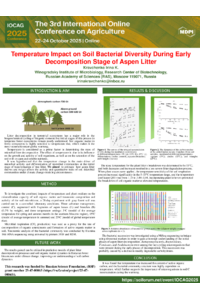
The biogeochemical cycling of elements in the environment is significantly influenced by litter decomposition in terrestrial ecosystems; yet, little is known about the processes involved in the early phases of litter decomposition in temperate forest ecosystems. Because forest ecosystems' soil organic matter is so sensitive to temperature increases, it is particularly vulnerable to the effects of global warming. We evaluate how aspen litter (leaves and twigs) affects the activity and quantitative traits of soil microbial communities under climate change-modeling circumstances. In order to conduct the studies, samples of gray forest soil from the Moscow region's typical forest biocenosis in Europe were used. Crushed leaves and twigs were applied to soil samples at a rate of 0.5% by weight during a 28-day incubation period at constant temperatures of 5, 15, and 25°C. CO2 emissions, organic carbon, and the amount of microbial biomass were assessed in relation to the quantity of ribosomal genes found in bacteria, archaea, and fungi. The ideal temperature for the plant litter's breakdown was determined to be 15°C, and both decreases and increases resulted in a less severe litter degradation process. When plant wastes were applied, the temperature sensitivity of the soil respiration process increased significantly in the 5–15ºC temperature range, and the temperature coefficient Q10 rose from 1.75 to 3.44–3.54. Incorporating plant leftovers promoted the breakdown of soil organic matter at elevated temperatures. The number of bacteria, fungus, and microbial biomass did not alter much. The bacterial and archaeal succession was investigated using a MiSeq sequencing technique using ribosomal markers in order to gain a thorough understanding of the initial phases of aspen litter decomposition. Bettaproteobacteria, Bacteroidetes, Firmicutes, and Acidobacteria were among the fast-cycling microorganisms that were present during the early phases of decomposition. This succession was probably caused by a decline in readily degradable carbohydrates. The results gained can be utilized in predictive models of plant litter decomposition processes and soil organic matter dynamics in Eurasian forest biocenoses under climate change, improving our understanding of soil carbon dynamics.
Keywords
litter decomposition
temperature sensitivity
microbial respiration
bacterial community
16S rDNA amplicon sequencing.
Poster
Kravchenko_sciforum-131676.pdf
Soil Chemical and Microbial Responses to Cover Crops as Alternatives to Plastic Mulch in Southern Californian Strawberry Fields
Effect of Organic and Mineral Fertilizers on Soil Physical Properties in an Arid Greenhouse Environment: Emphasis on Date Palm Waste Compost