Event submissions
Published
This submission belongs to the session S7. Agricultural Soil of the event The 3rd International Online Conference on Agriculture
Published date
20 Oct, 2025
Academic Editor
'%3e%3cpath%20d='M12.6657%2010.9104C12.4185%2010.325%2012.0599%209.79327%2011.6097%209.34482C11.1609%208.89508%2010.6293%208.5365%2010.0442%208.28888C10.0389%208.28626%2010.0337%208.28495%2010.0285%208.28233C10.8446%207.69279%2011.3752%206.73249%2011.3752%205.64904C11.3752%203.8542%209.92103%202.39999%208.1262%202.39999C6.33136%202.39999%204.87715%203.8542%204.87715%205.64904C4.87715%206.73249%205.40774%207.69279%206.22393%208.28364C6.21869%208.28626%206.21345%208.28757%206.20821%208.29019C5.62129%208.5378%205.09463%208.89284%204.64265%209.34613C4.1929%209.79493%203.83432%2010.3266%203.58671%2010.9117C3.34345%2011.4845%203.21226%2012.0987%203.20023%2012.7209C3.19988%2012.7349%203.20233%2012.7488%203.20744%2012.7619C3.21255%2012.7749%203.22022%2012.7867%203.22998%2012.7968C3.23975%2012.8068%203.25142%2012.8147%203.26431%2012.8202C3.2772%2012.8256%203.29105%2012.8284%203.30504%2012.8284H4.09109C4.14874%2012.8284%204.19459%2012.7825%204.1959%2012.7262C4.2221%2011.7148%204.62823%2010.7676%205.34617%2010.0497C6.08899%209.30683%207.0755%208.89808%208.1262%208.89808C9.17689%208.89808%2010.1634%209.30683%2010.9062%2010.0497C11.6242%2010.7676%2012.0303%2011.7148%2012.0565%2012.7262C12.0578%2012.7838%2012.1037%2012.8284%2012.1613%2012.8284H12.9474C12.9613%2012.8284%2012.9752%2012.8256%2012.9881%2012.8202C13.001%2012.8147%2013.0126%2012.8068%2013.0224%2012.7968C13.0322%2012.7867%2013.0398%2012.7749%2013.0449%2012.7619C13.0501%2012.7488%2013.0525%2012.7349%2013.0522%2012.7209C13.0391%2012.0947%2012.9094%2011.4855%2012.6657%2010.9104ZM8.1262%207.9024C7.52486%207.9024%206.9589%207.6679%206.53312%207.24211C6.10733%206.81633%205.87283%206.25037%205.87283%205.64904C5.87283%205.0477%206.10733%204.48174%206.53312%204.05596C6.9589%203.63018%207.52486%203.39567%208.1262%203.39567C8.72753%203.39567%209.29349%203.63018%209.71927%204.05596C10.1451%204.48174%2010.3796%205.0477%2010.3796%205.64904C10.3796%206.25037%2010.1451%206.81633%209.71927%207.24211C9.29349%207.6679%208.72753%207.9024%208.1262%207.9024Z'%20fill='%235D1EE1'/%3e%3c/g%3e%3c/svg%3e) MARGA ROS
MARGA ROSCitation
Marilou M. Sarong, Paul Jhon G. Eugenio, Gerald Glenn A. Hernandez, Franz Marielle N. Garcia, Ariel G. Mactal, Fernan T. Fiegalan, Maria Luisa T. Mason, Juvy J. Monserate, Engineered Biochar–Nanocomposites Enhanced Vetiver Growth and Nickel Uptake in Ni-Elevated Ultramafic Soils, in Proceedings of The 3rd International Online Conference on Agriculture, 22 October–24 October 2025, MDPI: Basel, Switzerland
Share
Email
Facebook
Twitter
LinkedIn
Engineered Biochar–Nanocomposites Enhanced Vetiver Growth and Nickel Uptake in Ni-Elevated Ultramafic Soils
'%3e%3cpath%20d='M12.6647%2010.9104C12.4176%2010.325%2012.0589%209.7933%2011.6088%209.34485C11.16%208.89511%2010.6283%208.53653%2010.0432%208.28891C10.038%208.28629%2010.0327%208.28498%2010.0275%208.28236C10.8437%207.69282%2011.3743%206.73252%2011.3743%205.64907C11.3743%203.85423%209.92005%202.40002%208.12522%202.40002C6.33038%202.40002%204.87618%203.85423%204.87618%205.64907C4.87618%206.73252%205.40677%207.69282%206.22296%208.28367C6.21772%208.28629%206.21248%208.2876%206.20724%208.29022C5.62031%208.53783%205.09365%208.89287%204.64167%209.34616C4.19192%209.79496%203.83334%2010.3266%203.58573%2010.9117C3.34247%2011.4846%203.21128%2012.0987%203.19925%2012.721C3.1989%2012.735%203.20135%2012.7489%203.20646%2012.7619C3.21157%2012.7749%203.21924%2012.7868%203.22901%2012.7968C3.23877%2012.8068%203.25045%2012.8148%203.26334%2012.8202C3.27623%2012.8256%203.29007%2012.8284%203.30406%2012.8284H4.09012C4.14776%2012.8284%204.19362%2012.7825%204.19493%2012.7262C4.22113%2011.7148%204.62726%2010.7676%205.34519%2010.0497C6.08802%209.30686%207.07452%208.89811%208.12522%208.89811C9.17592%208.89811%2010.1624%209.30686%2010.9052%2010.0497C11.6232%2010.7676%2012.0293%2011.7148%2012.0555%2012.7262C12.0568%2012.7839%2012.1027%2012.8284%2012.1603%2012.8284H12.9464C12.9604%2012.8284%2012.9742%2012.8256%2012.9871%2012.8202C13%2012.8148%2013.0117%2012.8068%2013.0214%2012.7968C13.0312%2012.7868%2013.0389%2012.7749%2013.044%2012.7619C13.0491%2012.7489%2013.0515%2012.735%2013.0512%2012.721C13.0381%2012.0947%2012.9084%2011.4856%2012.6647%2010.9104ZM8.12522%207.90243C7.52388%207.90243%206.95792%207.66793%206.53214%207.24215C6.10636%206.81636%205.87185%206.2504%205.87185%205.64907C5.87185%205.04773%206.10636%204.48177%206.53214%204.05599C6.95792%203.63021%207.52388%203.3957%208.12522%203.3957C8.72655%203.3957%209.29252%203.63021%209.7183%204.05599C10.1441%204.48177%2010.3786%205.04773%2010.3786%205.64907C10.3786%206.2504%2010.1441%206.81636%209.7183%207.24215C9.29252%207.66793%208.72655%207.90243%208.12522%207.90243Z'%20fill='%235D1EE1'/%3e%3c/g%3e%3c/svg%3e)
Marilou M. Sarong 1,2
Paul Jhon G. Eugenio 3
Gerald Glenn A. Hernandez 4
Franz Marielle N. Garcia 1
Ariel G. Mactal 2
Fernan T. Fiegalan 2
Maria Luisa T. Mason 2
Juvy J. Monserate 3
1. Crops and Resources Research and Development Center, Central Luzon State University, Philippines
2. Department of Soil Science, College of Agriculture, Central Luzon State University, Philippines
3. Department of Chemistry, College of Science, Central Luzon State University, Muñoz, Nueva Ecija, Philippines
4. Department of Chemistry, College of Arts and Sciences, Batangas State University, Philippines
Abstract
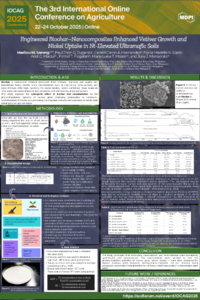
Ultramafic soils, particularly those affected by mining activities, are often enriched with toxic levels of nickel (Ni), posing serious constraints to plant growth and ecosystem rehabilitation. This study evaluated the efficacy of engineered biochar–nanocomposite amendments in enhancing vetiver (Chrysopogon zizanioides) growth, biomass production, and Ni phytoextraction in Ni-elevated ultramafic soils. A pot experiment was conducted using soils collected from mined areas in Zambales, a region known for its extensive ultramafic landscapes and Ni mining operations. Seven treatment combinations were assessed: T1—No Application (Control); T2—Biochar Alone; T3—Nanocomposite Alone; T4—Biochar + Nano Silica; T5—Biochar + Nano Calcium; T6—Biochar + Nano Chitosan; and T7—Biochar + Nanocomposite. Among all treatments, T4 (Biochar + Nano Silica) resulted in the highest biomass yield (17.2 g pot⁻¹) and maximum Ni phytoextraction (31.6 mg Ni plant⁻¹), significantly outperforming all other treatments. Plants grown under T4 exhibited robust shoot and root development, and superior tolerance to Ni stress. Correspondingly, Ni accumulation in plant tissues was significantly higher in T4, suggesting enhanced metal uptake and translocation capacity. The synergistic effect of biochar and nano silica improved soil pH and nutrient availability, while also enhancing the bioavailability of Ni in the rhizosphere, promoting more effective uptake by vetiver. T7 (Biochar + Nanocomposite) and T6 (Biochar + Nano Chitosan) also contributed to improved growth and Ni uptake but were less effective than T4. The results demonstrate the potential of nano silica-engineered biochar as a low-cost, environmentally sustainable amendment for the phytoremediation of Ni-contaminated ultramafic soils. This study highlights the practical application of nanotechnology-enhanced phytoremediation strategies using locally available soil and plant resources to rehabilitate Ni-impacted mined lands in the Philippines.
Keywords
Ni-elevated soils
nanophytoremediation
biochar-nanocomposite
Poster
Synthesis.pdf
Silent Disappearance: Observations on the Decline of Black-Colored Earthworms in Uttarakhand Paddy Fields
Sodium Alginate-Based Bioplastic Matrices Applied for Soil Regeneration