Event submissions
Published
This submission belongs to the session S7. Agricultural Soil of the event The 3rd International Online Conference on Agriculture
Published date
20 Oct, 2025
Academic Editor
'%3e%3cpath%20d='M12.6657%2010.9104C12.4185%2010.325%2012.0599%209.79327%2011.6097%209.34482C11.1609%208.89508%2010.6293%208.5365%2010.0442%208.28888C10.0389%208.28626%2010.0337%208.28495%2010.0285%208.28233C10.8446%207.69279%2011.3752%206.73249%2011.3752%205.64904C11.3752%203.8542%209.92103%202.39999%208.1262%202.39999C6.33136%202.39999%204.87715%203.8542%204.87715%205.64904C4.87715%206.73249%205.40774%207.69279%206.22393%208.28364C6.21869%208.28626%206.21345%208.28757%206.20821%208.29019C5.62129%208.5378%205.09463%208.89284%204.64265%209.34613C4.1929%209.79493%203.83432%2010.3266%203.58671%2010.9117C3.34345%2011.4845%203.21226%2012.0987%203.20023%2012.7209C3.19988%2012.7349%203.20233%2012.7488%203.20744%2012.7619C3.21255%2012.7749%203.22022%2012.7867%203.22998%2012.7968C3.23975%2012.8068%203.25142%2012.8147%203.26431%2012.8202C3.2772%2012.8256%203.29105%2012.8284%203.30504%2012.8284H4.09109C4.14874%2012.8284%204.19459%2012.7825%204.1959%2012.7262C4.2221%2011.7148%204.62823%2010.7676%205.34617%2010.0497C6.08899%209.30683%207.0755%208.89808%208.1262%208.89808C9.17689%208.89808%2010.1634%209.30683%2010.9062%2010.0497C11.6242%2010.7676%2012.0303%2011.7148%2012.0565%2012.7262C12.0578%2012.7838%2012.1037%2012.8284%2012.1613%2012.8284H12.9474C12.9613%2012.8284%2012.9752%2012.8256%2012.9881%2012.8202C13.001%2012.8147%2013.0126%2012.8068%2013.0224%2012.7968C13.0322%2012.7867%2013.0398%2012.7749%2013.0449%2012.7619C13.0501%2012.7488%2013.0525%2012.7349%2013.0522%2012.7209C13.0391%2012.0947%2012.9094%2011.4855%2012.6657%2010.9104ZM8.1262%207.9024C7.52486%207.9024%206.9589%207.6679%206.53312%207.24211C6.10733%206.81633%205.87283%206.25037%205.87283%205.64904C5.87283%205.0477%206.10733%204.48174%206.53312%204.05596C6.9589%203.63018%207.52486%203.39567%208.1262%203.39567C8.72753%203.39567%209.29349%203.63018%209.71927%204.05596C10.1451%204.48174%2010.3796%205.0477%2010.3796%205.64904C10.3796%206.25037%2010.1451%206.81633%209.71927%207.24211C9.29349%207.6679%208.72753%207.9024%208.1262%207.9024Z'%20fill='%235D1EE1'/%3e%3c/g%3e%3c/svg%3e) Sanzidur Rahman
Sanzidur RahmanCitation
Camila A. Vilca Pascuali, Gilberto Colina Andrade, Ruly Terán Hilares, Enhancing Salinity Resistance in Zea mays through Biopriming with Pullulan from Aureobasidium pullulans and Chlorella vulgaris, in Proceedings of The 3rd International Online Conference on Agriculture, 22 October–24 October 2025, MDPI: Basel, Switzerland
Share
Email
Facebook
Twitter
LinkedIn
Enhancing Salinity Resistance in Zea mays through Biopriming with Pullulan from Aureobasidium pullulans and Chlorella vulgaris

Camila A. Vilca Pascuali 1
'%3e%3cpath%20d='M12.6647%2010.9104C12.4176%2010.325%2012.0589%209.7933%2011.6088%209.34485C11.16%208.89511%2010.6283%208.53653%2010.0432%208.28891C10.038%208.28629%2010.0327%208.28498%2010.0275%208.28236C10.8437%207.69282%2011.3743%206.73252%2011.3743%205.64907C11.3743%203.85423%209.92005%202.40002%208.12522%202.40002C6.33038%202.40002%204.87618%203.85423%204.87618%205.64907C4.87618%206.73252%205.40677%207.69282%206.22296%208.28367C6.21772%208.28629%206.21248%208.2876%206.20724%208.29022C5.62031%208.53783%205.09365%208.89287%204.64167%209.34616C4.19192%209.79496%203.83334%2010.3266%203.58573%2010.9117C3.34247%2011.4846%203.21128%2012.0987%203.19925%2012.721C3.1989%2012.735%203.20135%2012.7489%203.20646%2012.7619C3.21157%2012.7749%203.21924%2012.7868%203.22901%2012.7968C3.23877%2012.8068%203.25045%2012.8148%203.26334%2012.8202C3.27623%2012.8256%203.29007%2012.8284%203.30406%2012.8284H4.09012C4.14776%2012.8284%204.19362%2012.7825%204.19493%2012.7262C4.22113%2011.7148%204.62726%2010.7676%205.34519%2010.0497C6.08802%209.30686%207.07452%208.89811%208.12522%208.89811C9.17592%208.89811%2010.1624%209.30686%2010.9052%2010.0497C11.6232%2010.7676%2012.0293%2011.7148%2012.0555%2012.7262C12.0568%2012.7839%2012.1027%2012.8284%2012.1603%2012.8284H12.9464C12.9604%2012.8284%2012.9742%2012.8256%2012.9871%2012.8202C13%2012.8148%2013.0117%2012.8068%2013.0214%2012.7968C13.0312%2012.7868%2013.0389%2012.7749%2013.044%2012.7619C13.0491%2012.7489%2013.0515%2012.735%2013.0512%2012.721C13.0381%2012.0947%2012.9084%2011.4856%2012.6647%2010.9104ZM8.12522%207.90243C7.52388%207.90243%206.95792%207.66793%206.53214%207.24215C6.10636%206.81636%205.87185%206.2504%205.87185%205.64907C5.87185%205.04773%206.10636%204.48177%206.53214%204.05599C6.95792%203.63021%207.52388%203.3957%208.12522%203.3957C8.72655%203.3957%209.29252%203.63021%209.7183%204.05599C10.1441%204.48177%2010.3786%205.04773%2010.3786%205.64907C10.3786%206.2504%2010.1441%206.81636%209.7183%207.24215C9.29252%207.66793%208.72655%207.90243%208.12522%207.90243Z'%20fill='%235D1EE1'/%3e%3c/g%3e%3c/svg%3e)
Gilberto Colina Andrade 1

Ruly Terán Hilares 2
1. Laboratorio de Bioprocesos, Facultad de Ciencias Farmacéuticas, Bioquímicas y Biotecnológicas, Universidad Católica de Santa María—UCSM, Urb. San José s/n—Umacollo, Arequipa 04000, Peru.
2. Bioprocess Laboratory - Faculty of Pharmaceutical, Biochemical and Biotechnological Sciences, Catholic University of Santa María—UCSM, Urb. San José s/n—Umacollo, Arequipa 04000, Peru.
Abstract
Soil salinity poses a significant threat to agriculture by disrupting essential physiological processes in crops such as Zea mays. To address this challenge, the synergistic effect of the combined application of pullulan, an exopolysaccharide produced by Aureobasidium pullulans ATCC 42023, and the microalga Chlorella vulgaris was investigated to evaluate its potential as a biostimulant strategy to mitigate salt stress in maize. Pullulan was produced in a stirred-tank bioreactor (STR) using glucose as a carbon source at concentrations of 60, 80, and 100 g/L. The highest yield was obtained at 100 g/L, reaching a productivity of 0.28 g/g of substrate. The polymer was recovered via ethanol precipitation and characterized using FTIR spectroscopy. In preliminary bioassays, maize seeds were primed with pullulan solutions at concentrations of 0, 2.5, 5.0, and 10.0 g/L. The 2.5 g/L treatment significantly enhanced coleoptile and root elongation, while higher concentrations exhibited inhibitory effects. A salinity threshold of 300 mM NaCl was established to simulate salt stress conditions. To optimize the biopriming conditions, a Central Composite Design (CCD) was implemented, evaluating pullulan concentration (0.17–5.83 g/L) and microalgal biomass loading (3.4–116.5 mg). The resulting empirical model was statistically significant (p < 0.001; R² = 0.9762), predicting that moderate levels of both biostimulants maximized seedling height. Conversely, excessive microalgae loading inhibited growth, likely due to reduced water availability at the seed surface. In conclusion, the combined application of pullulan and Chlorella vulgaris demonstrated a synergistic biostimulant effect under saline conditions, enhancing germination and early growth of Zea mays. This integrated biopriming approach offers a promising and sustainable strategy to alleviate salinity-induced stress in crop production systems.
Keywords
Zea mays
exopolysaccharide
Aureobadium pullulans
microalgae
salt stress.
Poster
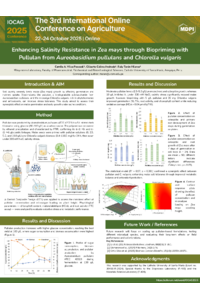
Enhancing Salinity Resistance in Zea mays through Biopriming with Pullulan from Aureobasidium pullulans and Chlorella vulgaris (2).pdf
Fungal community composition across different organs in two distinct almond tree cultivars
Influence of different nitrogen fertilization on photosynthetic pigments in winter wheat