Event submissions
Published
This submission belongs to the session S7. Agricultural Soil of the event The 3rd International Online Conference on Agriculture
Published date
20 Oct, 2025
Academic Editor
'%3e%3cpath%20d='M12.6657%2010.9104C12.4185%2010.325%2012.0599%209.79327%2011.6097%209.34482C11.1609%208.89508%2010.6293%208.5365%2010.0442%208.28888C10.0389%208.28626%2010.0337%208.28495%2010.0285%208.28233C10.8446%207.69279%2011.3752%206.73249%2011.3752%205.64904C11.3752%203.8542%209.92103%202.39999%208.1262%202.39999C6.33136%202.39999%204.87715%203.8542%204.87715%205.64904C4.87715%206.73249%205.40774%207.69279%206.22393%208.28364C6.21869%208.28626%206.21345%208.28757%206.20821%208.29019C5.62129%208.5378%205.09463%208.89284%204.64265%209.34613C4.1929%209.79493%203.83432%2010.3266%203.58671%2010.9117C3.34345%2011.4845%203.21226%2012.0987%203.20023%2012.7209C3.19988%2012.7349%203.20233%2012.7488%203.20744%2012.7619C3.21255%2012.7749%203.22022%2012.7867%203.22998%2012.7968C3.23975%2012.8068%203.25142%2012.8147%203.26431%2012.8202C3.2772%2012.8256%203.29105%2012.8284%203.30504%2012.8284H4.09109C4.14874%2012.8284%204.19459%2012.7825%204.1959%2012.7262C4.2221%2011.7148%204.62823%2010.7676%205.34617%2010.0497C6.08899%209.30683%207.0755%208.89808%208.1262%208.89808C9.17689%208.89808%2010.1634%209.30683%2010.9062%2010.0497C11.6242%2010.7676%2012.0303%2011.7148%2012.0565%2012.7262C12.0578%2012.7838%2012.1037%2012.8284%2012.1613%2012.8284H12.9474C12.9613%2012.8284%2012.9752%2012.8256%2012.9881%2012.8202C13.001%2012.8147%2013.0126%2012.8068%2013.0224%2012.7968C13.0322%2012.7867%2013.0398%2012.7749%2013.0449%2012.7619C13.0501%2012.7488%2013.0525%2012.7349%2013.0522%2012.7209C13.0391%2012.0947%2012.9094%2011.4855%2012.6657%2010.9104ZM8.1262%207.9024C7.52486%207.9024%206.9589%207.6679%206.53312%207.24211C6.10733%206.81633%205.87283%206.25037%205.87283%205.64904C5.87283%205.0477%206.10733%204.48174%206.53312%204.05596C6.9589%203.63018%207.52486%203.39567%208.1262%203.39567C8.72753%203.39567%209.29349%203.63018%209.71927%204.05596C10.1451%204.48174%2010.3796%205.0477%2010.3796%205.64904C10.3796%206.25037%2010.1451%206.81633%209.71927%207.24211C9.29349%207.6679%208.72753%207.9024%208.1262%207.9024Z'%20fill='%235D1EE1'/%3e%3c/g%3e%3c/svg%3e) MARGA ROS
MARGA ROSCitation
Oulad Heddar Meriem, Kraimat Mohamed, Laouar Bouchra, Souilem Zineb, Labgaa Imene, Bissati Samia, Rhizosphere Soil Properties of Peanut (Arachis hypogaea L.) Growing Under Field Conditions in Southern Algeria., in Proceedings of The 3rd International Online Conference on Agriculture, 22 October–24 October 2025, MDPI: Basel, Switzerland
Share
Email
Facebook
Twitter
LinkedIn
Rhizosphere Soil Properties of Peanut (Arachis hypogaea L.) Growing Under Field Conditions in Southern Algeria.
'%3e%3cpath%20d='M12.6647%2010.9104C12.4176%2010.325%2012.0589%209.7933%2011.6088%209.34485C11.16%208.89511%2010.6283%208.53653%2010.0432%208.28891C10.038%208.28629%2010.0327%208.28498%2010.0275%208.28236C10.8437%207.69282%2011.3743%206.73252%2011.3743%205.64907C11.3743%203.85423%209.92005%202.40002%208.12522%202.40002C6.33038%202.40002%204.87618%203.85423%204.87618%205.64907C4.87618%206.73252%205.40677%207.69282%206.22296%208.28367C6.21772%208.28629%206.21248%208.2876%206.20724%208.29022C5.62031%208.53783%205.09365%208.89287%204.64167%209.34616C4.19192%209.79496%203.83334%2010.3266%203.58573%2010.9117C3.34247%2011.4846%203.21128%2012.0987%203.19925%2012.721C3.1989%2012.735%203.20135%2012.7489%203.20646%2012.7619C3.21157%2012.7749%203.21924%2012.7868%203.22901%2012.7968C3.23877%2012.8068%203.25045%2012.8148%203.26334%2012.8202C3.27623%2012.8256%203.29007%2012.8284%203.30406%2012.8284H4.09012C4.14776%2012.8284%204.19362%2012.7825%204.19493%2012.7262C4.22113%2011.7148%204.62726%2010.7676%205.34519%2010.0497C6.08802%209.30686%207.07452%208.89811%208.12522%208.89811C9.17592%208.89811%2010.1624%209.30686%2010.9052%2010.0497C11.6232%2010.7676%2012.0293%2011.7148%2012.0555%2012.7262C12.0568%2012.7839%2012.1027%2012.8284%2012.1603%2012.8284H12.9464C12.9604%2012.8284%2012.9742%2012.8256%2012.9871%2012.8202C13%2012.8148%2013.0117%2012.8068%2013.0214%2012.7968C13.0312%2012.7868%2013.0389%2012.7749%2013.044%2012.7619C13.0491%2012.7489%2013.0515%2012.735%2013.0512%2012.721C13.0381%2012.0947%2012.9084%2011.4856%2012.6647%2010.9104ZM8.12522%207.90243C7.52388%207.90243%206.95792%207.66793%206.53214%207.24215C6.10636%206.81636%205.87185%206.2504%205.87185%205.64907C5.87185%205.04773%206.10636%204.48177%206.53214%204.05599C6.95792%203.63021%207.52388%203.3957%208.12522%203.3957C8.72655%203.3957%209.29252%203.63021%209.7183%204.05599C10.1441%204.48177%2010.3786%205.04773%2010.3786%205.64907C10.3786%206.2504%2010.1441%206.81636%209.7183%207.24215C9.29252%207.66793%208.72655%207.90243%208.12522%207.90243Z'%20fill='%235D1EE1'/%3e%3c/g%3e%3c/svg%3e)
Oulad Heddar Meriem 1
Kraimat Mohamed 2
Laouar Bouchra 3
Souilem Zineb 1
Labgaa Imene 1
Bissati Samia 4
1. Département de Biologie, Faculté des Sciences de la Nature et de la Vie et Sciences de la Terre, Université de Ghardaïa, 47000, Algeria.
2. Laboratoire de Valorisation et de Conservation des Ecosystèmes Arides, Université de Ghardaïa, 47000, Algeria.
3. Laboratoire des Matériaux, Technologie des Systèmes Energétiques et Environnement, Université de Ghardaïa, 47000, Algeria.
4. Laboratoire Bioressources Sahariennes, Université Kasdi Merbah, Ouargla, 30000, Algeria.
Abstract
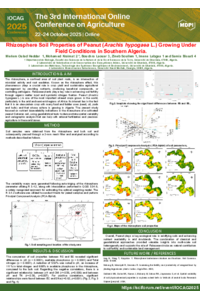
The rhizosphere, a confined area of soil plant roots, is an intersection of microbial activity and root exudates. Known as the rhizosphere effect, this phenomenon plays a crucial role in crop yield and sustainable agricultural management by providing nutrients, producing beneficial compounds, or controlling pathogens. Using a geostatistical approach, this study aimed to analyze the effect of peanut cultivation on soil quality improvement by comparing the physicochemical characteristics of rhizosphere and bulk soils in the Ghardaïa regions from southern Algeria. Samples of rhizosphere and bulk soils were prospected using a systematic plan. Subsequently, the pH, electrical conductivity, calcium carbonate, organic matter, total nitrogen, available phosphorus, total potassium, and soluble sodium were determined for each soil (rhizosphere and bulk soil). The results showed that both types of soils were moderately alkaline, with a reduction of 5.52% in the pH of the rhizosphere compared to the bulk soils. Soils were relatively low in organic matter, with only 3.3% of soils having organic matter levels above 20 g.kg-1. However, organic matter contents were consistently higher in the rhizosphere (8.51 ± 0.46 g.kg-1) than in the bulk soil (6.78 ± 0.68 g.kg-1). In the rhizosphere, an increase of 10% in labile phosphorus was noted. Total nitrogen was increased by 52.57%. T-tests suggested no significant difference in potassium and sodium levels, and they were moderately present in both soils. Significantly positive relationships were noted between electrical conductivity and soluble sodium (p<0.001). However, negative correlations were revealed between pH and organic matter ((p<0.01) and pH and total nitrogen (p<0.01). These results indicate the effects of rhizosphere interactions on soil properties improvement and their implications for sustainable agricultural practices. Incorporating peanut cultivation into crop rotation systems enriches the soil with nutrients, reduces agricultural carbon footprints, and helps farmers maintain soil quality in arid regions.
Keywords
Peanut
rhizosphere
bulk soil
sustainable agricultural
Ghardaïa.
Poster
Poster OULAD HEDDAR et al. 2025.pdf
Biotic and abiotic factors affecting Cistus ladanifer production in cultivated plots from mainland Spain
Landscape-Based Mitigation of Agrochemical Runoff in Erodible Agricultural Catchments: A Terrain and Soil-Driven Approach from the Idemili Watershed, Southeastern Nigeria