Event submissions
Published
This submission belongs to the session S7. Agricultural Soil of the event The 3rd International Online Conference on Agriculture
Published date
20 Oct, 2025
Academic Editor
'%3e%3cpath%20d='M12.6657%2010.9104C12.4185%2010.325%2012.0599%209.79327%2011.6097%209.34482C11.1609%208.89508%2010.6293%208.5365%2010.0442%208.28888C10.0389%208.28626%2010.0337%208.28495%2010.0285%208.28233C10.8446%207.69279%2011.3752%206.73249%2011.3752%205.64904C11.3752%203.8542%209.92103%202.39999%208.1262%202.39999C6.33136%202.39999%204.87715%203.8542%204.87715%205.64904C4.87715%206.73249%205.40774%207.69279%206.22393%208.28364C6.21869%208.28626%206.21345%208.28757%206.20821%208.29019C5.62129%208.5378%205.09463%208.89284%204.64265%209.34613C4.1929%209.79493%203.83432%2010.3266%203.58671%2010.9117C3.34345%2011.4845%203.21226%2012.0987%203.20023%2012.7209C3.19988%2012.7349%203.20233%2012.7488%203.20744%2012.7619C3.21255%2012.7749%203.22022%2012.7867%203.22998%2012.7968C3.23975%2012.8068%203.25142%2012.8147%203.26431%2012.8202C3.2772%2012.8256%203.29105%2012.8284%203.30504%2012.8284H4.09109C4.14874%2012.8284%204.19459%2012.7825%204.1959%2012.7262C4.2221%2011.7148%204.62823%2010.7676%205.34617%2010.0497C6.08899%209.30683%207.0755%208.89808%208.1262%208.89808C9.17689%208.89808%2010.1634%209.30683%2010.9062%2010.0497C11.6242%2010.7676%2012.0303%2011.7148%2012.0565%2012.7262C12.0578%2012.7838%2012.1037%2012.8284%2012.1613%2012.8284H12.9474C12.9613%2012.8284%2012.9752%2012.8256%2012.9881%2012.8202C13.001%2012.8147%2013.0126%2012.8068%2013.0224%2012.7968C13.0322%2012.7867%2013.0398%2012.7749%2013.0449%2012.7619C13.0501%2012.7488%2013.0525%2012.7349%2013.0522%2012.7209C13.0391%2012.0947%2012.9094%2011.4855%2012.6657%2010.9104ZM8.1262%207.9024C7.52486%207.9024%206.9589%207.6679%206.53312%207.24211C6.10733%206.81633%205.87283%206.25037%205.87283%205.64904C5.87283%205.0477%206.10733%204.48174%206.53312%204.05596C6.9589%203.63018%207.52486%203.39567%208.1262%203.39567C8.72753%203.39567%209.29349%203.63018%209.71927%204.05596C10.1451%204.48174%2010.3796%205.0477%2010.3796%205.64904C10.3796%206.25037%2010.1451%206.81633%209.71927%207.24211C9.29349%207.6679%208.72753%207.9024%208.1262%207.9024Z'%20fill='%235D1EE1'/%3e%3c/g%3e%3c/svg%3e) MARGA ROS
MARGA ROSCitation
Oluwaseyi Lola Awoyomi, Folasade Christianah Olaoye, Olajire Fagbola, Abisoye Oyepero Oyepero, Olutoye Olushola Fashola, Best Chidiebere Anukwu, Joseph Oluwabusayo Amao, Bisola Khadijat Oladimeji, Bolaji Elizabeth Oyekan, Aderonke Esther Agunbiade, Population of Fungi and Bacteria in Alfisols is Dependent on Seasonal Changes, Poultry Manure Application and Cowpea Varieties, in Proceedings of The 3rd International Online Conference on Agriculture, 22 October–24 October 2025, MDPI: Basel, Switzerland
Share
Email
Facebook
Twitter
LinkedIn
Population of Fungi and Bacteria in Alfisols is Dependent on Seasonal Changes, Poultry Manure Application and Cowpea Varieties
'%3e%3cpath%20d='M12.6647%2010.9104C12.4176%2010.325%2012.0589%209.7933%2011.6088%209.34485C11.16%208.89511%2010.6283%208.53653%2010.0432%208.28891C10.038%208.28629%2010.0327%208.28498%2010.0275%208.28236C10.8437%207.69282%2011.3743%206.73252%2011.3743%205.64907C11.3743%203.85423%209.92005%202.40002%208.12522%202.40002C6.33038%202.40002%204.87618%203.85423%204.87618%205.64907C4.87618%206.73252%205.40677%207.69282%206.22296%208.28367C6.21772%208.28629%206.21248%208.2876%206.20724%208.29022C5.62031%208.53783%205.09365%208.89287%204.64167%209.34616C4.19192%209.79496%203.83334%2010.3266%203.58573%2010.9117C3.34247%2011.4846%203.21128%2012.0987%203.19925%2012.721C3.1989%2012.735%203.20135%2012.7489%203.20646%2012.7619C3.21157%2012.7749%203.21924%2012.7868%203.22901%2012.7968C3.23877%2012.8068%203.25045%2012.8148%203.26334%2012.8202C3.27623%2012.8256%203.29007%2012.8284%203.30406%2012.8284H4.09012C4.14776%2012.8284%204.19362%2012.7825%204.19493%2012.7262C4.22113%2011.7148%204.62726%2010.7676%205.34519%2010.0497C6.08802%209.30686%207.07452%208.89811%208.12522%208.89811C9.17592%208.89811%2010.1624%209.30686%2010.9052%2010.0497C11.6232%2010.7676%2012.0293%2011.7148%2012.0555%2012.7262C12.0568%2012.7839%2012.1027%2012.8284%2012.1603%2012.8284H12.9464C12.9604%2012.8284%2012.9742%2012.8256%2012.9871%2012.8202C13%2012.8148%2013.0117%2012.8068%2013.0214%2012.7968C13.0312%2012.7868%2013.0389%2012.7749%2013.044%2012.7619C13.0491%2012.7489%2013.0515%2012.735%2013.0512%2012.721C13.0381%2012.0947%2012.9084%2011.4856%2012.6647%2010.9104ZM8.12522%207.90243C7.52388%207.90243%206.95792%207.66793%206.53214%207.24215C6.10636%206.81636%205.87185%206.2504%205.87185%205.64907C5.87185%205.04773%206.10636%204.48177%206.53214%204.05599C6.95792%203.63021%207.52388%203.3957%208.12522%203.3957C8.72655%203.3957%209.29252%203.63021%209.7183%204.05599C10.1441%204.48177%2010.3786%205.04773%2010.3786%205.64907C10.3786%206.2504%2010.1441%206.81636%209.7183%207.24215C9.29252%207.66793%208.72655%207.90243%208.12522%207.90243Z'%20fill='%235D1EE1'/%3e%3c/g%3e%3c/svg%3e)
Oluwaseyi Lola Awoyomi 1
Folasade Christianah Olaoye 2
Olajire Fagbola 2
Abisoye Oyepero Oyepero 1
Olutoye Olushola Fashola 1
Best Chidiebere Anukwu 1
Joseph Oluwabusayo Amao 3
Bisola Khadijat Oladimeji 1
Bolaji Elizabeth Oyekan 1
Aderonke Esther Agunbiade 1
1. National Centre for Genetic Resources and Biotechnology (NACGRAB), Apata, Ibadan, Oyo State 200262, Nigeria
2. University of Ibadan, Ibadan, Oyo State 200284, Nigeria
3. National Biotechnology Research and Development Agency (NBRDA), Abuja 900211, Nigeria
Abstract
ABSTRACT
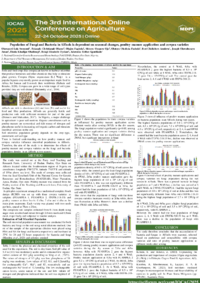
Soils and cowpea are known to harbour microbes thatproduce hormones and other chemicals that help to stimulate plant growth. A field experiment was carried out on an Alfisol to determine the effects of poultry manure application and cowpea varieties on microbial population density during two seasons (dry and wet). The experiment followed a split-plot design and was arranged in a Randomised Completely Block Design (RCBD) with three cowpea varieties (FUAMPEA 1, FUAMPEA 2 and ITO7K-318-33) and three rates of poultry manure, 0t/ha, 2t/ha and 4t/ha, and replicated thrice. Soil samples were collected before and after planting at intervals of 2, 4, 6 and 8 weeks after sowing (WAS) for fungi and bacteria population density during the two seasons.
The results indicated that there were significant differences in population densities of fungi and bacteria under rates of poultry manure application and a preference for cowpea varieties at different weeks after sowing (WAS) and season. Fungus population increased weekly with the poultry manure application of 2t/ha during the dry season, 2t/ha had the highest fungus population density of 6.0 x 10⁴ CFU/g of soil at 6WAS with ITO7K-318-33 and the control had the smallest fungus population density of 6.0 x 10³ CFU/g of soil with FUAMPEA 2. The bacteria population was highest with a population density of 8.5 x 10⁶ CFU/g of soil under the application of 4t/ha poultry manure at 6WAS with FUAMPEA 2. In the wet season, 2t/ha had the highest bacteria population of 8.5 x 10⁶ CFU/g of soil with FUAMPEA 2 at 4WAS and 2t/ha with FUAMPEA 2 had the highest fungus population density of 4.0 x 10⁴ CFU/g, while ITO7K-318-33 and FUAMPEA 2 gave the lowest with the control.
Hence, the populations of bacteria and fungi in Alfisols were influenced by the seasons, selected based on preference and compatibility with cowpea varieties and rates of poultry manure applications.
Keywords
Keywords: Cowpea varieties
Poultry manure
Alfisols
Fungi
Bacteria
Seasons
Poster
AWOYOMI ET AL 2025 ONLINE CONFERENCE POSTER_091000.pdf
Landscape-Based Mitigation of Agrochemical Runoff in Erodible Agricultural Catchments: A Terrain and Soil-Driven Approach from the Idemili Watershed, Southeastern Nigeria
Vineyard Restructuration Using Organic–Inorganic Fertilizers and Biostimulants