Event submissions
Published
This submission belongs to the session S7. Agricultural Soil of the event The 3rd International Online Conference on Agriculture
Published date
20 Oct, 2025
Academic Editor
'%3e%3cpath%20d='M12.6657%2010.9104C12.4185%2010.325%2012.0599%209.79327%2011.6097%209.34482C11.1609%208.89508%2010.6293%208.5365%2010.0442%208.28888C10.0389%208.28626%2010.0337%208.28495%2010.0285%208.28233C10.8446%207.69279%2011.3752%206.73249%2011.3752%205.64904C11.3752%203.8542%209.92103%202.39999%208.1262%202.39999C6.33136%202.39999%204.87715%203.8542%204.87715%205.64904C4.87715%206.73249%205.40774%207.69279%206.22393%208.28364C6.21869%208.28626%206.21345%208.28757%206.20821%208.29019C5.62129%208.5378%205.09463%208.89284%204.64265%209.34613C4.1929%209.79493%203.83432%2010.3266%203.58671%2010.9117C3.34345%2011.4845%203.21226%2012.0987%203.20023%2012.7209C3.19988%2012.7349%203.20233%2012.7488%203.20744%2012.7619C3.21255%2012.7749%203.22022%2012.7867%203.22998%2012.7968C3.23975%2012.8068%203.25142%2012.8147%203.26431%2012.8202C3.2772%2012.8256%203.29105%2012.8284%203.30504%2012.8284H4.09109C4.14874%2012.8284%204.19459%2012.7825%204.1959%2012.7262C4.2221%2011.7148%204.62823%2010.7676%205.34617%2010.0497C6.08899%209.30683%207.0755%208.89808%208.1262%208.89808C9.17689%208.89808%2010.1634%209.30683%2010.9062%2010.0497C11.6242%2010.7676%2012.0303%2011.7148%2012.0565%2012.7262C12.0578%2012.7838%2012.1037%2012.8284%2012.1613%2012.8284H12.9474C12.9613%2012.8284%2012.9752%2012.8256%2012.9881%2012.8202C13.001%2012.8147%2013.0126%2012.8068%2013.0224%2012.7968C13.0322%2012.7867%2013.0398%2012.7749%2013.0449%2012.7619C13.0501%2012.7488%2013.0525%2012.7349%2013.0522%2012.7209C13.0391%2012.0947%2012.9094%2011.4855%2012.6657%2010.9104ZM8.1262%207.9024C7.52486%207.9024%206.9589%207.6679%206.53312%207.24211C6.10733%206.81633%205.87283%206.25037%205.87283%205.64904C5.87283%205.0477%206.10733%204.48174%206.53312%204.05596C6.9589%203.63018%207.52486%203.39567%208.1262%203.39567C8.72753%203.39567%209.29349%203.63018%209.71927%204.05596C10.1451%204.48174%2010.3796%205.0477%2010.3796%205.64904C10.3796%206.25037%2010.1451%206.81633%209.71927%207.24211C9.29349%207.6679%208.72753%207.9024%208.1262%207.9024Z'%20fill='%235D1EE1'/%3e%3c/g%3e%3c/svg%3e) MARGA ROS
MARGA ROSCitation
Roumaissa Moulkaf, Tassadit Ait Kettout, Nassima Baha, Massakib Bekkaye, Isolation and Characterization of PGPR from Date Palm Rhizosphere in the Algerian Sahara: Insights into Soil Fertility and Stress Tolerance, in Proceedings of The 3rd International Online Conference on Agriculture, 22 October–24 October 2025, MDPI: Basel, Switzerland
Share
Email
Facebook
Twitter
LinkedIn
Isolation and Characterization of PGPR from Date Palm Rhizosphere in the Algerian Sahara: Insights into Soil Fertility and Stress Tolerance
'%3e%3cpath%20d='M12.6647%2010.9104C12.4176%2010.325%2012.0589%209.7933%2011.6088%209.34485C11.16%208.89511%2010.6283%208.53653%2010.0432%208.28891C10.038%208.28629%2010.0327%208.28498%2010.0275%208.28236C10.8437%207.69282%2011.3743%206.73252%2011.3743%205.64907C11.3743%203.85423%209.92005%202.40002%208.12522%202.40002C6.33038%202.40002%204.87618%203.85423%204.87618%205.64907C4.87618%206.73252%205.40677%207.69282%206.22296%208.28367C6.21772%208.28629%206.21248%208.2876%206.20724%208.29022C5.62031%208.53783%205.09365%208.89287%204.64167%209.34616C4.19192%209.79496%203.83334%2010.3266%203.58573%2010.9117C3.34247%2011.4846%203.21128%2012.0987%203.19925%2012.721C3.1989%2012.735%203.20135%2012.7489%203.20646%2012.7619C3.21157%2012.7749%203.21924%2012.7868%203.22901%2012.7968C3.23877%2012.8068%203.25045%2012.8148%203.26334%2012.8202C3.27623%2012.8256%203.29007%2012.8284%203.30406%2012.8284H4.09012C4.14776%2012.8284%204.19362%2012.7825%204.19493%2012.7262C4.22113%2011.7148%204.62726%2010.7676%205.34519%2010.0497C6.08802%209.30686%207.07452%208.89811%208.12522%208.89811C9.17592%208.89811%2010.1624%209.30686%2010.9052%2010.0497C11.6232%2010.7676%2012.0293%2011.7148%2012.0555%2012.7262C12.0568%2012.7839%2012.1027%2012.8284%2012.1603%2012.8284H12.9464C12.9604%2012.8284%2012.9742%2012.8256%2012.9871%2012.8202C13%2012.8148%2013.0117%2012.8068%2013.0214%2012.7968C13.0312%2012.7868%2013.0389%2012.7749%2013.044%2012.7619C13.0491%2012.7489%2013.0515%2012.735%2013.0512%2012.721C13.0381%2012.0947%2012.9084%2011.4856%2012.6647%2010.9104ZM8.12522%207.90243C7.52388%207.90243%206.95792%207.66793%206.53214%207.24215C6.10636%206.81636%205.87185%206.2504%205.87185%205.64907C5.87185%205.04773%206.10636%204.48177%206.53214%204.05599C6.95792%203.63021%207.52388%203.3957%208.12522%203.3957C8.72655%203.3957%209.29252%203.63021%209.7183%204.05599C10.1441%204.48177%2010.3786%205.04773%2010.3786%205.64907C10.3786%206.2504%2010.1441%206.81636%209.7183%207.24215C9.29252%207.66793%208.72655%207.90243%208.12522%207.90243Z'%20fill='%235D1EE1'/%3e%3c/g%3e%3c/svg%3e)
Roumaissa Moulkaf 1
Tassadit Ait Kettout 2
Nassima Baha 1
Massakib Bekkaye 1
1. Laboratory of Biology and Physiology of Organisms, Faculty of Biological Sciences, University of Sciences and Technology Houari Boumediene, BP 32, EL ALIA, 16111, Bab Ezzouar, Algiers, Algeria.
2. Laboratory of Research on Arid Zones, Faculty of Biological Sciences, University of Sciences and Technology Houari Boumediene, BP 32, EL ALIA, 16111, Bab Ezzouar, Algiers, Algeria.
Abstract
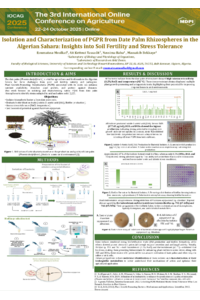
Plant growth-promoting rhizobacteria (PGPR) in arid environments such as the Algerian Sahara Desert have attracted increasing scientific interest due to their potential to improve soil fertility and crop productivity under extreme conditions. In these regions, oasis agroecosystems are characterized by low-nutrient soils, high salinity, and extreme temperatures, yet they support the growth of both date palms (Phoenix dactylifera L.) and other cultivated plants. This resilience suggests thatroot-associated microbial communities play a crucial role.
The aim of this study was to isolate and characterize the culturable bacterial communities associated with the rhizosphere and root endosphere of date palms growing in oasis soils. Using culture-dependent methods, we isolated a diverse collection of bacterial strains, with a predominance of genera such as Bacillus, Pseudomonas, and members of the Actinobacteria phylum. These isolates were screened for key PGPR traits, including inorganic phosphate solubilization, nitrogen fixation potential, and indole-3-acetic acid (IAA) production. In addition, their tolerance to abiotic stresses such as high salinity and temperature was evaluated.
Several isolates demonstrated antagonistic activity against Fusarium oxysporum under in vitro conditions, suggesting potential for use in biological control strategies. These findings highlight the capacity of date palm-associated bacterial communities to enhance soil fertility and support plant growth in harsh agroecological conditions.
Overall, the results show the importance of native PGPR in sustaining productivity in desert agriculture and offer promising prospects for the development of microbial biofertilizers and biocontrol agents adapted to arid environments.
Keywords
PGPR
date palm
rhizosphere
endophytes
Sahara Desert
soil fertility
biocontrol
Fusarium oxysporum
arid agriculture
Poster
Roumaissa Moulkaf IOCAG 2025 Poster.pdf
Vineyard Restructuration Using Organic–Inorganic Fertilizers and Biostimulants
Transforming Early Growth of Cruciferous Vegetables with Biochar