Event submissions
Published
This submission belongs to the session S8. Crop Production of the event The 3rd International Online Conference on Agriculture
Published date
20 Oct, 2025
Academic Editor
'%3e%3cpath%20d='M12.6657%2010.9104C12.4185%2010.325%2012.0599%209.79327%2011.6097%209.34482C11.1609%208.89508%2010.6293%208.5365%2010.0442%208.28888C10.0389%208.28626%2010.0337%208.28495%2010.0285%208.28233C10.8446%207.69279%2011.3752%206.73249%2011.3752%205.64904C11.3752%203.8542%209.92103%202.39999%208.1262%202.39999C6.33136%202.39999%204.87715%203.8542%204.87715%205.64904C4.87715%206.73249%205.40774%207.69279%206.22393%208.28364C6.21869%208.28626%206.21345%208.28757%206.20821%208.29019C5.62129%208.5378%205.09463%208.89284%204.64265%209.34613C4.1929%209.79493%203.83432%2010.3266%203.58671%2010.9117C3.34345%2011.4845%203.21226%2012.0987%203.20023%2012.7209C3.19988%2012.7349%203.20233%2012.7488%203.20744%2012.7619C3.21255%2012.7749%203.22022%2012.7867%203.22998%2012.7968C3.23975%2012.8068%203.25142%2012.8147%203.26431%2012.8202C3.2772%2012.8256%203.29105%2012.8284%203.30504%2012.8284H4.09109C4.14874%2012.8284%204.19459%2012.7825%204.1959%2012.7262C4.2221%2011.7148%204.62823%2010.7676%205.34617%2010.0497C6.08899%209.30683%207.0755%208.89808%208.1262%208.89808C9.17689%208.89808%2010.1634%209.30683%2010.9062%2010.0497C11.6242%2010.7676%2012.0303%2011.7148%2012.0565%2012.7262C12.0578%2012.7838%2012.1037%2012.8284%2012.1613%2012.8284H12.9474C12.9613%2012.8284%2012.9752%2012.8256%2012.9881%2012.8202C13.001%2012.8147%2013.0126%2012.8068%2013.0224%2012.7968C13.0322%2012.7867%2013.0398%2012.7749%2013.0449%2012.7619C13.0501%2012.7488%2013.0525%2012.7349%2013.0522%2012.7209C13.0391%2012.0947%2012.9094%2011.4855%2012.6657%2010.9104ZM8.1262%207.9024C7.52486%207.9024%206.9589%207.6679%206.53312%207.24211C6.10733%206.81633%205.87283%206.25037%205.87283%205.64904C5.87283%205.0477%206.10733%204.48174%206.53312%204.05596C6.9589%203.63018%207.52486%203.39567%208.1262%203.39567C8.72753%203.39567%209.29349%203.63018%209.71927%204.05596C10.1451%204.48174%2010.3796%205.0477%2010.3796%205.64904C10.3796%206.25037%2010.1451%206.81633%209.71927%207.24211C9.29349%207.6679%208.72753%207.9024%208.1262%207.9024Z'%20fill='%235D1EE1'/%3e%3c/g%3e%3c/svg%3e) Isabel Lara
Isabel LaraCitation
Karolina Ratajczak, Agnieszka Faligowska, Katarzyna Panasiewicz, Grażyna Szymańska, Assessing potential of CO₂ sequestration by sowing precision of legume in support of sustainable agriculture, in Proceedings of The 3rd International Online Conference on Agriculture, 22 October–24 October 2025, MDPI: Basel, Switzerland
Share
Email
Facebook
Twitter
LinkedIn
Assessing potential of CO2 sequestration by sowing precision of legume in support of sustainable agriculture

Karolina Ratajczak 1

Agnieszka Faligowska 1

Katarzyna Panasiewicz 1

Grażyna Szymańska 1
1. Department of Agronomy, Poznań University of Life Sciences, 11 Dojazd St., 60-632 Poznań, Poland
Abstract
In response to the forecasts of ongoing global climate change, many studies emphasize the need for continuous monitoring of greenhouse gas emissions using the carbon footprint method in order to support environmental management in agricultural production, and thus slow down the rate of growth of the concentration of these gases. The use of low-emission technologies, including sequestration, which involves reducing carbon dioxide emissions into the atmosphere, is currently a priority action for sustainable development in agriculture, thus it is important to search for new solutions.
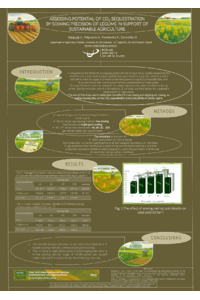
The material for this research consisted of the results of rigorous 5-year field experiments on yellow lupine (Lupinus luteus L.) as a legume crop. The first factor was sowing method: row sowing (traditional) and single-grain sowing. The second factor was sowing rate: 40, 60, 80, and 100 germinated seeds per square meter. Gas emissions were calculated as the sum of direct and indirect emissions produced during fuel combustion by tractors participating in all technological operations of cultivation, gas emissions from the field as a result of the use of mineral fertilizers and their production, emissions related to seed preparation, pesticide application, and the use of electricity and agricultural machines.The aim of this study was to determine the effect of row sowing and single-grain sowing, as well as sowing rate, on the CO2 sequestration and productivity of yellow lupine.
The carbon footprint values for yellow lupin cultivation calculated on the basis of multi-annual data for an area of 1 ha amounted to an average of 1522.6 kg CO2 equivalent. The lowest average emission values were calculated for the lowest sowing rate and precise single-grain sowing. The increase in seed yield due to precise single-grain sowing in the sowing density range of 40-80 plants per square meter reduced the carbon footprint of the legume crop.
Keywords
sowing rate
single-grain sowing
yield
yellow lupine
carbon footprint
Poster
Ratajczak et al._2025_IOCAG.pdf
Plant phenotyping technology adoption and our quest to cope with climate change
Evaluating the combined use of Kolosal Pro Fungicide and novel resistant spring wheat cultivars (Triticum aestivum L.) against Septoria Tritici Blotch and Yield enhancement