Event submissions
Published
This submission belongs to the session S8. Crop Production of the event The 3rd International Online Conference on Agriculture
Published date
20 Oct, 2025
Academic Editor
'%3e%3cpath%20d='M12.6657%2010.9104C12.4185%2010.325%2012.0599%209.79327%2011.6097%209.34482C11.1609%208.89508%2010.6293%208.5365%2010.0442%208.28888C10.0389%208.28626%2010.0337%208.28495%2010.0285%208.28233C10.8446%207.69279%2011.3752%206.73249%2011.3752%205.64904C11.3752%203.8542%209.92103%202.39999%208.1262%202.39999C6.33136%202.39999%204.87715%203.8542%204.87715%205.64904C4.87715%206.73249%205.40774%207.69279%206.22393%208.28364C6.21869%208.28626%206.21345%208.28757%206.20821%208.29019C5.62129%208.5378%205.09463%208.89284%204.64265%209.34613C4.1929%209.79493%203.83432%2010.3266%203.58671%2010.9117C3.34345%2011.4845%203.21226%2012.0987%203.20023%2012.7209C3.19988%2012.7349%203.20233%2012.7488%203.20744%2012.7619C3.21255%2012.7749%203.22022%2012.7867%203.22998%2012.7968C3.23975%2012.8068%203.25142%2012.8147%203.26431%2012.8202C3.2772%2012.8256%203.29105%2012.8284%203.30504%2012.8284H4.09109C4.14874%2012.8284%204.19459%2012.7825%204.1959%2012.7262C4.2221%2011.7148%204.62823%2010.7676%205.34617%2010.0497C6.08899%209.30683%207.0755%208.89808%208.1262%208.89808C9.17689%208.89808%2010.1634%209.30683%2010.9062%2010.0497C11.6242%2010.7676%2012.0303%2011.7148%2012.0565%2012.7262C12.0578%2012.7838%2012.1037%2012.8284%2012.1613%2012.8284H12.9474C12.9613%2012.8284%2012.9752%2012.8256%2012.9881%2012.8202C13.001%2012.8147%2013.0126%2012.8068%2013.0224%2012.7968C13.0322%2012.7867%2013.0398%2012.7749%2013.0449%2012.7619C13.0501%2012.7488%2013.0525%2012.7349%2013.0522%2012.7209C13.0391%2012.0947%2012.9094%2011.4855%2012.6657%2010.9104ZM8.1262%207.9024C7.52486%207.9024%206.9589%207.6679%206.53312%207.24211C6.10733%206.81633%205.87283%206.25037%205.87283%205.64904C5.87283%205.0477%206.10733%204.48174%206.53312%204.05596C6.9589%203.63018%207.52486%203.39567%208.1262%203.39567C8.72753%203.39567%209.29349%203.63018%209.71927%204.05596C10.1451%204.48174%2010.3796%205.0477%2010.3796%205.64904C10.3796%206.25037%2010.1451%206.81633%209.71927%207.24211C9.29349%207.6679%208.72753%207.9024%208.1262%207.9024Z'%20fill='%235D1EE1'/%3e%3c/g%3e%3c/svg%3e) Lorenzo Negri
Lorenzo NegriCitation
Doaa Jamal Abudarwish, Micropropagation of Hyphaene thebaica Through Seed and Root Tip Cultures: A Strategy for Sustainable Crop Production, in Proceedings of The 3rd International Online Conference on Agriculture, 22 October–24 October 2025, MDPI: Basel, Switzerland
Share
Email
Facebook
Twitter
LinkedIn
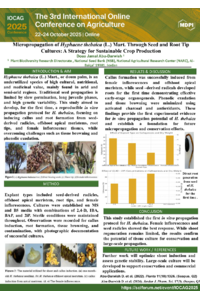
Micropropagation of Hyphaene thebaica Through Seed and Root Tip Cultures: A Strategy for Sustainable Crop Production

Doaa Jamal Abudarwish 1
1. Plant Biodiversity Research Directorate , National Seed Bank (NSB), National Agricultural Research Center (NARC), Al-Balqa’ 19381, Jordan
Abstract
Hyphaene thebaica (L.) Mart., commonly known as doum palm, is a culturally, nutritionally, and medicinally valuable (yet underutilized) species predominantly found in arid and semi-arid regions of Africa and the Middle East. Despite its ecological and economic potential, no standardized or comprehensive in vitro propagation protocol has been previously established for this species. Traditional propagation methods, primarily via seeds, are constrained by slow germination, long juvenile phases, and genetic heterogeneity. Therefore, the development of reliable tissue culture techniques is essential for the species' large-scale propagation, conservation, and genetic enhancement.
This review presents, for the first time, a scientific synthesis and evaluation of in vitro culture strategies for Hyphaene thebaica, based on original research findings and emerging data. It explores the use of various explants, including seed-derived radicles, root tips, and floral tissues, in initiating callus, shoot, and root formation. The influence of key factors such as plant growth regulators (e.g., 2,4-D, IBA, BAP, 2iP), carbon sources, and culture media compositions (e.g., MS, B5) is discussed in detail. Special emphasis is placed on the successful induction of embryogenic callus and somatic embryos from female inflorescences, marking a novel achievement in H. thebaica micropropagation.
Additionally, the review addresses challenges such as phenolic compound exudation, tissue browning, and somaclonal variation, offering practical mitigation strategies. This pioneering work lays the foundation for future conservation, genetic improvement, and commercial exploitation of H. thebaica through plant biotechnology.
Keywords
Hyphaene thebaica
doum palm
micropropagation
in vitro culture
somatic embryogenesis
callus induction
plant growth regulators (PGRs)
Poster
Dr.Doaa AbuDarwish poster.pdf
Morpho-Biochemical Responses of Sugarcane Varieties to Salinity Stress During Formative Growth
Corn Yield Response to Microbial Nitrogen, Irrigation and Seeding Rate Strategies