Event submissions
Published
This submission belongs to the session S4. Zero-Pollution Solutions in Crop Protection of the event The 3rd International Online Conference on Agriculture
Published date
20 Oct, 2025
Academic Editor
'%3e%3cpath%20d='M12.6657%2010.9104C12.4185%2010.325%2012.0599%209.79327%2011.6097%209.34482C11.1609%208.89508%2010.6293%208.5365%2010.0442%208.28888C10.0389%208.28626%2010.0337%208.28495%2010.0285%208.28233C10.8446%207.69279%2011.3752%206.73249%2011.3752%205.64904C11.3752%203.8542%209.92103%202.39999%208.1262%202.39999C6.33136%202.39999%204.87715%203.8542%204.87715%205.64904C4.87715%206.73249%205.40774%207.69279%206.22393%208.28364C6.21869%208.28626%206.21345%208.28757%206.20821%208.29019C5.62129%208.5378%205.09463%208.89284%204.64265%209.34613C4.1929%209.79493%203.83432%2010.3266%203.58671%2010.9117C3.34345%2011.4845%203.21226%2012.0987%203.20023%2012.7209C3.19988%2012.7349%203.20233%2012.7488%203.20744%2012.7619C3.21255%2012.7749%203.22022%2012.7867%203.22998%2012.7968C3.23975%2012.8068%203.25142%2012.8147%203.26431%2012.8202C3.2772%2012.8256%203.29105%2012.8284%203.30504%2012.8284H4.09109C4.14874%2012.8284%204.19459%2012.7825%204.1959%2012.7262C4.2221%2011.7148%204.62823%2010.7676%205.34617%2010.0497C6.08899%209.30683%207.0755%208.89808%208.1262%208.89808C9.17689%208.89808%2010.1634%209.30683%2010.9062%2010.0497C11.6242%2010.7676%2012.0303%2011.7148%2012.0565%2012.7262C12.0578%2012.7838%2012.1037%2012.8284%2012.1613%2012.8284H12.9474C12.9613%2012.8284%2012.9752%2012.8256%2012.9881%2012.8202C13.001%2012.8147%2013.0126%2012.8068%2013.0224%2012.7968C13.0322%2012.7867%2013.0398%2012.7749%2013.0449%2012.7619C13.0501%2012.7488%2013.0525%2012.7349%2013.0522%2012.7209C13.0391%2012.0947%2012.9094%2011.4855%2012.6657%2010.9104ZM8.1262%207.9024C7.52486%207.9024%206.9589%207.6679%206.53312%207.24211C6.10733%206.81633%205.87283%206.25037%205.87283%205.64904C5.87283%205.0477%206.10733%204.48174%206.53312%204.05596C6.9589%203.63018%207.52486%203.39567%208.1262%203.39567C8.72753%203.39567%209.29349%203.63018%209.71927%204.05596C10.1451%204.48174%2010.3796%205.0477%2010.3796%205.64904C10.3796%206.25037%2010.1451%206.81633%209.71927%207.24211C9.29349%207.6679%208.72753%207.9024%208.1262%207.9024Z'%20fill='%235D1EE1'/%3e%3c/g%3e%3c/svg%3e) Azucena Gonzalez-Coloma
Azucena Gonzalez-ColomaCitation
Kwanele Phiwinhlanhla Msele, Lawrence Nkosikhona Malinga, Caswell Thinandavha Munyai, Baseline Susceptibility of Eldana saccharina to CORAGEN® SC: Implications for Resistance Monitoring and Management in Sugarcane, in Proceedings of The 3rd International Online Conference on Agriculture, 22 October–24 October 2025, MDPI: Basel, Switzerland
Share
Email
Facebook
Twitter
LinkedIn
Baseline Susceptibility of Eldana saccharina to CORAGEN® SC: Implications for Resistance Monitoring and Management in Sugarcane
'%3e%3cpath%20d='M12.6647%2010.9104C12.4176%2010.325%2012.0589%209.7933%2011.6088%209.34485C11.16%208.89511%2010.6283%208.53653%2010.0432%208.28891C10.038%208.28629%2010.0327%208.28498%2010.0275%208.28236C10.8437%207.69282%2011.3743%206.73252%2011.3743%205.64907C11.3743%203.85423%209.92005%202.40002%208.12522%202.40002C6.33038%202.40002%204.87618%203.85423%204.87618%205.64907C4.87618%206.73252%205.40677%207.69282%206.22296%208.28367C6.21772%208.28629%206.21248%208.2876%206.20724%208.29022C5.62031%208.53783%205.09365%208.89287%204.64167%209.34616C4.19192%209.79496%203.83334%2010.3266%203.58573%2010.9117C3.34247%2011.4846%203.21128%2012.0987%203.19925%2012.721C3.1989%2012.735%203.20135%2012.7489%203.20646%2012.7619C3.21157%2012.7749%203.21924%2012.7868%203.22901%2012.7968C3.23877%2012.8068%203.25045%2012.8148%203.26334%2012.8202C3.27623%2012.8256%203.29007%2012.8284%203.30406%2012.8284H4.09012C4.14776%2012.8284%204.19362%2012.7825%204.19493%2012.7262C4.22113%2011.7148%204.62726%2010.7676%205.34519%2010.0497C6.08802%209.30686%207.07452%208.89811%208.12522%208.89811C9.17592%208.89811%2010.1624%209.30686%2010.9052%2010.0497C11.6232%2010.7676%2012.0293%2011.7148%2012.0555%2012.7262C12.0568%2012.7839%2012.1027%2012.8284%2012.1603%2012.8284H12.9464C12.9604%2012.8284%2012.9742%2012.8256%2012.9871%2012.8202C13%2012.8148%2013.0117%2012.8068%2013.0214%2012.7968C13.0312%2012.7868%2013.0389%2012.7749%2013.044%2012.7619C13.0491%2012.7489%2013.0515%2012.735%2013.0512%2012.721C13.0381%2012.0947%2012.9084%2011.4856%2012.6647%2010.9104ZM8.12522%207.90243C7.52388%207.90243%206.95792%207.66793%206.53214%207.24215C6.10636%206.81636%205.87185%206.2504%205.87185%205.64907C5.87185%205.04773%206.10636%204.48177%206.53214%204.05599C6.95792%203.63021%207.52388%203.3957%208.12522%203.3957C8.72655%203.3957%209.29252%203.63021%209.7183%204.05599C10.1441%204.48177%2010.3786%205.04773%2010.3786%205.64907C10.3786%206.2504%2010.1441%206.81636%209.7183%207.24215C9.29252%207.66793%208.72655%207.90243%208.12522%207.90243Z'%20fill='%235D1EE1'/%3e%3c/g%3e%3c/svg%3e)
Kwanele Phiwinhlanhla Msele 1,2

Lawrence Nkosikhona Malinga 1,2
Caswell Thinandavha Munyai 2
1. South African Sugarcane Research Institute, Private Bag X02, Mount Edgecombe 4300, South Africa
2. School of Life Sciences, University of KwaZulu-Natal, Private Bag X01, Scottsville 3209, South Africa
Abstract
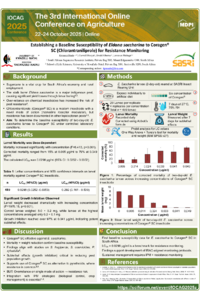
Eldana saccharina Walker is one of the most destructive sugarcane pests in South Africa. The application of chemical pesticides mainly controls this pest; however, the resistance in pest populations threatens the effectiveness of these pesticides. Laboratory bioassays were conducted at the South African Sugarcane Research Institute to assess the baseline susceptibility of E. saccharina against different concentrations (0.005, 0.014, 0.024, 0.033, 0.041 and 0.049 µg/ml) of CORAGEN® SC (chlorantraniliprole) insecticide. Two-day-old larvae were inoculated into an artificial diet with CORAGEN® SC solution. Daily monitoring of larval feeding and movement behaviour on the diet was performed for seven days, and the mortality rate and larval weight data were determined. The data was subjected to probit analysis using IBM SPSS version 27 to determine a lethal concentration (LC50) of the E. saccharina population and its 95% confidence limits. Differences in mortality and larval weight across different concentrations were assessed using a one-way ANOVA in IBM SPSS. Tukey’s multiple comparisons were used to assess differences in larval mortality and weight between concentration groups. The study showed that mortality increases progressively from the lowest to the highest concentration. The highest concentration (0.049 µg/ml) resulted in 79% mortality, while the control (15%) exhibited minimal effects. Additionally, larval weight decreased as concentration increased, with the control having the highest mean weight (8 mg) and the highest concentrations (0.041 and 0.049 µg/ml), resulting in the lowest weight (0.2 mg). The LC50 value was 0.0298 ug/ml with a 95% CI of 0.0252 - 0.0353 ug/ml. The results demonstrated a positive correlation between insecticide concentration, mortality rate and larval weight reduction. These findings provide crucial data for resistance monitoring, aiding in developing sustainable pest management strategies for sugarcane production. This study could further serve as a foundation for developing an IRAC laboratory-based resistance monitoring protocol.
Keywords
sugarcane pest
chlorantraniliprole
insecticide resistance
pest management
lethal concentration
larval mortality
Poster
IOCAG MDPI Online Conference-Kwanele-Msele.pdf
Development and Stability Evaluation of an Environmentally Friendly Aqueous Suspoemulsion of Emamectin Benzoate
Effect of natural farming components on growth, diseases, seed quality and economics in onion