Event submissions
Published
This submission belongs to the session S4. Zero-Pollution Solutions in Crop Protection of the event The 3rd International Online Conference on Agriculture
Published date
20 Oct, 2025
Academic Editor
'%3e%3cpath%20d='M12.6657%2010.9104C12.4185%2010.325%2012.0599%209.79327%2011.6097%209.34482C11.1609%208.89508%2010.6293%208.5365%2010.0442%208.28888C10.0389%208.28626%2010.0337%208.28495%2010.0285%208.28233C10.8446%207.69279%2011.3752%206.73249%2011.3752%205.64904C11.3752%203.8542%209.92103%202.39999%208.1262%202.39999C6.33136%202.39999%204.87715%203.8542%204.87715%205.64904C4.87715%206.73249%205.40774%207.69279%206.22393%208.28364C6.21869%208.28626%206.21345%208.28757%206.20821%208.29019C5.62129%208.5378%205.09463%208.89284%204.64265%209.34613C4.1929%209.79493%203.83432%2010.3266%203.58671%2010.9117C3.34345%2011.4845%203.21226%2012.0987%203.20023%2012.7209C3.19988%2012.7349%203.20233%2012.7488%203.20744%2012.7619C3.21255%2012.7749%203.22022%2012.7867%203.22998%2012.7968C3.23975%2012.8068%203.25142%2012.8147%203.26431%2012.8202C3.2772%2012.8256%203.29105%2012.8284%203.30504%2012.8284H4.09109C4.14874%2012.8284%204.19459%2012.7825%204.1959%2012.7262C4.2221%2011.7148%204.62823%2010.7676%205.34617%2010.0497C6.08899%209.30683%207.0755%208.89808%208.1262%208.89808C9.17689%208.89808%2010.1634%209.30683%2010.9062%2010.0497C11.6242%2010.7676%2012.0303%2011.7148%2012.0565%2012.7262C12.0578%2012.7838%2012.1037%2012.8284%2012.1613%2012.8284H12.9474C12.9613%2012.8284%2012.9752%2012.8256%2012.9881%2012.8202C13.001%2012.8147%2013.0126%2012.8068%2013.0224%2012.7968C13.0322%2012.7867%2013.0398%2012.7749%2013.0449%2012.7619C13.0501%2012.7488%2013.0525%2012.7349%2013.0522%2012.7209C13.0391%2012.0947%2012.9094%2011.4855%2012.6657%2010.9104ZM8.1262%207.9024C7.52486%207.9024%206.9589%207.6679%206.53312%207.24211C6.10733%206.81633%205.87283%206.25037%205.87283%205.64904C5.87283%205.0477%206.10733%204.48174%206.53312%204.05596C6.9589%203.63018%207.52486%203.39567%208.1262%203.39567C8.72753%203.39567%209.29349%203.63018%209.71927%204.05596C10.1451%204.48174%2010.3796%205.0477%2010.3796%205.64904C10.3796%206.25037%2010.1451%206.81633%209.71927%207.24211C9.29349%207.6679%208.72753%207.9024%208.1262%207.9024Z'%20fill='%235D1EE1'/%3e%3c/g%3e%3c/svg%3e) Azucena Gonzalez-Coloma
Azucena Gonzalez-ColomaCitation
Amine El Messbahi, Abdellatif Elghali, Hudson Wallace Pereira de Carvalho, Otmane Raji, Mostafa Benzaazoua, Greenhouse Trials of Hydrothermally Modified Syenite Rocks: A Climate-Smart Potassium Source for Soybean on Depleted Tropical Soils., in Proceedings of The 3rd International Online Conference on Agriculture, 22 October–24 October 2025, MDPI: Basel, Switzerland
Share
Email
Facebook
Twitter
LinkedIn
Greenhouse Trials of Hydrothermally Modified Syenite Rocks: A Climate-Smart Potassium Source for Soybean on Depleted Tropical Soils.
'%3e%3cpath%20d='M12.6647%2010.9104C12.4176%2010.325%2012.0589%209.7933%2011.6088%209.34485C11.16%208.89511%2010.6283%208.53653%2010.0432%208.28891C10.038%208.28629%2010.0327%208.28498%2010.0275%208.28236C10.8437%207.69282%2011.3743%206.73252%2011.3743%205.64907C11.3743%203.85423%209.92005%202.40002%208.12522%202.40002C6.33038%202.40002%204.87618%203.85423%204.87618%205.64907C4.87618%206.73252%205.40677%207.69282%206.22296%208.28367C6.21772%208.28629%206.21248%208.2876%206.20724%208.29022C5.62031%208.53783%205.09365%208.89287%204.64167%209.34616C4.19192%209.79496%203.83334%2010.3266%203.58573%2010.9117C3.34247%2011.4846%203.21128%2012.0987%203.19925%2012.721C3.1989%2012.735%203.20135%2012.7489%203.20646%2012.7619C3.21157%2012.7749%203.21924%2012.7868%203.22901%2012.7968C3.23877%2012.8068%203.25045%2012.8148%203.26334%2012.8202C3.27623%2012.8256%203.29007%2012.8284%203.30406%2012.8284H4.09012C4.14776%2012.8284%204.19362%2012.7825%204.19493%2012.7262C4.22113%2011.7148%204.62726%2010.7676%205.34519%2010.0497C6.08802%209.30686%207.07452%208.89811%208.12522%208.89811C9.17592%208.89811%2010.1624%209.30686%2010.9052%2010.0497C11.6232%2010.7676%2012.0293%2011.7148%2012.0555%2012.7262C12.0568%2012.7839%2012.1027%2012.8284%2012.1603%2012.8284H12.9464C12.9604%2012.8284%2012.9742%2012.8256%2012.9871%2012.8202C13%2012.8148%2013.0117%2012.8068%2013.0214%2012.7968C13.0312%2012.7868%2013.0389%2012.7749%2013.044%2012.7619C13.0491%2012.7489%2013.0515%2012.735%2013.0512%2012.721C13.0381%2012.0947%2012.9084%2011.4856%2012.6647%2010.9104ZM8.12522%207.90243C7.52388%207.90243%206.95792%207.66793%206.53214%207.24215C6.10636%206.81636%205.87185%206.2504%205.87185%205.64907C5.87185%205.04773%206.10636%204.48177%206.53214%204.05599C6.95792%203.63021%207.52388%203.3957%208.12522%203.3957C8.72655%203.3957%209.29252%203.63021%209.7183%204.05599C10.1441%204.48177%2010.3786%205.04773%2010.3786%205.64907C10.3786%206.2504%2010.1441%206.81636%209.7183%207.24215C9.29252%207.66793%208.72655%207.90243%208.12522%207.90243Z'%20fill='%235D1EE1'/%3e%3c/g%3e%3c/svg%3e)
Amine El Messbahi 1
Abdellatif Elghali 1
Hudson Wallace Pereira de Carvalho 2,3
Otmane Raji 1

Mostafa Benzaazoua 1
1. Geology and Sustainable Mining Institute, University Mohammed VI Polytechnic, Benguerir 43150, Morocco
2. Global Critical Zone Science Chair, University Mohammed VI Polytechnic, Benguerir 43150, Morocco
3. Center for Nuclear Energy in Agriculture (CENA), University of São Paulo, Piracicaba 13416-000, SP, Brazil
Abstract
Potassium (K) deficiency is a significant limitation to crop production in tropical regions, where highly weathered soils are prevalent and access to imported K fertilizers, such as potassium chloride (KCl), is often restricted. As a sustainable alternative, K-rich syenite rocks, naturally abundant in silicate minerals, hold promise, though their low solubility limits direct agronomic use. This study investigates the potential of a chlorine-free K fertilizer produced through low-temperature hydrothermal conversion of syenite rocks from Morocco (~15 wt.% K2O), aimed at enhancing nutrient release while ensuring agro-environmental considerations. Greenhouse trials were conducted using a randomized complete block design (RCBD) with five replicates, on a tropical soil highly K-depleted. Treatments included hydrothermally converted syenite (HTS), untreated syenite, KCl, and a no-K control, with K applied uniformly at a rate of 500 kg K/ha across treatments. Soybean, a nutritionally significant and key contributor to sustainable cropping systems in tropical agriculture, was selected to assess fertilization effectiveness. Plant growth, biomass accumulation, and potassium uptake were measured over 60 days. The results showed that HTS significantly improved plant performance and potassium uptake, with outcomes close to those of KCl, while untreated syenite remained less effective. These findings demonstrate the effectiveness of processing syenite rock to enhance potassium bioavailability for soybean, and highlight the potential of syenite as a locally sourced product and an eco-friendly potassium fertilizer. Its adoption may reduce reliance on imported potash fertilizers, improve tropical soil fertility, and contribute to more resilient and circular nutrient management practices for sustainable agriculture.
Keywords
Potassium fertilizer
Syenite rock
Tropical soils
Cl-free fertilizer
Nutrient management
Climate-smart agriculture
Poster
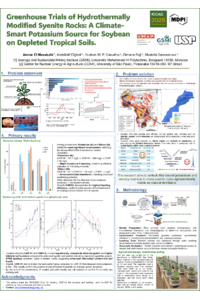
Amine El Messbahi_Poster MDPI-IOCAG.pdf
Antifungal and growth-promoting activities of shell nanoparticles of chitosan aspartate
Molecular Characterization and Identification of Endophytic Bacteria from Sugarcane Stalk Against Ringspot Disease of Sugarcane (Epicoccum sorghinum) in Negros Island Region (NIR), Central Philippines State University